Main page (English) - Main page (Finnish) - Logbook index - Latest log
Minerva reef and arrival to New Zealand 2.11.-2.12.2002
updates: 2.11. 10.11. 18.11. 25.11. 2.12.
2.11.2002
Pacific Ocean 26° 00' S 178° 58' E
Today we crossed the longitude 180° coming back to Eastern hemisphere.
We cannot receive any e-mail because of the broken modem. That will be inspected
as soon as we get to NZ.
Yesterday, Friday, we left the Minerva reef heading to New Zealand
800 miles away. We spent two nights in Minerva. It is really a special place,
worth visiting. It was very odd to be anchored in the middle of the ocean. The
reef is round, about 3 miles at widest, and 15-20 meters deep in the middle. The
reef can be seen at low tide, but at high tide all the land disappears. Despite
that Minerva gives very good protection all the time from the waves since the
piece of land is about 100 meters wide. There is only one, deep and wide
passage. We were wondering if
that is made by nature or by man. Anyhow, Minerva is a perfect ocean shelter.
When we arrived to Minerva after two smooth spinnaker days and three
nights there were 8 boats. They had left Nukualofa on Sunday as we did, but had
been motoring through the calms. When we came in, the first boats were
hoisting their anchors, and soon all the 8 had disappeared. Relief! It was nicer
to be alone.
In the morning a rain shower woke us. The wind had shifted 180
degrees, so we motored to the other side of the reef. In the evening we had to
move once more because of the shifting wind. But there are anchorages the full
360 degrees! We took a walk on the reef but didn't saw any of the lobsters
people talk so much about. Only beatiful clams, maybe edible, but since not
being sure, we left them in peace.
On Friday normal trade winds were blowing and we prepared to leave.
Then we saw a sail getting closer to Minerva and for our surprise it was our
friend Indy. We waited for Andy and Lisa, and had a chat about the
coming weather over a cup of coffee. Before we got out from Minerva we got
a fish, a 3 kilo, greenish-grey, but remained unrecognisable.
The characeristics of this leg are tens of boats - maybe even hundreds - sailing
towards New Zealand and the spekulation of weather. Every talk on VHF and SSB is
concerning the weather at some point. Until now we have had light winds, but
usually they are strongest below 30 deg. South. There are several sources for
weather. We listen twice a day Russell Radio, which gives individual weather
predictions for the calling yachts. At the same time you will hear some familiar
boats and their position. There are so many boats that only listening to the
Russell Radio gives an good overview of the weather. In addition we
take weather faxes from Auckland. There are about ten Swedish boats around, some
of them already in NZ. They have an own radio time, where also we have been
chatting time to time. Hannu has been talking to Swedish-Finnish Ciru,
whos skipper Timo has been around the Pacific for 12 years.
It's getting colder the more south we come. Day temperature is still around 24
deg C, but 20 deg at nights feels cold! We have to wear socks and shoes again. The
sea temperature has come down, being 24 at the moment.
We have 600 miles to Opua on this Saturday evening. The sky is covered with clouds,
it will be a dark night.
10.11.2002
Opua, New Zealand
The sailing from Minerva to Opua, New Zealand,
lasted a week. GPS showed 888.8 miles, so we had made about a 100 extra. The
weather got rougher each day we got closer to NZ, but it did not reach storm
force. The last three days it was blowing about 25 knots, sometimes 35-40 knots,
but the sea remained moderate. First we sailed with full sails, partly to test
the boat and partly to obtain maksimum speed. It made living uncomfortable,
water was coming constantly into the cockpit, and leaning 30 degrees we were
moving inside mainly by hanging on the rails. Well, the night watch couldn't
fall to sleep!
We tested our stom jib, althoug the normal tack jib would have been okay. But it
was time for the 15 year old sail to get its first salt bath. Combination storm
jib and reefed genoa worked also well. The sailing conditions were superb, but
our course was right to the wind hindering us to enjoy the weather. The wise
ones sailed west first, heading to NZ from north in favourable westerlies. But
we stubborns took the rhumbline which made us motorsail the last bit. We didn't
feel like tacking away from the destination so near the end.
We had radio contact all the way with the Swedes, Elenor, Lorna,
Nerfhus and Kåranita. It was interesting to follow
different route choices and progress. Only we stayed on our eastern route, all
the others had the west-tactic. We all arrived within a couple of days.
Only a hundred miles from Opua we heard on VHF that a Dutch solosailor had lost
his mast and the engine didn't work. A yacht nearby went for help. A helicopter
was relaying all the VHF conversation, because the boats couldn't read each
other. Both arrived safely to Opua after two days towing.
The temperature continued to decrease the closer we got. Especially nights
were cold, thermometer showing 14-15 degrees C. Despite of our arctic overalls
we started to freeze during the last hour of the night watch. Daytemperature is
around 20 degrees C, but the wind is cold. Still, we enjoy the fresh weather.
There is a familiar smell of spring in the air, that you never get in the
tropics. The air is also dryer, so maybe we get rid of mold for a while.
On midday Friday we saw land, although Auli had smelled the earth already in the
dark hours of the morning. We saw Cape Brett and gradually the
rest of the hilly shore of New Zealand. It was a marvellous feeling! We were on
the other side of the world, at last.
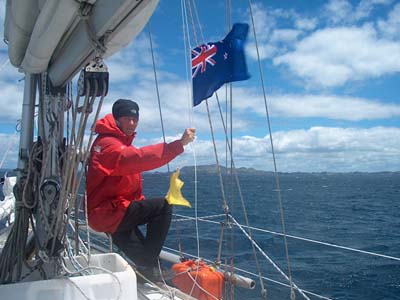
New Zealand in sight. No short-sleeve weather
anymore.
We throved our last onion, a couple
of garlics and the rest of honey into ocean. You are not allowed to import any
fresh vegetables or fruits or meat to NZ. We ate our last portion of reindeer
meet a couple of hours before landfall. The quaratine officer took the butter,
cheese and milkpowder away, as well as the garbage - good. We were allowed to
keep an unopened milk bottle. The effective and friendly clearing procedure was
over in an hour and we moved to marina berth.
Opuan marina is rather new and everything is very clean. The 14
meter berth costs 25 NZ dollars (12,50 euros) per day or 150 dollars per week.
It was hard to remember when we last had a hot shower, elsewhere than in the
cockpit. It might have been Panama in May. So it was a great pleasure to stand
under hot water after all the little splashing in the boat.

We got a tasty dryfish receipe from Andy:
soak the fish in
soya for a hour and hang them to dry for day or two.
Hannu was eating most of the fish directly from the line, hmph.
In the evening we joined the growd
at the Opua Yach Club. 17 yachts had arrived that day, and several
other earlier. The guest boaters seemed to be the loudiest, although the locals
didn't do much worse. There had been a ladies sailing race, like every Friday,
and it was time for the results. The race was participated by 10 boats, each
having 3-5 crew members. Not any young sporty girls, but stout ladies in their
mid-age. Opua Yacht Club has 300 members, same as Sindbad. How about getting 10
boats with women crew in Sindbad?! Or even one boat for the next round
the Pihlajasaaari race? I am getting the reason why the Kiwis are the best
sailors in the world.
On Tuesday, 12th of November, we have been one and half years on our voyage, so
look for an update in couple of days.
10.11. is the Fathers' Day in Finland,
congratulations to all fathers, especially to Frans and Olli!
18.11.2002 Bay
of Islands, New Zealand
Our first NZ-week was full of happenings, and not all pleasant. A terrible
one was the sinking of the Swedish yacht Mica after collision with
a ship. We had talked with Alf, the skipper of Mica, on VHF near
the Minerva reef, but soon the 28-foot Mica was far behind us. Alf didn't have a
SSB-transmitter, so he wasn't with the Swedish net during the sailing.
Only 55 miles from the north end of New Zealand, at 10 pm Saturday evening
(9.11.) Alf heard terrible noise. He rushed out and saw a huge ship wall side by
side his boat. He tried to steer free without luck. The ship was tearing apart
the chainplates of the Laurin design glassfiber boat. Mica started to take water
in. Alf launched his liferaft and sent a mayday call on VHF including his
position. The water was knee high already. Alf couldn't pull the liferaft close
enough the boat, so he had to swim into it in the 12-14 deg. sea.
The weather wasn't bad, about 25 knots of wind, 2-3 meters waves and a good
visibility. Mica had mast top navigation lights on - still when the boat was
sinking. Alf was left alone in the dark sea without knowing will he be rescued
or not. After a while he saw lights of a passing vessel and he lit a handheld
flare. At the same time a huge wave rocked the boat and he dropped the flare. It
burnt a whole in the bottom and the raft was filled by water. Alf had to sit on
a pontoon.
The New Zealand Coast Guard got the mayday call and forwarded it as a digital
selective call both on VHF and SSB to all stations. This call opens
automatically a DSC-transceiver, which is obligatory on professional vessels.
Seven vessels - ships and yachts - answeared the call, but not the ship that had
droven over Mica. A Russian ship nearby went for help and managed to find Alf
after three hours, as well as get the frozen man aboard. Alf was saved but his
home and everything he owned was lost. Mica wasn't insured.
The officials have not published the name or the flag of the ship that sunk
Mica, but the ship has been traced. Because this happened on the international
waters, the NZ authorities can not do anything, only Alf as a individual could
sue them.
This horrible case did not only came up to the news, but it was in every sailors
mind and a general issue in Opua, where Alf arrived after a couple of days.
Everybody had something to give when a collection was going around in the
yachtclub bar. Alf is thinking about a new boat already.
The rest of the happennings were mmore pleasant. In the first evening we saw a
familiar lookin man at the yach club. A familiar he was, Jay from
Australia, whom we had met four years ago in Visby, Sweden, We drove around
Gotland one September day, and spent an evening in Jay's wooden boat. He was
sailing alone, without an autopilot. He had arrived to Opua three years ago and
was running a boat carpenter's business. A couple of days later Jay and his
girlfriend took us by car to see the nearby sightseeings: the idyllic village of
Kerikeri, where are located the oldest house in New Zealand from
1822 and a stonebuilt missonary station from 1833 (also of these years can be
noticed how young the European history is here); the Rainbow fall; and
ingredible fabulous kauri tree forest. The kauris are thousands of
years old, huge, straight trees, branches starting somewhere up near the sky.
The NZ kauri cannot be found anywhere else, but relatives grow f.ex. in Fiji,
Borneo and Indonesia. Nowdays kauris are protected because the Europeans cut
them almost to nonexistent.
We got a lot done during the week, partly because of the efficient service. The
UV-shade of the genoa and the hals tabling were worn out, so we got them
repaired. Our sprayhood, which is mounted only with buttons, let big waves in,
and we were tired to get cold showers. The sprayhood got a small rope around
which goes in a track mounted to the windscreen. Now the srayhood is water
tight. Hannu changed the motor oil and did some other small jobs, Auli washed a
huge pile of laundry. However, we didn't manage to repair the SSB modem.
The oil stove was turned on again, beacuse it was 13-14 deg C inside the boat in
the mornings, outside temperature was around 9 deg C. During the days it's
relative warm, a T-shirt weather, but wind is cold, and nights usually under 10
deg C. But we have it warm and cosy inside with the stove.
After a week we were ready to leave Opua. Besides the marina and boats supply
companies there isn't any other facilities in Opua. Nearest village Paihia
lies 6 hilly kilometers away. Once we walked there along a beautiful shore
trail, but 10 dollar taxi fares began to be too much. It was time to move on.
Before we did that, we saw Indy arriving in Saturday afternoon. We
had a brief chat with Lisa and Andy. They had seen a lot of sharks in Minerva,
and also catched lobsters - which managed to get lost during the night! But at
least it was proved that the stories of the lobsters in Minerva are true.
Bay of Islands consists of beautiful islands and shelterd bays. Several
of them are nature protection areas, but landfall is still permitted. The
scenery is fantastic, since the islands have both white sandy beaches and high
tops with sharp rock walls and green hills. The scenery reminds a bit of Norway
or Scotland, but it's not quite the same, being something very its own, and we
haven't seen this kind of landscape anywhere else.
i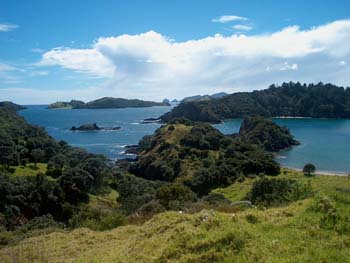
Our first sights over the Bay of Islands
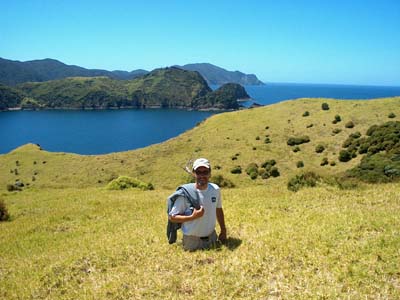
Almost every island has walking trails. One morning on Moturua, we started the round trip of the island. Already the first hill took our breathe. We both have a really lousy condition. That is what sailing (=sitting and sleeping) does to you. The two hour walk around the island was beautiful. The nature of NZ is very special, different trees from palms to more home like species. The track went through grassy fields to dense forest, up to bare hills and down to sandy beaches. One very common tree was like a giant heather - or had we transformed to Lilliputians. The fern tree gave the same feeling, it was a giant fern with rolled leeves like the small ones at home.
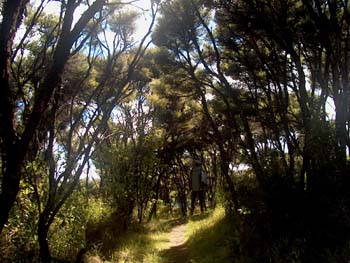
Heather forest and Lilliputian-Hannu
Before Moturua we stopped at Motuarohia (the names are mostly maori language), which was the first landing site of Captein Cook in Bay of Islands in 1769. The first European in New Zealand, however, was Dutch Abel Tasman in 1642. He named the land as a new sea land, neue zeeland.
25.11.2002
Whangarei, New Zealand
We spent a couple of more days in the Bay of Islands, on Urupukapuka
island, and in Russell, which is a charming village with a
population of one thousand. The history of Russell tells the history of NZ in a
nut shell. There was first a Maori settlement in the area, called Kororareka.
Maoris arrived to New Zealand around 1000 AD, which makes it the lastly
populated island group in the Pacific by the Polynesian tribes. When the Europeans
started to move in 1830's, Kororareka became the hubbub spot for whalers and
seamen. There were tens of bars and brothels in the tiny village, that got a
nickname Hell hole of the Pacific. Runaways and drunks, as well as
traders and ordinary settlers moved in. When the British power stabilised in NZ,
also the rowdy life in Kororareka was put to an end. In 1840 Kororareka got the
name Russell. It was the same year the Maoris and the Englishmen signed the treaty
of Waitangi. The new capital of New Zealand, Auckland took a lion's
share of the trade and shipping, and the life in Russell became quiet. Nowdays
Russell, with strand cafés, wooden villas and gardens, lives on tourism.
From Russell we returned to the island of Moturua, where on a nearby islet was a
big occurrence of mussels. They could be reached only on low tide
and the swell made it difficult to get on land. Hannu stayed on the dinghy while
Auli jumped on the islet with a knife and a bag. It wasn't an easy task to
loosen the tightly side-by-side sitting mussels. They have strong threads coming
out of the shell that clasp them hard on the rock. We got quite a bunch of
5-10 cm long mussels.
After rounding Cape Brett on a sunny and calm Thursday we had left Bay of
Islands behind us. The next stop was in the big and beautiful bay of Whangamumu,
where a whaling station was still active in the 1930's. Now there wasn't more
left of the station than some concrete blocks and rusty carbage. The whales were
captured in a special way here: by netting. The net hold the whale until it was
killed by a harpoon.
We walked on a hill nearby our anchorage, which seemed to be covered by short,
dry grass. But it was thigh-high rough hay where we had to trudge like through
meter deep snow. That was an excersise! The next day we were on our way
along a forest trail. Because of misinterpretation of the guide board, our
expected two hours walk prolonged for almost five hours. And the terrain was
hard. Partly overgrown path went up and down from one hill to another, from a
valley to forest. The ascensions were steep diminishing our speed to crawling.
The changing scenery and variety of nature from palms to kauri trees, from
bushes to damps rewarded our sweating.
|
|
|
Whangarei is located
15 miles inland, along a narrowing and shallowing river. When the echo sounder
started to show three meters we were worried. But the route became even more
shallow. It was hard to believe the echo sounder figures, since Whangarei is a
lively and rather big marina. It was Sunday and the marina office didn't answer
on VHF call. Then Auli found a leaflet telling that marina should be entered
during the high tide. Well.... It was middle tide, water going down. Echo
soudner started to alarm, but to our astonishment we continued to move. The
bottom is soft mud, so that we were able to get through. But there was still a
good way to go, and we were afraid of stucking in the middle of the passage -
that would be really embarrasing. We had to hurry, we needed every dropping inch
of water under the keel.
We made it to the crowded marina, and now we are waiting for a place. There are
mostly pile moorings: the boat it tied from stern and bow to piles rammed in the
river. You get ashore by dinghy.
The Whangarei city has appx. 45.000 inhabitants and provides all the services
from slide developing to big supermarkets.
2.12.2002
Whanagrei, New Zealand
The week in Whangarei has been a total city life week. The only movement of
Kristiina has been up and down with the tide. We bought a new TV, and have been
watching it with all the anxioty gathered in one and half years. We got a local
sim-card to our cell phone contributed by the Data-Info. The
number is +64-210 389 645. Also text messages work.
The time has gone with working, Auli writing and Hannu maintaining Kristiina.
The fast outer shrouds of the main mast have been changed to running ones.
Saves the main sail under tail wind. The leaking inflatable is under repair, as
well as the electrical compass and rod kicker.
As the reputation, Whangarei is a handy size town with everything
near the harbour. Only the traffic is terrifying. In addition that people here
drive on the "wrong" side, the cars drive fast and don't stop for a
pedestrian. Green light for pedestrians is so short that you have to run across.
How about the old people and other slow ones. These notes on traffic are not
just our remarks, but a real problem. TV has attitude campaigns for the peaking
Christmas and holiday traffic. Boards along the roads tell that you shouldn't
drive if you are drunk. Last year 59 people died in the Christmas traffic -
that's a lot for a country with 3,3 million inhabitants.
When Finland celebrated the 1st of December, "minor
Christmas", the summer began here officially. The most common holiday month
is July. We celebrated the 1.12. with new potatoes, herring and strawberries. It
hard to get in the Christmas mood when the sun is hot, but you cannot miss it in
the shops with christmas songs and winter decorations. TV commercials are funny
with artificial snow and winter wonderland
songs. So, winter and Christmas belong together even if there is no sight of
coldness and darkness.
In Sunday evening we got rare visitors, the first Finns after Panama. Anssi
and Mikko in their twenties were driving around New Zealand - and
looking for surfing beaches - as an end for their study visit. It was very nice
to speak our own language since a long time. Especially Hannu has had hard times
missing Finnish speaking company. We have friends in the sailing society, but
most of the people don't slow down or change their advanced vocabulary when
speaking to foreign language speaker, which put an end to the conversation
quickly. General remarks and weather are not enough to fill the need for
associate. We are a bit jealous for the Swedes, who have five boats to choose
company of their own country.