30.3.2003
Lyttelton/Christchurch, New Zealand
With a mussel and local white wine dinner we said goodbye to beautiful
Marlborough Sounds, where we had enjoyed ourselves for six weeks. On
Tuesday, 25.3., we motored with the sun rise through the Tory Chanell,
which gave us a good burst out. We headed to Lyttelton, the harbour town
of Christchurch, 170 miles away. To our dissapointment the small craft
facilites are near to nothing in Lyttelton, mostly because of a storm that
devastated the marina two years ago. The only safe moorings are in the
crowded inner harbour with cargo ships and fishing boats. Only piling
mooring is available, and a dinghy is needed to get ashore. No power.
Water is available by a floating pier, where Kristiina can tie only during
the high water. To the shower and washing machine is a 15 minute walk,
they are located at the yacht club, where the marina used to be. When
there are no facilities, the fee isn't big either: 3,50 NZ dollars (1,75
euros). Understandably, there are not many foreign boats around. Luckily
there is a regular bus service to Christchurch.
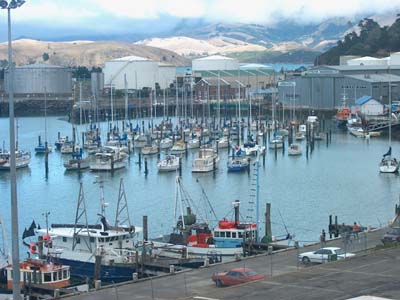
Lyttelton inner harbour
Christchurch is the biggest town on the South Island with 300.000 inhabitants. The first white settlers came from England in 1850 with an idea to establish a theocratic society. More churches than pubs were built. The city centre is dominated by the cathedral, consecrated in 1881. Around the centre spreads typical kiwi town with one-family-houses. There are hardly any block of flats in the second biggest city of NZ. The city centre is pleasant with the cathedral square, walking streets, the Avon river, the Botanical Garden, and the Art Centre, which is located in the former Cantebury Collage from 1877.
Christchurch - or more precisely Lyttelton,
is on latitude 43 deg. 36 minutes, an appropriate place for us to leave
eastwards, but we also have an other reason for coming here. Already in
December we got an invitation to sauna. To a Finnish sauna. It was
presented by Ville and Riitta, parents of three children who
have been living here for three years. We had patiently waited sauna all
these months, but when we arrived, we couldn't hold on anymore. The next
evening we were sitting in the sauna where the Finnish oven gave it's
best. Oh, it felt heavenly! The only thing a Finn is missing abroard is
sauna. An old saying, but so true.
Ville and Riitta have built their house themselves. It has double windows
and good isolation - normal for us, but rare here. The kiwis still follow
the British way, hot water bottles, wall-to-wall carpets and electric fire
places, instead of building warm homes.
We got mail from Finland, the most interesting of them the new book of
Pertti Duncker: Merivuokon kaksi pistettä, Äitsaari-Manaus
about his trip to the Amazon. The heat, fear of robbery, running out of
drinking water, troubles with the old boat, and the simple life of the
river villages are far from us here in the "sivilised" world.
Once again we have to admire the journey of Merivuokko. Many would have
given up facing all the troubles, but not Pertti. And his fiancee Mirja
seems to be as tough.
Our meaning is to drive around the south of the South Island before we
leave the country, but we are still waiting for our satellite phone.
8.4.2003 Wanaka, New
Zealand
At last we got the satellitephone back and were able to hit the road.
We rented a budget campervan (76 dollars/day), a Hiace with two punks and
some kind of kitchen. The interior is unpractical, I have never seen as
poor planning in a boat, even in a small one. The car has a gas cooker, a
fridge and a sink. No shower, toilet or heater. First the 30 litre water
tank made me thoughtful, but we are not at sea, we can take water every
day if needed. All in all, the car is great: no need to seek a place to
stay overnight or to pay restaurant prices for eating.
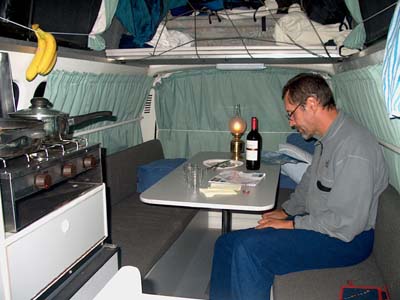
We are living 10 days in the back
of a Hiace
It was fun to drive around. Soon we decided
to explore inland and the mountains, we are able to see enough coastline,
and ten days is a limited time. The southwest South Island is dominated by
a mountain chain. The highest peak is Mt Cook, 3755 metres. We drove first to
the Mt Cook National Park, which has 22 over 3 kilometre peaks. It was raining and we couldn't see anything. Pity, the area sure
would have offered great views and walking tracks. We had better weather
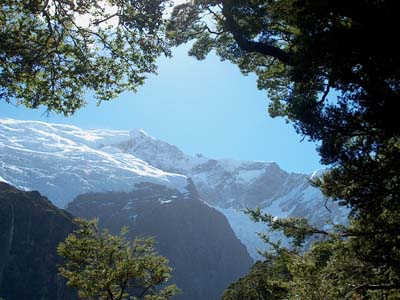
in the Mt Aspiring (3027 metres) National Park.
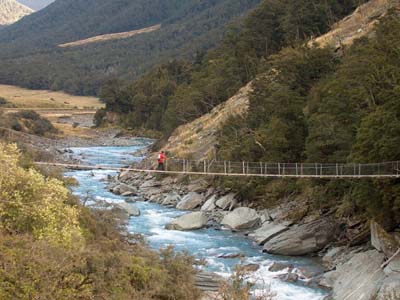
We walked a track
rising over the tree line, near to a small glacier. We are both in a poor
shape, after five hours walking we were tired. There was a reward
waiting: a sauna! First time we overnighted in a motor park/camper van
site, and this one happened to have a sauna. The place was a bit more expensive than
normally, but the sauna was worth the 30 dollars. We also got power to use
a fan heater. The night was cold, in the morning grass was white of
frost. There was also laundry, kitchen, tv and internet - which we enjoyed.
Our journey is now continuing to the Fox and Franz
Josef glaciers.
|
|
|
12.4.2003 Arthur's
Pass, New Zealand
I write this on the front seat of the Hiace, at a picnic ground, in
700 metres hight, along the mountain road that connects east and west
coasts. The Arthur's Pass, most narrow and high strech of
the road, was found by and Arthur Dobson. Tomorrow we have the
final tramp of our mountain tour, glimb to the Avalanche peak to 1833
metres. The past week has had shorter and longer walks, of which the best
were an early morning walk to the Lake Matheson.
The snow tops of Mount Cook and Mount Tasman were reflecting on the water
surface. This scenery can be found in several postcards and brochures. We
didn't have our digital camera with us, because the batteries were worn
out in the cold. A couple of mornings we have woke up in a +4 C car,
hrrrr.
The other great trip was a walk on the Fox Glacier. That we
had to do with a guide and five other tourists, because unexperienced and
without proper gear it's not wise to go on a glacier. We got mountainboots
and spikes under them. The trip began along the glacier river, soon we
ascended the hill side above the glacier, and after an hour we could
start the actual walk on the ice. Glacier ice is tight packed snow, that
has fallen on the top and made it's way down during the years. At the
altitude we were, it's not snowing but raining, and it rains a lot: from 7 to
14 metres per year depending on the spot along the 7 km long glacier.
Above the freezing zone it snows 45-50 metres a year.
|
|
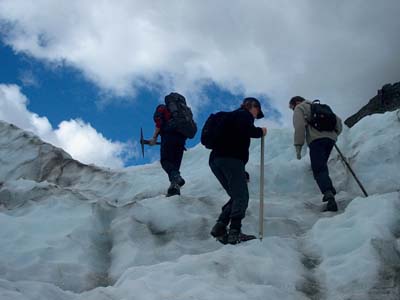 Guide was chopping steps in front, we game behind |
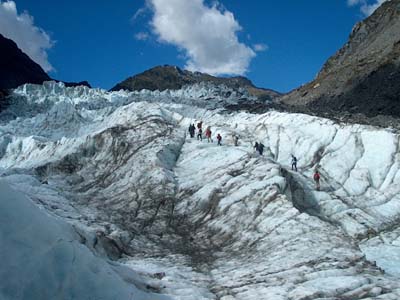
We walked in a line behind the guide, who
was making steps with her ice-ax. We had to stay on the path. We were pointed out a couple of dangers, f.ex. a whole under a rock called
"moulan", mill, which can be 10-20 metres deep. The guide told
that the Fox glacier is about 80-90 metres thick. Small brooks were
rippling all over, digging their way through the ice. The surface was covered by
different size rocks, from car-size to small gravel. Sometimes we could
hear a crush when the rocks game down. Ice had smelted under them. The ice
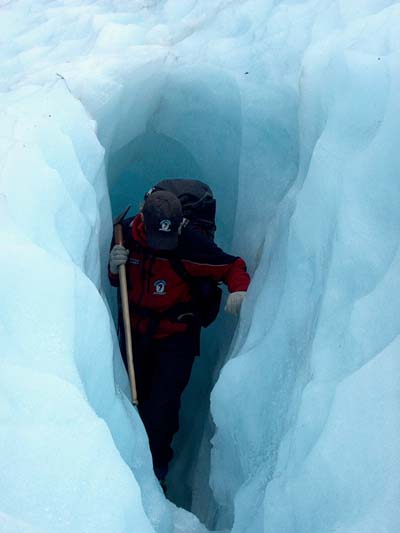
is beautifully blue, especially in the holes and coves.
Three hours went fast. Every step needed consentration, because only the
middle of the foot was steady, un-slippery. There are probably different
kind of ice-shoes and spikes (and proper names for them as well) but we
got a model that had spikes only in the middle. Stepping on your toe or
heel was slippery. The ice was full of small bulges, like waves, and the
spike had to go on top. Getting down was more difficult than going up. An
hours walk at the end along the valley to the bus, and we were tired - and
happy.
|
|
 |
Franz Josef and Fox
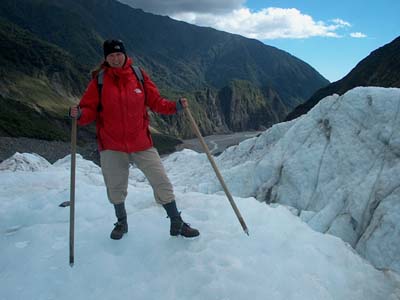
glaciers are located 25 km apart, and both have a tourist
village with cafes, motels, and touring companies. The glaciers are like
giant icy rivers, that flow down slowly between the mountains. Fox is
nowdays moving about 4 cm in a day, Franz Josef has been as fast as 5
metres in a day, but at the moment is's flowing only about 70 cm per day.
In different times glaciers grow and retreat; the last 10 years has been
just smelting, Fox has became one kilometer shorter. Franz Josef was first
explored in 1865 by an Austrian Julius Haast, who gave it name after the
Austrian emperor. Fox got it's name after a kiwi prime minister.
13.4.2003 Avalanche peak (1833 m)
What a climb! The route went right up, tigh rise from the very first
steps. The bushline is in 1300 metres, so there we reached the view.
Especially when the morning sun warmed the clouds away, so that we could
see down to the valley. Tussocks ended at 1600 metres, after that the
mountain side was rock. But we had to walk all the way in gravel and rock,
because the track followed a dry river bottom full of different size
rocks. We saw three keas, mountain parrots, the only of their kind
in the world. The other fauna limited to grasshoppers.
|
|
|
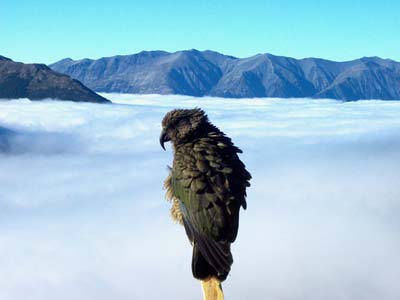
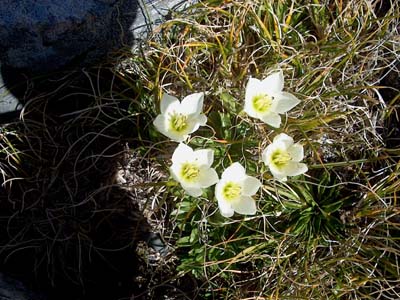
The ascend to the top took 4 hours. The last half an hour along very narrow ridge. The views were naturally even greater from the peak. So much Auli could look around being scared of heights. Comming down took on the legs and felt like an eternity. In six and half hours we were safely back at the car. We felt good!
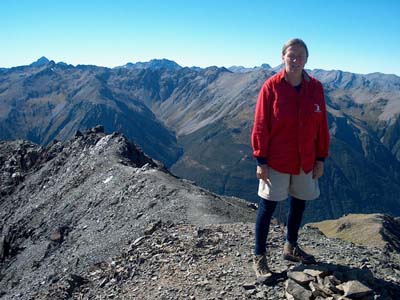 At the top! The painful face is because of the depths on both side. NB Mountain-style: no trouser legs at all |
|
21.4.2003 Lyttelton/Christchurch, New Zealand
Happy Easter!
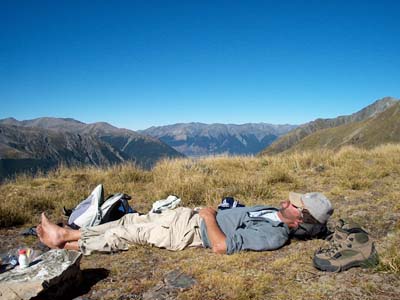
Our Easter went with preparations for the
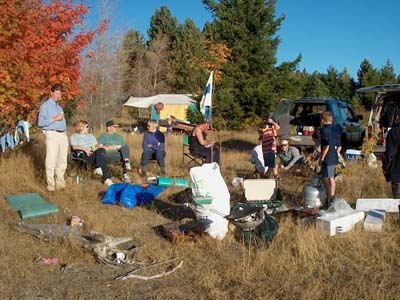
voyage, and in a Finn-meeting. The Finns in Christchurch, six adults
accompanied with three Kiwi husbands, and a dozen of Finnish-Kiwi
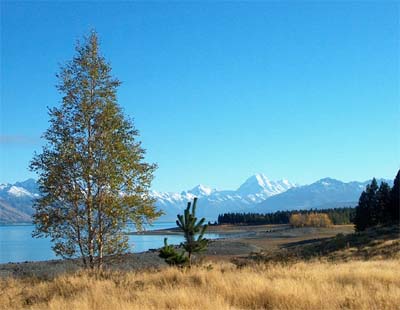
children, met on Saturday by the Lake Pukaki near
Mt Cook. We drove there in Pilvio's car, where we also spent the night,
the experienced car-sleepers. The place and the weather were gorgeous: the
sun was shining in a cloudless sky, turquoise glacier lake was glimmering,
and the scenery was framed by snow topped mountains. The spot had been
chosen because of a variety of Finnish trees: birches, spruces and rowans. The leaves
were bright with autumn colours. Strange having Easter in autumn. The
get-to-gether programme consisted of smoking salmons, eating Easter eggs,
and a lot of chat. When the night darkened, a huge fire was lighted,
fascinating especially the children. Only Pirjo and Rick
with their five kids stayed the night at the camp. We sat in a cosy, close
circle round a small fire, admired the stars and the mountains, on which
the full moon gave it's pale light. We told stories about our lives; two
totally different lifestyles, both rich and full of life. It was a real
magical Easter night.
|
|
|
Back at the boat the preparations for the
Pacific crossing is continuing. Although there are stopovers every month
on this 3-4 month-trip, both Tahiti and Hawaii
are expensive places, so we buy as much food as we can take with us.
Almost all the food - flour, pasta, rice, cans, coffee, biscuits, nuts and
candies - has been purchased already. Vegetables, fruits and eggs we buy
from the local ship supplier company to get them as fresh as possible.
From there we also get the duty-free alcohol. The McSherry shipping agent
is taking care of not only the Lyttelton harbour, but also ships all the
way to Antarctica and Chile. Their attitude to our minimal needs has been
very friendly and helpful.
Preparations include the purchase of new batteries. We have been thinking
it back and forth, when finally the four years old batteries made the
decision for us: they didn't charge properly anymore, which would have
ment extra motor running at sea. Also the hp laptop will get a new
battery. Small thing, but saving power, too.
Hannu mounted cleats to the bow for the sea anchor rode, so that we don't
need to go on the deck when using it. All the up-opening hatches,
including the fridge and floor, have been fitted with bolts and bars.
Barbecue, Helkama kick scooters, and all the other harbour gear have been
stored at the bottom of the cockpit lockers. We have gone through the
charts and taken the ones we need.
The weather has given us hard times and lot to consider. The coastal winds
are constantly easterly. Although it would be otherwise out at the sea,
it's not nice to leave in head winds. Also the high pressures coming from
the Tasman sea - we should ride at the south edge of one of them - have
been more in south than the normal 40-45 deg S. The NZ weather is so
unpredictable that forecast is given for 18 hours ahead only. That's too
short notice for the customs. It's always hard to make the decision when
to leave, but even more difficult this time.