|
27.10.2003 Prince William Sound, Alaska
Oops, it's already Monday evening and no homepage update. Well, here comes
the story, photos will be put later when we get to Cordova. On Tuesday, a week
ago, we finally left Valdez. First time on our two-and-half years journey we
have fever. It's usual in Alaska, some never get cured. Fever forced us to buy
two pans and a shovel. Landlocked Bay seemed a good place to stop, since
there were several abandoned mines. Some gold has been found from these, but
mostly they produced copper. First claims were made already in 1897 - before the
goldrush - by misters Jacobson and Thorstensen,
neighbours, I suppose. So we could't find a better place to try our new
toys (and to cure the fever) than an old mine. We panned several
"bowls" but no sign of gold.

At night we experienced our first Alaskan williwaw. That is a sudden,
strong gust, which gains its strength running down the hillsides. We
woke up in the middle of the night to a starting gale. One howl in the
rig and one roll, which sent alarm-clock, eye-glasses and some other
loose items down to floor. The boat was definetely not in sea-shape.
Outside it was blowing hard. We rushed up looking for fleeces, raingear,
boots and hats. Here in north you are not as quickly ready for outside
watch as in tropics. The night was dark as coal and it was hard to see
if the anchor had already dragged. We had alarmingly little water under,
about 4 metres, but we had turned closer to the shore and it was low
tide. Hannu started the engine, I turned on the radar. When it was ready
we could finally see if we were dragging or not. The wind was blowing
steady 35-40 knots, until a williwaw hit us and pressed the indicator to
bottom, 70 knots. Our dinghy, although empty and tied with one rope, was
near to go with the williwaw from the deck. Kristiina was rocking and
rolling like at open sea. Our main anchor, 27 kg (60 lbs) CQR hold -
once again. No more williwaws came and the little storm died as quickly
as it had started. A front or a low pressure had passed us, although
nothing was said in the forecast. After an hour and half we were back in
bed, though Hannu slept in the cabin, just in case. But the rest of the
night was quiet.
 |
Bearing in mind the williwaw experience, in our next anchorage, Beartrap
Bay, we drove to the very end of the bay, accessable only on high
tide because of a shallow sill. In addition to the anchor, we tied
Kristiina onshore with two long lines. Very pleased with ourselves we
sat inside having lunch when the conversation turned into tide. How much
was the tide here, actually... It was "dark moon", so the
differences were at highest. To our bewilderment the tidetable told that
our neat williwaw shelter would be nearly dry during the low tide! The
tide difference was 16,6 ft i.e. 5 metres, the next day even more. So,
we had to get the lines back to boat and move in the centre of the bay,
where some water was left under the keel even in low tide.
We have now spent four peaceful days in Beartrap Bay. Couple of days it
was raining so we stayed mainly inside reading. Today it has been sunny.
The place is beautiful: snowy peaks surround green spruce hills. Seals
and sea otters live in the bay, as well as many different kind of birds,
unrecognisable. We explored a shallow bay and a river next to us (no
gold). River benches are full of salmon rests and bear tracks. Several
streams run into the Beartrap Bay, so the bears must have a feast during
the salmon season. We haven't seen any bears now, they must be
hibernating soon. Some of the streams run down steep hillsides as
waterfalls. Terrain is difficult to walk, but we made one hike through
the dense forest and bushes to a big waterfall (no gold). The forecast
is promising a couple of more sunny days, which we will spent somewhere
out here. |
1.11.2003
Cordova, Alaska
 The
winter is near, decks are covered by crispy white stuff in the mornings. The
past days have been wonderful: sunny, clear skies and calm. Finally, we saw
northern lights, not so that there had not been them before, we have just been
too sleepy to stay awake. One night we stood in the cockpit wearing our heavy
winter overalls, staring at the magnificient green-red flashing. It's an odd
show without sound, all the time you expect a thunder or at least some cracking
On the last day of October we arrived to Cordova. The immediate
feeling of the tiny fishing town is as nice as we have been told. We stay! The
harbour - which is huge, 850 slips! - is full of fishing boats and seagulls. The
town spreads along hillsides nearby. A short evening walk on the first day
didn't reveal much, but we checked out the library. It's much smaller than in
Valdez, but the main thing, internet access, is available. We can get a library
card with a 15 dollar deposit. The crocery store was a positive surprise both in
terms of selection and prices, they are the same than in Valdez and Seward. We
had been warned the opposite, since Cordova is lacking road access. There is
another visiting yacht in the harbour, a 50 ft French aluminium sloop. A slip
for a year is 788 dollars, and it's reasonable to take it for a year, because
the monthly fee is expensive, 275 dollars. Electricity costs 25 cents per kWh.
Shower is the same ingredible 4 dollars than in Valdez, but here is a recreation
centre with sauna (yes!) and shower. With a monthly fee (37,50) you can splash
as much as you like, and on the side do some aerobics or weight lifting. Well,
the rates are clear now, so let's briefly look at some Cordova history.
The first inhabitants were Eyak indians, but along the time also Chugach inuits,
Tlingits and Aleuts came to this place. The Aleuts, however, were brougth here
by force by the Russian fur traders, because the other tribes refused to hunt
seaotters for the Russians. Before the fur traders, Vitus Bering, the Danish
navigator working for the Russian czar, sailed in. It was summer 1741, but
Bering didn't take contact with the natives, maybe in fear, and turned almost
immediately for home journey. In December, Bering died in scurvy, and his ship
was wrecked.
The history of the American Cordova begun with a cannery in 1889, continued with
a copper mine until the price of copper collapsed and the mine was closed in
1938. Since then Cordova has lived on fishing. Presently, there are appx. 2500
inhabitants, but the amount doubles during the salmon fishing season in summer.

Not a good photo of Cordova, but maybe
this gives an idea of the area.
On background is Mt. Eyak and a ski-lift. Only snow is missing...
8.11.2003 Cordova, Alaska
The last week has gone quickly with settling down in Cordova.  First
time in our 2,5 years trip we have an address of our own!
(P.O. Box 1943, Cordova, AK, 99574-1943, USA.) Our mail consists at
least the electricity bill once a month, hopefully something else, too.
We considered taking phone and internet to the boat (there are cables on
the dock), but it is too expensive. Opening 120 dollars, monthly payment
53 dollars. The local cell phone is not a good deal for us: Cordova area
has an analogical system (like the old NMT in Scandinavia) and it is not
working in Anchorage. There are state wide and US wide operators, but
then the phone is roaming in Cordova and the calls cost a lot.
Living "ashore" and in the end of a power line has brought two
luxus machines to the boat: a toaster and a VCR. We bought a inexpensive
US system VCR (55 dollars), so now we can watch TV during the long dark
evenings even there are no tv channels. We can loan free video tapes
from the library. And to the top of all settling down, our super-car
Subaru arrived on a ferry from Valdez on Friday. Cordova has 50 miles
road, and several hiking trails start along it, so it's not so bad idea
to have a car here, even if you cannot escape the area by car.
Our French neighbours, Sylvie and Jean, were on a visit
one evening. Jean is a naval architect, and their home, Patago 50,
is in principle for sale. More boats and design can be found on their
web site www.jfandre.com.
Our overwintering is not quite perfect, because we are spending almost
two months (10.12.-26.1.) in Finland visiting our parents.

15.11.2003
Cordova, Alaska
 The
first snow came to Cordova on Thursday. However, we experienced the snow
a couple of days earlier, when we drove the 48 mile (77 km) highway. It
was colder inland, but now also the coast has got 10 cm snow cover.
The highway passes through Copper River Delta, a large
area of marshland, bushes, mudflats, glacier rivers, ponds and creeks.
Moose, bears, foxes and beavers as well as thousands of birds live on
the delta.
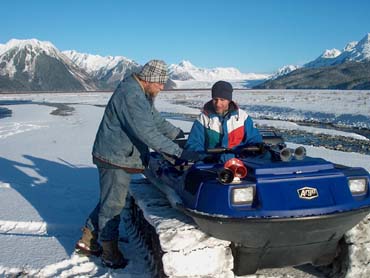
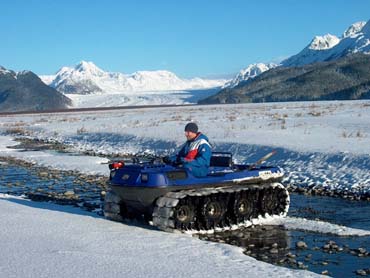
We made also another trip to the delta during the same week, this time
with Bruce from the next dock using his
"argovechile". This thing has crawlers and can go on land and
in water. Despite the crattle we saw six moose, four with big, beautiful
horns.
The Cordova highway ends to the Million Dollar Bridge,
built in 1910. The name tells the costs. The bridge was built for a
railway, transporting copper ore. Nowdays there are no sign of the
railroad. Cordova town was established much for for the coppermine,
which operated 1911-1938. The 1964 earthquake broke the end of the
bridge, and now a lifting and repairing operation has started. Some speculate that it
foresees the continuation of the highway. But the official explanation is the
historical value of the bridge and it's importance as tourist attraction.
Restoration is funded by federal money. Building a road to Cordova seems to divide people in two. Anyway, building a road across the glaciers, mountains
and delta is very big and expensive operation. And Cordova would lose
something of its uniqueness.
|

Copper River Delta
|

Million Dollar Bridge
|
Our fight against the cold
has continued. 20 years old Kristiina is insufficiently insulated compared to new
boats. Kristiina has 3 cm styrox plates, but nowdays an insulation foam
is used, which penetrates even to the smallest holes. Closets are damp
and the storage under our madrass has mold. It's important to circulate
the air, so Hannu put a computer fan to the air intake. Our Anchorage
friends, the Höylä's, had bought us two fans - with a light. We both
woke up in the middle of the night to green, red and blue tinkling,
until Hannu cut the light wire. The other fan circulating the oil stove
air has also light, but that doesn't bother, on the contrary it's nice
to have night-light in the cabin.
The windlass has long been in bad shape and Hannu took it out
now for reparation. It was covered with salt, very wet, probably leading
cold and damp into the boat.
|

Windlass covered with salt and water
|

Fan with a light is not a good
idea above the bunk
|
|
Bruce giving advice...
|
...and there you go!
|
21.11.2003 Cordova,
Alaska
Winter lasted a week, and we
spent it being a lot outside. We made a weekend trip to a forest cabin
with Sylvie and Jean. It was a nice hike,
but fire wood was wet and the stove uneffective, so when we woke up we
had freezing temperature inside. On the last sunny day Hannu glimbed to
Mt Eyak.

We saw lynx tracks around the Mc
Kinley Lake cabin |

After several hours warming we
had nice inside, but
in the morning the temperature was below 32 F |

Hannu on the top of Mt. Eyak |

Ski hill is waiting for little
more snow |

Behind the lake is Copper river
delta |

Harbour wavebreaker can be seen
behind the hilltop.
Open sea, the Gulf of Alaska, is on the background |

Watering in -10 C (14 F). Only
one water point is kept
open, so we got a little tour around the docks. |

Some inside work was also
made:
Hannu reparing the windlass |
1.12.2003
Cordova, Alaska
|
This will be the
last update from Cordova for two months. In a couple of days
we'll start our journey to Finland: first the ferry to Valdez,
then the 8-10 hours drive to Anchorage over the mountains. We'll
stay four nights in Anchorage, among other things celebrating
Finland's Independence Day (6.12.) with Pirkko and Antti. Then
finally the flight to Finland. The next update will be round
mid-December.
The past week has been full of visits and parties. The last
Thursday of November is Thanksgiving, which
origins from 1621. That year the English, who had arrived a year
earlier aboard Mayflower, got their first generous
harvest, and they celebrated it with the Indians. The harvest
feast was repeated year after year and the habit spread over the
country. In 1863, president Abraham Lincoln made it a national
holiday.
We were invited to Robyn's and Mark's (I hope I have the names
right!) home for Thanksgiving dinner. We didn't know our hosts
before, but the kind invitation was passed by Sue Kesti, whom
Auli had met at aerobics. It was really wonderful to take part
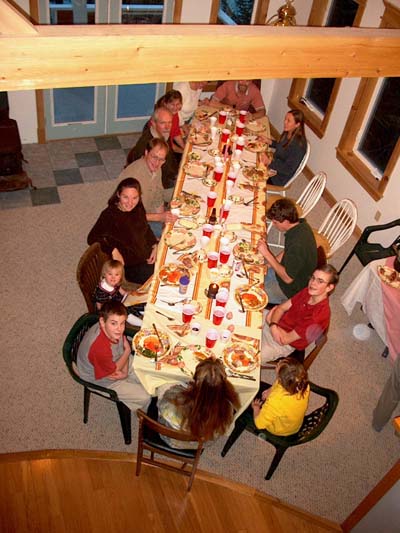
of Thanksgiving, first time for us. Traditionally, there was the
turkey with lot of side dishes, and pumpkin pie for dessert.
There were 15 people around the table with warm and friendly
atmosphere.
|
|
We have had dinner a couple
of times in Sylvie's and Jean's boat, so last Saturday it was our turn
to be hosts. We had a Christmas party to our
three neighbour boats. We prepared a variety of Finnish Christmas
dishes: beetroot salad (rosolli), herring, salt salmon, mushroom salad,
liverpaté, ham, cookies, and - of course - warm and spicy wine. The
salmon was near to be left out from the menu, because it's hard to get
fish in a fishing town, you cannot buy it in the crocery's. I went round
asking where I could get it, talking about it also in the library. So
loud that a young man, Mike, stood up from the internet, saying that he
has fish. Mike promised to give us the fish, if we'll make one salt
cured salmon for him as well. That was a deal!
The salt salmon ('graavilohi' in Finnish) is known here by it's Swedish
name 'gravlax', sometims only 'lax' (which means 'salmon'). But what
would it be in English, salt cured salmon?
|

Auli (42) baking Christmas
cookies first time
without her Mom
|
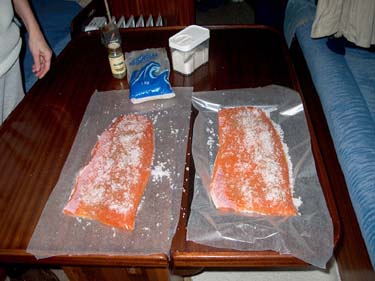
Salt cured salmon (graavilohi):
put some sugar, white pepper and dill on the fish, and cover it
with sea salt. Pack tightly in vax paper and keep it cold for 1-2
days. Slice thin and eat with bread or potatoes.
|
Our Christmas party
succeeded, and the salmon turned out good. But Mike didn't come to get
his fish. So, on Sunday evening we went looking for his house, from
where Auli had earlier got the fish. But we didn't find it. I just
couldn't remember where the house was. Well, Mike got his fish on
Monday.

Boat neighbours Jean, Deidre, Danny, Lilli,
Bruce and Sylvie
On Monday there was a less
nicer job waiting: a jammed toilet. Fortunately, the plumber wasn't far
away. Auli escaped the smell...
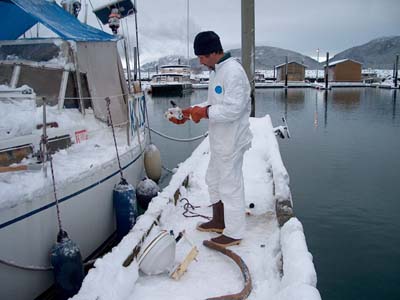
Bowl and tubes out and clean

Main road in Cordova
Previous
- Next
|