19.7.2003 Pacific Ocean
27 44 N 157 55 W
A get-together of five yachts from different countries was a
perfect end to our stay at the Hawaii Yacht Club. The next
day,  Tuesday, boats spread to south, north and west: French Chaski,
Canadian SawLeeAh and Australian illywhacker (skipper
Peter is looking at the camera, NB! wine bottles under the table, we
should not have taken own drinks to the club) to south,
American Jasmine back to westcoast before heading north. The
short meeting reflects the character of Hawaii: it's a meeting place for
cruisers in the middle of the Pacific. Almost every port is 2000+ miles
away, and everybody are coming or heading somewhere else. The Hawaiian
Islands themselves are not a pleasant sailing area. Channels are too
windy, the lee sides of the islands are too calm, the wind starts and
stops in a second, and it's gusty. The anchorages are unshelter and the
harbours growded. But one month's stop was a needed break to the
offshore life. Especially the week in Honolulu and meeting all the nice
sailors made our stay.
On Tuesday we also left Honolulu, but not yet Hawaii. We sailed 30 miles
along the coast and anchored (to an open roadsted again, but luckily
very little swell) to turn the Honolulu pace down. In the morning we
woke up to voices, which turned out to belong to people in two dolphin
charter boats. There were people in the water, snorkling and following a
flock of about 20 dolphins. In a moment we jumped in swimming suits,
grabbed our snorkling gear and dived into the sea. Dolphins were
approaching us and soon we saw them under the green water. Hannu swam
further and came very close to them, I was soon left behind. Below you
could hear high tones, dolphins communicating with each other. That was
a marvellous morning and a best farewell we could get of Hawaii.
On Wednesday, 16th July, we turned Kristiina's bow towards north and
started our 2200 miles long sailing to Kodiak. We decided,
after all, to head to Alaska, despite that we told in the
log book on 22.6. that the six months
permits make us to go via Canada. We should get a
six months extension, and a stay in an other country for two weeks
starts the time from beginning. Three weeks at sea are not counted,
however, you really must enter land. So our permits that started on
19.6. are running all the time, even at sea. Obviously the rule is not
made for sailors.
Trade winds have been at their best: steady easterlies without gusts, so
the beginning of this sailing has been most pleasant. With full sails we
have made 145, 129 and 109 miles per day. The wind has weakened day after
day, probably because we are getting closer to the North Pacific high.
According to the weather map the high is really big, so trying to get
the southerlies in it's west end, seems to be vain. This time we are
heading straight to the target, without any wind strategies.
Now it's last days to enjoy the heat. Bright blue seawater typical to
the tropics is about 26 C, but gets gradually colder before dropping to
10 C at latitude 40. This latitude seems to be the magical line for low
pressures, above 40 N there is a constant row of lows arriving from
west. We'll see what the winds are up there. Kodiak is situated at 57
North.
26.7.2003 Pacific Ocean
39 55 N 159 18 W
Sharp swell foretold change in the weather. We had motored two days
in a calm, but the swell meant wind. The sharp waves rose finally so
high, that we were losing our speed. The engine was turned off. Besides
the swell also a current of one knot was reason for reduced speed. It
was no good trying with force, we switched anchor light on and waited
for wind. It came in the morning with rain, and it was - like the swell
on the previous day - straight from ahead. We started to tack - or more
preciously, to rise as high in the wind we could. Wind was not strong,
15-25 knots, but tacking makes life uncomfortable and the wind speed
feels double its real force. We had reached the south edge of the
Pacific high, but instead of west-east line, it curved ENE-WSW. The
pattern of wind blowing away from an anticyclone's centre added to this
curved streamline meant head winds for north goers. First we could reach
our target (9 deg.) but on the third day our course had fallen to 330
deg. We tacked. Kristiina wa turning and turning, finally bow pointing
almost to south. What the h..? She is not a tacker, but she is not this
bad! The wind had shifted at the very same moment we had tacked. Turning
back to starboard tack took us to goal again. We laughed to this
incredible timing. Spirits were even higher after a shower in the
cockpit. The wind had decreased and we were able to wash ourselves from
three-day's sweat and salt-greased hair. Before warm shower Auli took a
saltwater bath (=throwing buckets of seawater on herself) to find out
whether the sea temperature had fallen. It had. We were at the 36.
latitude.
The weather fax told that the high spreaded itself far west, so there
was no point rounding it that way. We had to go through, which means
either head winds, variables or calm. Although the high is at its
narrowest at this point where we are, it is about ten degrees, i.e. 600
miles wide.
Soon after we'd crossed latitude 30, we saw the first albatross.
Only three of 14 species live on the northern hemisphere: Black
footed, Laysan and Short tailed albatross. We saw the Black footed,
which is totally brown. Long wings and big size give no room for mistake
recognising these gallant birds.
But a flock of dolphins remained unrecognised. They had white bellies,
distinctive white line on side, and a white spot on dorsal fin. Maybe
Pacific White-Sided dolphin, but it didn't match completely.
Temperature continues to fall being 18-20 C daytime. Our North Face
fleece jackets and trousers come to need again, and bed sheet is
companied with a quilt. With persistence we still avoid socks during the
day. The colour of the sea has changed from blue to grey. The sea is
warmer than air causing fogs.
Meals reduced to a minimum during the head winds. We ate little and
easy. Canned ravioli, rice-corn-onion with soya, pasta with vacuumed
roast beef (a great found in Honolulu). Almost like ordering it, the
weather was calm on Hannu's birthday (25.7.) and there
wasn't any hesitation for the meny: pizza.
All the fresh food except oranges, some apples and onions is finished.
The last brownish bananas were used as a filling in a roll cake, which
was baked in some calm day. We continue Kristiina's recipes with this
chocolate roll cake, for which we can thank two persons: Antti who
e-mailed it to us somewhere between Galápagos and Marquesas, and Lissu,
who wasn't content with our modest supply of odd cookies (may even be
finished by then), but wanted something tasty and sweet. Since then the
roll cake has been a standard baking.
|
 |
At 3.15 pm Kristiina's anchor went down into the darkgreen water
of Kaguyak Bay in the southern
tip of Kodiak Island. Green hills surround the bay, bald eagle
nests in the nearby conifer tree, black birds
(ravens?) croak ashore. Shore bushes are full of yellow and red berries
like raspberry (blackberries?). Someone has been grubbing the
bushes (Kodiak bear, the largest in the world?). From Honolulu we sailed 2260 nautical miles in 18 days and 5 hours. The Pacific Ocean is crossed second time, 7622 miles and 60 days from New Zealand. Feeling is incredible! Now we open the sparkling wine to celebrate and continue this later. |
7.8.2003 Kodiak, Alaska
Let's first go back to sea, between latitudes 40 and 57 north. The
low pressures with west winds never came. Instead the high spread way up
to north and we got light winds and calms. Two days we motored. Three
days before arrival it started to blow from west, caused by the top of
the high. It was excellent sailing with low sea. Day after day we
wondered the increasing light. It's funny that we have forgotten it in
two years, last time we were this high north in summer 2001. Already at
three am it starts to shimmer and the sun rises at 4.30. It gets dark
around 9 pm. Light is very different than round the equator. The sun is
setting unwillingly slow, dim is hanging around.
Temperature continued to decrease finally stopping at 10-13 deg C. Sea
water was so cold that baths were unthinkable. We had read that North
Pacific is full of ships and carbage. We saw seven ships during the
whole trip and saw occasionally some rubbish, less than we had expected.
Closer the land we saw huge kelp strings, thick as an ankle, with round
balls in the end. First we thought that they were old nets, they looked
like rope with floats. The closer the shore we got the more birds we
saw. Fulmars, shearwaters, petrels, gulls, terns and all kind of
unidentified ones as well as puffins. They are Tufted Puffins with big,
red bill, white head and yellow tuft. Different guy than in the
Atlantic.
Finally the outer islands came into sight. It was a sunny day, but the
mist in the horizon diminshed the visibility. Because the weather was
fine and we didn't have to go straight away to a port-of-entry, we
decided to stop in a nature harbour before the town of Kodiak.
The first morning we woke up to clear skies. It was 18 deg C already in
the morning. During our morning coffee in the cockpit a seal popped
it's head up near us. After a while a small, light brown deer walked to
the beach.  The
bald eagles we had met already the day before, they
were still sitting in their tree. There was a huge nest in the top, but
according to their behaviour it seems that they don't have chicks. Gulls
and other sea birds stepped on the shore exhibited by the low tide. Auli
was watching them with binoculars and saw mussels. To the shore! We took
mussels, which are smaller than in NZ, first, and went on to bushes
next. Bowls were soon full with thumb-size berries. Yellow and red, both
ripe and sweet! We started to walk along the shore making noise in case
of bears. Bear has poor eye sight but good hearing. The Kodiak bear is
largest of all, it can weight 800 kilos. Most of the Kodiak island is
protected because of the bears. When we paddled back to boat, we saw
movements on the end of the bay. Mother with three cubs! We yelled and
rushed for binoculars, but at the same time the mother rushed into
the high grass, stood up once and vanished. The little ones rushed
after. Had they heard or smelled us this far, about one kilometer away?
We were up in the wind, so it might be that we frightened them. They were
gone. We continued to stare through the binoculars and soon we saw the
cubs playing in the high grass. Maybe it was good that the first
meeting happened with distance.
We had mussel paella and chocholate roll cake filled with berries for
dinner. After that we didn't have to wait for sleep. No rolling, no
rocking, and no wake-up after four hours. What a feeling!
On Tuesday, the second morning we woke up to a full fog. The sea was
mirrow calm. We heard an engine running somewhere in the fog, thinking
it came from another bay. But soon a fishing boat appeared, from the end
of our bay. How had they managed to sneak by us in the narrow bay. They
pulled beside us and we chatted for a while. The local skipper had two
slovaks with him and they had examined the crab traps in the bay.
Skipper asked if we knew how to cook a crab, and next we had three huge,
mean crabs with sharp scissors, hardly manageable to our biggest pot. It
took three hours to prepare them. First the cruel cooking and then
digging out the meat from legs and belly. It made almost one kilo of
juicy meet. Cooked in garlic and white wine, served with pasta,
yummy! And we had crab meat for two huge meals.
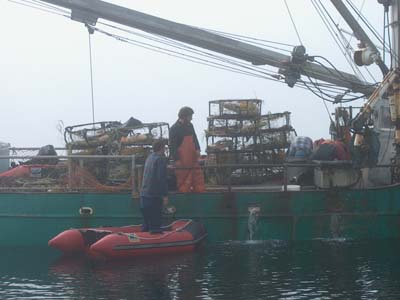
Hannu paddled over to get crabs
In addition to interesting animal sights, we found less attractive life
inside the boat. A worm was found among flour and rice, and an unopened
oatmeal package had two small moths (butterflies) in it. Yak! All were
bought in NZ.
On Wednesday 6th of August, we motored through calm and partly foggy sea
92 miles to the town of Kodiak. We saw a lot of humpback whales and
birds on our way.
10.8.2003 Kodiak, Alaska
Kodiak has been inhabited some 7500 years. The history of the
island, as of the various parts of Alaska, is characterised by three
different eras of people: Eskimos, Russian and American. Kodiak is an  area
of the Aluiit eskimos. Word kodiak means island in their
language. Russians came after furhunters in the 1780's. The first
Russian settlement was established to Three Saint's Bay in 1784. To the
present Kodiak townsite Russians came in 1792 naming it Pavlovskaia
Gavan, St. Paul's Harbor. The orthodox church had a strong role
within the migration - as churches tend to have. Onion cupolas were
rised in many Eskimo villages and local people was baptised. In 1867,
czar Alexander II sold Alaska to the Americans for 7,2 million
dollars.
Presently, the Kodiak island has 14 000 inhabitants, 2500 bears and same
amount of fishing boats. Fishing (salmon, halibut and herring) and
crabbing are the main livelihoods.
Alaska is volcanic area. In 1912, the eruption of Novarupta
volcano covered Kodiak with ash. In 1964, an earthquake (same that
devastated Hawaiian Islands 2500 mileas away) and the following
tsunami-waves destroyed several villages. The sea charts still have
unchartered areas after the eartquake.
 |
Alaska covers 1
593 439 square kilometres various terrain from arctic
desert to mountains and coastline. Alaska is twice the
length of Finland (2240 km) and 3550 km broad. Aleutians, Kodiak
and the Alaska peninsula make the South-West Alaska. |
We have had incredible luck
with weather: +20-25 C and sunny. Had
to dig shorts up again. Kodiak harbour is full of different size fishing
boats, among them a few local pleasure boats. We are the only visitor at
the moment. Every season some 20 foreign pleasure boats visit the
harbour. The slip costs 13 dollars per day, including only water.
Electricity would be an extra 10 dollars per day. Showers are located at
the nearby laundromat, but keeping oneself clean is costly: a shower is
5 dollars! For that the water runs for 20 minutes, so we have managed to
wash ourselves with one payment. Also laundry is more expensive than
elsewhere: normal size load 3,50 compared to the average 1-1,50 dollars.
People are very friendly and interested on us. The local paper reporter
came for an interview, fishermen stop for a chat. We got a good size
salmon from the neighbour boat, so culinarism is continueing. We fried
huge fillets, made a tasty soup and salted (in the Finnish way) the rest
of the salmon. It had also fisheggs.
The three guys that gave us the salmon were not local but working on the
boat for the summer. They share the fuel and food costs with the skipper
and get 10 per cent each of the catch. They had just been three weeks
out, and after a brief call for laundry and provision, they were off for
a month again. The boat was middle-size, maybe 15 ft long. They use nets
to catch the salmon about five miles offshore. The catch is stored
uncleaned in a pool full of cold water.
|
|
|


Alaska has five salmon
species: Pink, Chum, Silver, Sockeye and King. The meat of
the pink is - after it's name - really red. Over half of the Alaskan
catch is pink salmon, king being the most rare. Salmon season lasts
usually from May to September, and the amount of the catch is carefully
regulated and monitored.
Salmon spawn in fresh water, in rivers and estuaries, but migrate to the
sea to eat and grow. The time spent
at sea varies from species to species, some being out even for six
years. As mature they migrate back to the same river they were born. How
they find back to their birth stream from the vast ocean is not known.