|
26.4.2004
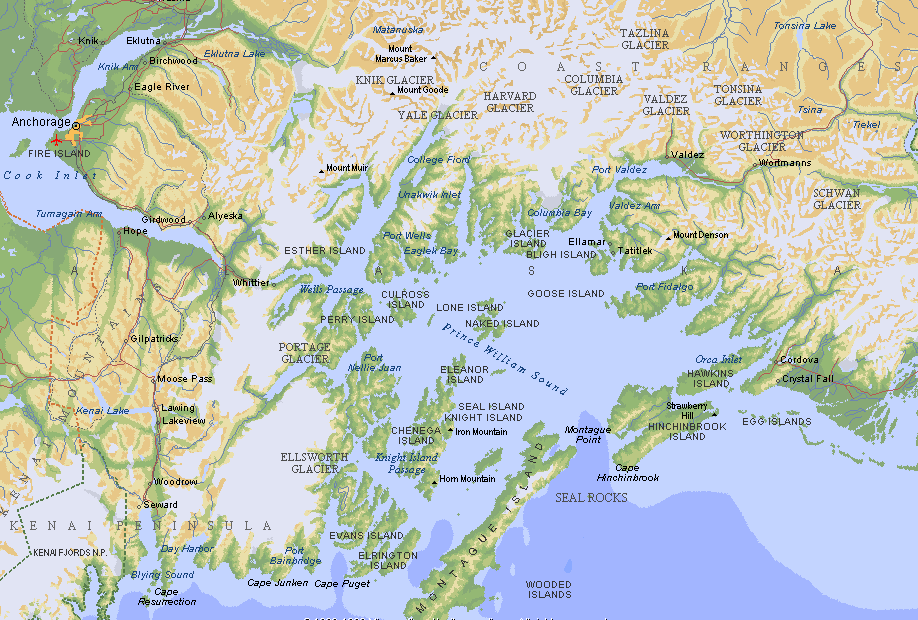
Naked Island, Prince William Sound, Alaska
We woke up with rain rattling on to cabin window and wind howling
through the rigging. It was the morning we were supposed to leave. Well,
we didn't. No point going in bad weather, because we don't have
to. We rented two movies (The Waterworld, where bad guys house a rusted
Exxon Valdez, and a Harry Potter). The next morning it wasn't raining,
so we left. Even it was Friday. It is a belief that leaving harbour on
Friday brings bad luck. But we are just going to a nearby bay, we told
ourselves.
Also that afternoon it started to rain, and it rained for two days. But
it felt good to be moving again. Especially on Sunday, when we got fresh
easterly wind and we were able to sail. The temperature was around 40 F
(5 C) so we digged out the 'winter' overalls that had lied unused all
winter.

Sprinsailing in Alaska: two overalls on
We saw a lot of migrating birds and also seabirds, mostly divers (Pacific
Diver?). But most excited we were about some killer whales, which swam
slowly into a fjord.
We had fish luck: Auli got two good size rockfish. Hannu wasn't as
lucky: he lost one halibut lure and got an ugly looking, unedible fish.
Today, Monday, it has been fair, and we have been walking the whole day
criss-cross the Naked Island. It's about 60 miles from Cordova.  The
low, forest covered island is full of deer tracks. Luckily no sign of
bears. There are still spots of thick snow, but some persistent plants
penetrate through the snow. We saw hundreds of geese flying over the
island today.
Our sailing in Prince William Sound continues, and next there will be a
brief stop in Whittier - to fill up with diesel. The captain happened to
check the fuel after we had left Cordova, and it wasn't enough to
Seward. I sure asked when we were leaving, that do we need...
My swimming season has come so far, that this morning I stood in the
cockpit with the towel. But I didn't have the guts. The water seemed so
black. Maybe tomorrow.
4.5.2004 Granite
Bay,
Prince William Sound, Alaska
 The past, rainy week had two sunny days. Both were spent by
paddling. The canoe feels steady and takes a lot of gear (cameras,
foodsack, backpack, snowshoes, pump). It is easy to carry up the shore
or over a neck of land. However, it's a bit heavy to paddle, but that
only gives us more muscles. The canoe is just the thing we have long
wanted: we can move silently, without disturbing animals.
On the 30th of April - the First of May Eve (which is a celebration day
in Finland) - we were in Long Bay, Culross Passage. In the
end of the (long!) bay there is a tidal lake, connected to the sea with
a short riverstump. We paddled to the other end of the lake, but
couldn't go further because of a rapid. We saw an otter (land otter, not
a seaotter) in the lake. It jumped into the water when it saw us, but
came then very near. With a little mur-mur it dived again. We paddled on
the bay the rest of the day, stopping for coffee and lunch by a fire. It
was the first warm spring day, and sitting in a calm spot you could show
some sunshine to the winterpale legs. First time the dinner was eaten
out, in the cockpit. The next day it was raining. 
Otter's skihill. It has slied down and
climbed up to the trees again.
As we told previously, we had to pop in Whittier to take fuel. It was
expensive, 1.90 $ per gallon. We took 91 gallons (345 litres). We also
had a shower (6.80 $) and bougth a gallon of milk (4.70 $). We had
planned to leave Kristiina in Whittier and take a brake from the rain in
Anchorage with our friends Antti and Pirkko, but there was no vacancy in
the harbour. Finally that was good, because the sky cleared and we
enjoyed the above mentioned day in the Long Bay.
From Culross Passage we motored (no wind) to Granite Bay via Nellie Juan
and Disk Island. Granite Bay looked an interesting paddling place with a
lot of small islands and bays. And it is, we have been paddling around,
exploring the shallow shores. There is a strong tidal current here,
because water runs through two narrows between the outer and inner bay.
We haven't seen any signs of animals, except birds - there are lot of
them. Pochards or goldeneyes and some smaller ones.
There is still a lot of snow on ground. The anchorage by the Nellie Juan
Glacier had about 4 metres snow, which hindered us of going ahore. The
islands in the middle of PWS have less snow. Here it's partly smelted,
but the end of the bay has 2-3 metres. We made a short snowshoe trip,
and will go again today, because the arm muscles need a rest after
yesterday's paddling.

We haven't seen any fish in this bay, but when we came we stopped for
fishing. Auli got four rock fish, of which one weighted one kilo. Salmon
comes later into the bays and river mouths.
We try to be in Seward on the next weekend to be able to take a trip to
Anchorage.

11.5.2004 Seward, Alaska,
USA
A lot has happen after the last update, where we were paddling and
fishing in Granite Bay. We spent alltogether three relaxed
and sunny days there. We hiked and paddled, and got some more fish
outside the bay. An otter lived in this bay, as well. In opposite to the
sea otter, who spends most of the time on its back, the land otter swims
the "normal way", belly down. During our snowshoe hike we saw
the first bear tracks (black bear) - and they were fresh! It's easy to
define the freshness when you see tracks on snow. This bear was not up
so early that the snow would still have been hard, and not a long before
us, so that the sun would have smelted the edges of the track. The
spring sun warms up the snow, tracks vanish and become larger and
unclear already in an hour. We figured this out of our own tracks. After
we had seen the bear tracks, I placed the bearspray to my waist. We
bought this "weapon" in Cordova. If a bear would attact, you
are supposed to blind it with a strong pepper spray. Just to remember to
be upwind yourself...
From Granite Bay we headed towards Seward, stopping in Chenega
Bay on our way. About 50 persons live in the village. Chenega
used to be on Chenega Island, but a 35-feet wave caused by the 1964
earthquake washed the whole village away, and 23 of the 68 inhabitants
died. Twenty years later, in 1984, a new Chenega Bay was established on
Evans Island. The teacher of the village, Steve, came down to the boat,
and the next day we visited the school. There were only three kids out
of ten at place, the rest were on a cultural happening in Tatitlek. We
told about our trip and then the children came down to see Kristiina.
|

There were several computers and
a wireless internet connection at the school, but the map was
from Soviet Union time.
|

Although the kids have been
living by the sea, on an island, a sailboat was something new
and exciting.
|
We arrived to Seward on
Friday, and in the same evening we drove to Anchorage. Nina was very
kind to borrow her car. We spent the night with Antti and Pirkko, maybe
the last time (at least in Anchorage). Monday was reserved for
"business", so since we had two days and a car, we made a trip
to the Interior. The goal was the Denali National Park, but we drove all
the way to Fairbanks.
The Denali National Park is huge: 6 million acres, bigger
than the state of Massachusett. It is named after the highest mountain
in Alaska (the highest in the North America, as a matter of fact), Mt
McKinley. The natives in this area, the Athabascan indians, called the
mountain Denali, the "High One". It rises to 20 320 feet (6.2
km). The landscape of the National Park is mainly taiga and tundra.
Caribou, wolf, moose, bear, fox, wolverine and lynx live here. Because
the National Park is very popular among the tourists, you need a
permission to move around. There is a 89 miles (142 km) long road, but
no private cars are allowed, except on special permissions, which are
delt out in a lottery in September. During the season tourists are
transported around by bus. You can get an idea of the high amount of
visitors by the number of lottery-cars: it's 1600! As a total, hundreds
of thousands of people visit the area every year.
The season wasn't started yet, which was good and bad. The Visitor
Center with films and all information was closed, and there were no
bus-trips. But we were allowed to drive  on
our own in the Park. A few other early birds were on the road with us.
We saw several caribous. Our encyclopedia (Wsoy Facta
2001) tells the following about the caribou, the relative
of the reindeer: "There are six sub-species of caribous in North
America. They are all very well adapted to cold and snow. Their cloven
hooves are broad and sharp, easy to dig food under the snow. Their hair
is hollow, so it dries fast. Both sexes have horns. The males drop their
horns earlier, so that the females can protect their food caches. The
rutting season is in autumn, calves are born in spring." The
horns of the caribous were growing and maybe itchy, because one animal
was standing on three feet, trying to scratch the horns with the fourth.
It looked very funny. The animals were so far away, that I didn't get
any good photos with the digital camera. (Photo: Wsoy Facta 2001.)
The scenery was like in Lappland, Finland, if you cut off the mountains.
The top of the Denali was hidden by the clouds, but we saw it on our way
back, from far though.

Denali National Park has 89 miles of
road.
Just a mile outside the
National Park entrance is a tourist village with huge hotels and various
services. Everything was still closed, however, so we continued our way
to Fairbanks (pop. 32.000), and stayed overnight in a
motel. The next day's programme was to visit the museum of the
University of Alaska, which is famous of a 36.000 years old, restored
bison, and a gold exhibition, but - the museum was closed.
One of the jobs on Monday was the Immigration office, where we thought
we could renew our six months staying permission. Wrong. We have to
apply it from an office located in Nebraska. The application costs 195
dollars each. Even we have a 10-year visa, we are allowed a 6 months'
permission at a time. An alternative to the application would be leaving
the country for 24 hours. It would have been almost easier and cheaper
to take a trip to Canada, we were not far from the border. This personal
permission has nothing to do with the cruising license allowed by the
customs, to which we already got a four month extension.

Our route to the Interior. The beige area
on the left is Canada.
Tomorrow, on the 12th
of May, it's three years since we left Finland. According to our
original plan, we were supposed to be home this summer, but it was
delayed by a year. As the homepage hopefully conveys, Alaska is one of
the best places we have been on our trip, and we are not regretting
spending the extra yea
Previous
- Next
|