|
20.7.2004 Kodiak, Alaska,
USA
On Friday, the 16th, we hauled Kristiina out to Fuller's Boatyard,
which is conveniently located 15 minutes walk from the town centre. The
bottom was rather dirty, but of algae, not barnacles. The previous
painting took place 16 months ago, in March 2003, in New Zealand.
Because the previous antifouling was ablative (it ablates, dissolves),
we bought similar now as well. The only colour available was black (but
it looks dark purple). Neither of the three paint selling stores had
ablative antifouling in stock, the black paint was a shipping error.
The private boatyard was quite resonable in terms of Alaskan price
level: lift up & down 280 dollars (in Sand Point it would have been
480 $), daily fee 17$, pressure
washer 25 $, electricity 7.50 $ a day. Plus 6 % tax.
A piece of wood had jammed the log propeller, probably when we hit the
trunk. Around the shaft we found tight rounds of something that looked
like woollen thread, must be from a trawl. Zincs were not too worn out.
Hannu changed only the propeller zinc and welded a new one to the rudder
blade.
Life hasn't been just work, during the weekend was the Bear Country Music Festival.
First time we got a ride in a school bus, which took people to the
festival area 10 miles away from the town. We took the very first bus on
Saturday afternoon. Besides us there was one passanger. Hmmm...not a
good sign for a festival. There were three stages, each having an
audience of about five, of which two were friends to the performer and one the
next musician. Weather was typical to Kodiak: rain. But during the
evening more people came and feeling got higher. Especially the Kodiak
Island Drummers was enjoyable to listen. The group has done its
practising and played with hard discipline. Also a couple of local bands
were creating a good feeling with their rock/jazz/blues.
We even danced. Unfortunately we forgot camera home.
There are two French boats in the harbour. Except Patago,
these are the first foreign cruisers we have seen since Hawaii.
From now on we are monitoring the weather and forecasts - nervously -
and speculating when to leave. There are 550 miles to Sitka,
straight east. Forecast promised easterly for the next couple of days.
25.7.2004 Kodiak, Alaska,
USA
Skipper's birthday. Has the man changed over the three years?

Greenland 25.7.2001 |

Tahiti 25.7.2002 |

38º 09' N 159º 41' W
25.7.2003 |

Kodiak 25.7.2004 Jammed toilet! |
3.8.2004 Sitka, Alaska, USA
We waited a week in Kodiak for the wind to turn. For Monday they
still predicted SE 35, but we left the town and anchored in the
beautiful and sheltered bay of Long Island. We should have left the
harbour earlier, but leaving - always difficult. It was easy to walk on
the island because there is a road from WW II. And also some collapsed
houses and other structures from the war. After a half an hour we
saw a newer building by a pond, a little shed which we thought was for hunting.
No, it
was a sauna! "This is a banya for use,
not to abuse" it stood on the door. Great! It was small, but clean. Dry wood
was piled in one corner. We rushed back to boat to get towels, soap and
clean clothes. Already after half an hour heating the stones sizzled promising, and
another half hour and the sauna was ready. Ahhhh! The place was most idyllic and peaceful, and the heat was perfect, smooth and hot.
The water in the lake was cold but refreshing. We enjoyed and laughed,
what a wonderful surprise and a perfect end to our stay in Kodiak.

The shed by the small lake turned out to be
a very good sauna.
On Tuesday, 27th of July, we started
our sail to Sitka in a fresh southerly wind. We made 6-7 knots, either
because of current or because of the clean bottom. However, according to chart we should
have had the current against us. The wind shifted to SW and was fresh
until Wednesday, but then it started to calm down. The last 24-hours
was mostly motoring except a couple of hours with spinnaker! Don't
remember when we last time had spinnaker up. So, crossing the Gulf of
Alaska was very pleasant, except the beginning where the shallow waters
made the waves ugly and bumpy. As usual, Auli was seasick the first day,
but after that she was back to normal, baking a chocolate cake one day and
a bread the other day. We had reindeer and mushrooms for dinner after we
had finished halibut which the Kodiak fishermen gave us.
On Saturday 31st we were in front of Sitka. The sky cleared and sun started
to warm. We saw some salmon jumping, so we reduced the speed to 1,5 knots and
put two lures out. Catch: three salmons.

Dinner is secured. Cape Edgecumbe at
the background.
A nice end to a nice trip was meeting Sylvie
and Jean in Sitka. Patago had
arrived two days earlier. The salmon dinner in Kristiina lasted for
early hours since there was so much to talk about. It was really fun to
meet our winter-neighbours!
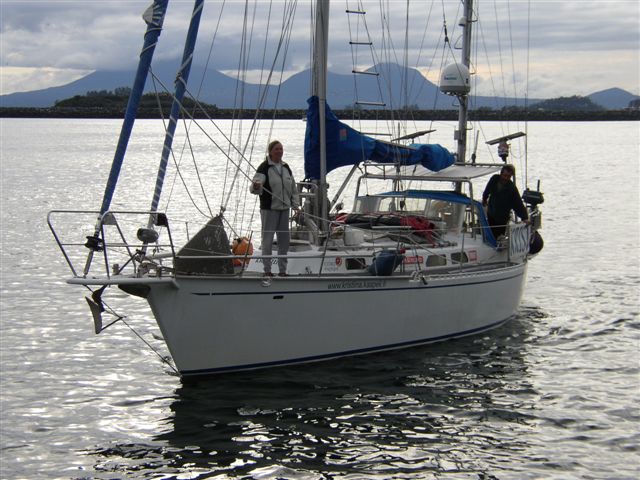
We arrived to Sitka harbour
after 551,5 miles
that took 4 days and 8 hours. Photo:
J-F Andre.
9.8.2004 Craig, Alaska, USA
We had so much to do in Sitka, that I didn't tell anything about the
town in the previous update. So here is a brief history. Shee-Atika
was the name the Tlingit indians gave to place where
present Sitka (pop. 9000) lies. Shee was the name of present
Baranof Island. The Tlingits didn't yield to the Russian command as
easily as the Aleuts, and some bloody fights took place. In 1804 the
Russians finally beat the Indians, and Sitka became the "capital of
Russian Alaska after Kodiak. Aleksander Baranof was the governor. Fur
trade was succesfull and the town expanded. In 1848, the St. Michael's
orthodox church was finished, and it is the tourist attraction and
symbol for Sitka (the same way as the orthodox church in Unalaska),
although the present church is a replica that was built after the
original burned in 1966. The bishop's house (built 1842) still exists
and it is the oldest building in Sitka. The present day Sitka is a
tourist town. Cruising ships bring thousands of passangers in a day. The
city centre is full of gift shops and the price level is rather high.
For us it was fun to have so many people around for a long time!
|

The orthodox church is in the
middle of the town
|

The biggest cruising ships cannot
enter the harbour
|
Sitka is a lovely town. Lots
of wooden houses and beautiful gardens, a wide shoreside with several
harbours. You can anchor free inside the breakwater. There is a coin
shower, only 2 dollars (almost free compared to 8 dollars in Kodiak). In
addition to Patago we met sv Nellie Juan (Pat and Dennis
fish during the summer in Cordova), German sv Wanderlust,
and American sv Speakeasy. It was fun to meet other
sailors. We visited the Sheldon Jackson museum, which is better
than museums in Kodiak and Dutch Harbor. Otherwise the time was spent
with routine: croceries, laundry, internet. The weather was warm (15-20
C ie 58-70 F) and we were finaly able to turn off the heater.
We left Sitka on Wednesday (4.8.) and motored to Goddard Hot Springs
Bay 15 miles away. As the name tells there are hot springs and
the water has been conveyed to two big wooden bath tubes. A hot bath is
always available.

We have been trying to catch
crabs, but so far the only catch is a sea star. Didn't taste that one. In
Goddard Bay we found odd red blueberries. For a while we though that we'd
made a botanical find, but the plant book revealed that they were red
huckleberries, very common in SE Alaska.
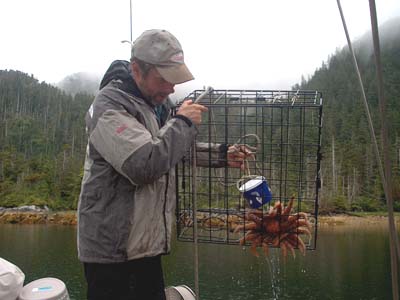
Unedible catch
|

The most easy place to pick
blueberries.
|

Huckleberries
|
Our route took us along the
west side of Baranof Island, and it would have been
interesting to spend some time exploring the outside shores, but weather
forecast said hard wind, so we hurried onwards. The wind never came, it
has been totally calm. On the west side of Prince of Wales Island
we found the beautiful Maurelle Islands (55° 39' N 133° 34' W),
several low, small islands and islets. A bit like some parts of Finnish
archipelago. The first night we had company in the anchorage, a fishing
vessel and a motor cruiser. Goodbye privacy! It could have lasted
longer. From now on the number of people and boats increase. It wasn't
pleasant to hear and smell motorboat's generator in the quiet summer
night. Why they needed so much power?

I didn't feel very flexible in Hannu's
wetsuit, but at least it was warm!
The weather is much warmer
here in SE Alaska. At the moment, 7.30 pm, it's 22 C / 73 F. Hot! Auli
was snorkeling today. Water is maybe +15 C / 58 F and wearing Hannu's
heavy wetsuit was too much. We have been paddling as well, and found
good size razor clams, but the crab pot is still empty. What's the
reason, bytes? Jean and Sylvie told that chicken is effective. We used
only chicken skin and grease - isn't that enough...
Tomorrow we motor the 20 mile strech to Craig, a 2000
inhabitants fishing town, where I hopefully can transfer this text to
internet. From there we continue towards Canada.

From Sitka to Prince Rupert , the
Canadian port of entry, is 300 nm.
An extarct from the update
14.8. telling about US towns Craig and Klawock:
We spent an afternoon in Craig, taking care of "business"
(update, crocerie's, fuelling, shower). We stayed overnight in the dock
(10 dollars). The weather remained sunny and warm, you could wear shorts
from morning to late evening. Weather forecast promised calm seas so we
decided to continue an outside route. But before we had rounded to the
west side of Dall Island, it started to blow and the sky was covered
with clouds. Because we didn't know if it was just a temporary front or
a more permanent change in the weather, we
choose the inside passage instead. It was a bit annoying, especially
after the Craig harbourmaster had showed us some neat places on the
outer shore of Dall Island. The inside passages are pretty as well, but
for us, being spoiled by magnificient archipelago of Finland, the dense
scenery of bush and forest doesn't make big impact. In most of the
anchorages you couldn't go on land, at least not without a heavy bush
cutting machine. We haven't found the south part of SE Alaska very
temptating after Prince William Sound and Alaska Peninsula, but probably
the north part with Glacier Bay is more beautiful. The scenery there is
presumably similar to PWS, mountains and glaciers. Forest is different
down here, it has more verierty. Some places have more cedar trees than
spruce.
Cedar was the tree indians used - and still use - for carving totems.
Close to Craig is Klawock, a 700 inhabitants native
village with some 20 Tlingit totems. The reasons to make a
totem pole or totem carving were several, but the most common was to
remember an event or period of time. Totems told the history of a clan
or family, sometimes about the life of a dead person. The shamans had
their own special totems, very often showing sacred animals such as a
raven or an eagle.
Although the scenery hasn't been that amazing, we never get tired of
watching animals. We saw blackbears beachcombing on two mornings. Every
anchor bay has a shy seal. Motionless and quiet herons and quick and
noisy kingfishers are common. Kingfisher is rather small bird, a size of
a jay, with a tuft. It sits in a tree near the water or flies back and
forth making fast dives down to water for a fish. First time I saw near
when kingfisher got a catch. The fish in its mouth it flew back to a
tree starting to slam the fish a branch. The the catch, almost length of
the bird, was swallowed as whole. A couple of ruffles and it went back
for fishing.
During the daytime we have seen a lot of humback whales. And the salmons
jump as they never get tired. Auli got one salmon and the next day two
rock fish, but the crab pot has been emty. We met two Australian sailors
and their theory was, that if there is seaotters, there is no crabs.
They told us that the BC inside passage has a lot of crabs. They has a
similar pot than us, so that gave us hope.
On Friday, the 13th of August we motored 70 miles over the Dixon
Entrance to Prince Rupert. No sailing, the weather was still
calm. And hot. After 12 hours, at 5 pm, we moored to the very full town
harbour of Prince Rupert.
Previous
- Next
|

