|
14.8.2004 Prince Rupert,
Canada
 We
are in Canada! Goodbye Alaska! Exactly a year and ten days ago we
arrived to the south tip of Kodiak. The time in Alaska has been best on
our trip so far. Nowhere else have we seen so gorgeous scenery, so much
wild animals, tranquility and friendly people. Especially Prince William
Sound, Kodiak and the islands, Alaska Peninsula and Shumagin Islands
will be remembered as very special places. Let's to back to Alaska for a
while, to Craig, where we were last time.
We spent an afternoon in Craig, taking care of "business"
(update, crocerie's, fuelling, shower). We stayed overnight in the dock
(10 dollars). The weather remained sunny and warm, you could wear shorts
from morning to late evening. Weather forecast promised calm seas so we
decided to continue an outside route. But before we had rounded to the
west side of Dall Island, it started to blow and the sky was covered
with clouds. Because we didn't know if it was just a temporary front or
a more permanent change in the weather,  we
choose the inside passage instead. It was a bit annoying, especially
after the Craig harbourmaster had showed us some neat places on the
outer shore of Dall Island. The inside passages are pretty as well, but
for us, being spoiled by magnificient archipelago of Finland, the dense
scenery of bush and forest doesn't make big impact. In most of the
anchorages you couldn't go on land, at least not without a heavy bush
cutting machine. We haven't found the south part of SE Alaska very
temptating after Prince William Sound and Alaska Peninsula, but probably
the north part with Glacier Bay is more beautiful. The scenery there is
presumably similar to PWS, mountains and glaciers. Forest is different
down here, it has more verierty. Some places have more cedar trees than
spruce.
Cedar was the tree indians used - and still use - for carving totems.
Close to Craig is Klawock, a 700 inhabitants native
village with some 20 Tlingit totems. The reasons to make a
totem pole or totem carving were several, but the most common was to
remember an event or period of time. Totems told the history of a clan
or family, sometimes about the life of a dead person. The shamans had
their own special totems, very often showing sacred animals such as a
raven or an eagle.
 Although the scenery hasn't been that amazing, we never get tired of
watching animals. We saw blackbears beachcombing on two mornings. Every
anchor bay has a shy seal. Motionless and quiet herons and quick and
noisy kingfishers are common. Kingfisher is rather small bird, a size of
a jay, with a tuft. It sits in a tree near the water or flies back and
forth making fast dives down to water for a fish. First time I saw near
when kingfisher got a catch. The fish in its mouth it flew back to a
tree starting to slam the fish a branch. The the catch, almost length of
the bird, was swallowed as whole. A couple of ruffles and it went back
for fishing.
During the daytime we have seen a lot of humback whales. And the salmons
jump as they never get tired. Auli got one salmon and the next day two
rock fish, but the crab pot has been emty. We met two Australian sailors
and their theory was, that if there is seaotters, there is no crabs.
They told us that the BC inside passage has a lot of crabs. They has a
similar pot than us, so that gave us hope.
On Friday, the 13th of August we motored 70 miles over the Dixon
Entrance to Prince Rupert. No sailing, the weather was still
calm. And hot. After 12 hours, at 5 pm, we moored to the very full town
harbour of Prince Rupert. Here the harbourmaster doesn't help with the
berths, you have to find one yourself. It's so crowded that boats have
to raft, which we did as well. Then to the phone to call the customs. I
though I was making an appointment with the customs to come to the boat,
but the clearance was made over the phone. Welcome to Canada, said the
officer.
* * *
Two Finnish around-the-world
sailings have come to their end this summer and the boats have returned
home safely. Riitta and Pekka on sv Iiris arrived to
Kotka, Finland in June after four years circumnavigation. Manna and Jari
on sv Aida should be back in Helsinki in these days. Aida
has very interesting and elegant homepages in address www.sailyachtaida.net Greetings
to both crews!

Tlingit totems in Klawock
24.8.2004 Sointula, Canada
We stayed in Prince Rupert, the border town of about
20.000 inhabitants, only the necessary couple of days it took us to do
the laundry and shopping, and visit the interesting museum. They didn't
want any payments in the harbour during the weekend, so we left on
Sunday before the cashier arrived on Moday morning.
|

Prince Rupert is a busy base for
fishing charters.
Here is the catch of the day: salmon, halibut and most likely some
lingcods.
|

Prince Rupert public floats.
It isn't quite as idyllic as it looks in this photo.
In reality, the harbour was noisy and dirty.
|
We anchored 15 miles out of
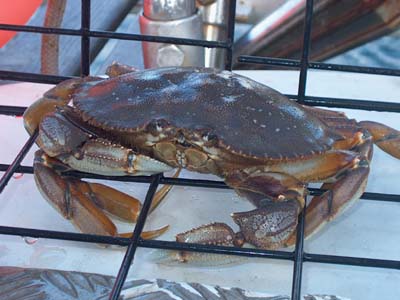
Prince Rupert, in a quiet bay, and set the crabpot out. Curiosity and
impatience made us to check it already after an hour: two crabs! In the
morning there were SIX angry creatures snapping their scissors. Three
females were let free, you are not allowed to take females so that the
stock remains. But the three sizeable males made a big pile of meat.
Crab in saffron sauce - yammy! We had bought the Canadian fishing
license in Prince Rupert (114 CAD, about 55 euros). Next day we got more
value on our license when Hannu got a big, handsome sockey salmon. We almost
prefer sockeye for king, especially if you make the salt cured (gravlax)
salmon. The big sockeye was enough for gravlax and three meals.
The weather was still sunny, calm and warm. Or almost hot for us (20-25
C / 70-78 F). In two nights we had thunderstorms - the first was really a
show. Sky was full of lightnings going in every direction, and it was
bright as during a day. It was cracking and banging. Poor Auli was very
afraid. An irrational fear, which is only helped by getting under the
covers in bed! In the morning the sky was blue again and we started to
motor along the Grenville Channel.
|

Motoring along the long narrow
channels became soon boring. Photo: Grenville Channel.
|

Lowe Inlet - an anchorage along the
Grenville Channel. Salmons are jumping up the waterfall.
|
We got bored of the inside
passages and took a swing outside. We spent two marvellous days in Campania
Island (53º 06' N 129º 31' W). The route into the anchorage
was very narrow and full of shoals and rocks. GPS and chart didn't
match, on the chart we were going over the shoals and anchored almost on
land. The error was half cables. This anchorage was the last (so far)
solitude place. Boats - and the chatter in VHF - increased as we got
south. It has it's fun, however, it's always fun to listen to various
boat names. Near Bella Bella, in St. John Harbour (52º 11' N 128º 29'W)
were two big, floatable lodges. Instead of parking place and cars in
front of the house there were a row of open boats. Outside the bay 24 of
these small boats were hanging around, customers fishing.
We couldn't stay in the native village of Bella Bella
longer than a quick visit to the croceries. The dock was full and
anchorage too open. There is a marina nearby (Shearwater) but we
preferred to continue rather than pay for a slip in a marina. It started
to rain in Bella Bella and has done so since that. After two more
anchorages and (only) one crab we arrived to Sointula. Totalling 324
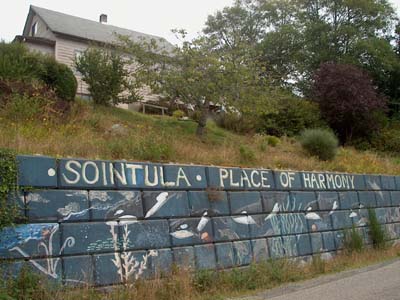
miles from Prince Rupert. We will tell about Sointula, an utopia society
established by Finns in 1901, in our next update.
1.9.2004 Comox, Kanada
 Sointula, located on small Malcolm Island, was founded by
Finns in early 1900. First we thought that there wasn't much more left
of the Finnish influence than the name, but that was not quite the case.
Island has still descendants of the first Finns that arrived, as well as
others with Finnish ancestors. The store sells Turun sinappi (mustard),
Fazerin Sininen (chocholate), Juhlamokka (coffee), näkkileipä (rye
crackers), piparkakku (ginger biscuits) and pulla (baking). The local
newsletter is called Sisu, although written in English. The
library has a collection of Finnish language books. The local band, Hilltoppers,
plays Finnish folk music. Nowdays only a few residents speak Finnish. We
met three of them: Liisa (80 v.), Pentti (76 v.) and Leo (74 v.), and
heard three different life stories. Sointula has very relaxed and
pleasant atmosphere. Houses are pretty and gardens well kept. Naturally
we found a sauna. We hiked the six kilometres long Mateoja-trail
cross the island. In the last evening we enjoyed of delicious food and
good conversation in the beautiful house of Shane and Stephanie, who
have been living 30 years on the island.
The history of Sointula began
of a dream to establish a community where people are happy and things
run well. Conditions in the mines and on the railroad construction
sites, where most of the Finns worked like other immigrants, were poor.
Strikes didn't bring any improvement, because there was plenty of
workforce from different countries. Finns established temperance
societies. Gradually an idea of establishing own community arose. It
wasn't particularly distinctive that time, also other nationalities were
establishing ideological communities. The Finns had read Matti
Kurikka's (1863-1915) thougths about socialistic utopia. He was
an enthusiastic visioner, unpractical but appealing. Kurikka supported
temperance, body exercise and the arts, and was against churches. Later
he spoke for free sex, which didn't gain as unreserved approval. Kurikka
had tried to establish an ideal community in Australia, but it failed,
so when the Canadian Finns asked him to take the lead in their project,
he willingly agreed. He had no money, so the Finns did a collection and
Kurikka arrived to Nanaimo, Vancouver Island, in August 1900. A search
for a suitable place began, concluding to Malcolm Island.
While they waited for the official matters to clear, Kurikka established
a magazine named Aika (Time) in Nanaimo. In Finland
Kurikka had acted as the editor-in-chief for Työmies (a
socialist newspaper) in 1897-99. He had worked with A.B. Mäkelä, and
now he suggested that his colleague and friend would be invited to
Canada. The Finns rised the money again, and A.B. Mäkelä and his wife
arrived to Nanaimo. Mäkelä took over the Aika magazine and Kurikka
started to travel around Canada and US, all the way to east coast and
New York. He tried to talk more Finns to move to Malcolm Island's
settlement.
In November 1901, papers were signed by His Majesty the King of England
and the Kalevan Kansa Colonization Cooperation. The first
members arrived to Malcolm Island in December 1901. It wasn't the first
time an ideal community was established on the island, a former attempt
by English ended to fights and poverty.
Same happened to the Finnish project. Kurikka left Sointula in September
1904, the cooperation was officially suppressed in May 1905. What went
wrong? The main reasons were perhaps lack of practicality and luck. The
cooperation was to gain money from logging, but the price of wood was so
low, that transportation costs ate all the surplus. Neither was fishing
profitable enough. Before they had houses on the island, more and more
people moved in, ending to live in poor conditions. Horses and cattle
were brought on island, but there were no animal shelters. Vessels,
tools and gear were bought on credit.
However, the end of utopia didn't mean the end of community. People
stayed and continued on living. They were farming, logging and fishing.
In the 1960's and 70's, the community got a fresh shoot of blood when a
bunch of hippies move on the island. The most of its hundred year
history Sointula has lived on fishing. The last five years have brought
changes: fishing is not enough for a livelihood, young people are moving
out, retired and summer residents are moving in. The comunity will
change, but not dissapear. Sointula seems to be very strongly alive. The
cooperative, founded in 1909 is still active, being the eldest
cooperative in British Columbia. There is no local government in
Sointula, instead things are taken care by voluntary boards. The
centennial celebrations in 2001 brought publicity and tourists - some
think too many. Despite the utopia never succeeded, the present day
Sointula seems very healthy and good environment to live.
Utopia lost - paradise found?
After Sointula we had Johnstone Strait,
a narrow canal running along the eastern shore of Vancouver Island,
ahead of us. It's infamous of its currents, which especially now, during
the spring tides, run fast. The strongest currents are found in Seymor Narrows,
the prediction for yesterday (29.8) was 14 knots. Naturally, the
best time to enter the Narrows is near or during the slack. We were two
hours before the slack and for the best our speed was 13.8 knots! The
water was boiling and foaming around. Strong eddies opened suddenly -
like pulling the plug in a huge tube - next minute there was a big
swelling, like a giant tab open. Exciting! We have seen several currents
from Faroe Island to Cook Strait in New Zealand not to mention the
rivers, but Johnstone Strait is something. You get nice travel speed
along the way when running with the current.
Seymor Narrows was astonishingly also a gate to sivilisation. A whole
new scenery opened up after the narrows: a big factory and block houses.
The shores were full of houses, boats were running everywhere. It's
funny how suddenly it changed, the north side of Seymor Narrows is all
bush and forest.
Coming to sivilisation made us to try the cell phone - and it worked!
Several text messaged was immediately sent, and when friends started to
wake up in Finland, our phone started to peep for incoming messages.
Fun! A real sign of sivilisation. (The cell didn't work in Alaska.) But
the satellite phone has had troubles finding the satellite, probably
because we are on the edge of one area and even the mizzen mast is
enough to hinder the contact.
After Seymor Narrows we anchored in Gowlland Harbour
nearby.
The Next day, just when we
were leaving, a woman rowed towards us shouting Hei Suomi (Hello
Finland)! She was Ulrika, who had left Helsinki 30 years
ago. We ended up staying another night in that bay, as Ulrika's and Baden's
guests on their dock. We did leave, however, that first morning, but
outside in the channel it was blowing hard from the nose and we were
going to have the current against us for 16 miles further away. It was
only two knots, but combined with the strong headwind it was not
temptating. We turned around. And just in the last minute, because even
now, right after the slack, the current was so strong that we made only
2-3 knots with full power. The delay didn't matter, we had a very
pleasant evening with Ulrika and Baden. They live in a wooden fishing
boat, built in 1947, which Baden has restored and remodelled gorgeously.
The boat is full of beautiful details and practical solutions. The
former fish storage is now a spacious shower and store room.

6.9.2004 Nanaimo, Canada
The previous update was made in Comox, where we
stopped to visit Ossi and Sisko, who have been living in
Canada for 30 years. The invitation was made over three years ago, when
we were sailing on the Great Lakes. Ossi found our email address in
Suomen Kuvalehti (magazine).
Although our friends Timo and Leena from SV Tinja stayed
the whole winter in Comox nine years ago, we wouldn't - the attitude in
the harbour was odd, almost unpolite. And for the top, we were charged
for 46 feet (0.60 CAD per feet) although the overall length of Kristiina
is 42 feet (measured in Panama). Well, that's a way to collect harbour
fees as well, but the staff could have told us, for instance when they
were measuring the boat (that was done without our knowledge). In terms
of money it's not a big deal, we had to pay about two dollars more per
day what we were told in arrival, but they way it was done was annoying.
And even more irritating was the reaction of the harbour staff when I
complained. Other boaters must have had same problems, so fast was the
change of her mood to a very arrogant and defending, not listening what
I tried to say. She was just repeating feet and overall lengths, while I
was trying to say that to hell with the feet, do your measuring openly
and tell the price to your customers beforehand. Not a nice visit to the
harbour of Comox.
Comox was our first town on the Island of Vancouver. The City
of Vancouver is located on mainland. Both are named after George
Vancouver, the English explorer, who sailed with Kaptain Cook on
his second and third trip. Vancouver commanded an journey made in
1791-94 during when the cost of North America was surveyd all the way
from Alaska to California. The island of Vancouver is about 500 km long
and has 700.000 inhabitants. Half of them live in Victoria, the capital
of British Columbia. The greater Vancouver has about 2 million
inhabitants. British Columbia is one of the ten provinces in Canada.
Next we stopped in Nanaimo, which is a lovely town with a
population of 70.000. No arguments about the harbour fees, because
we anchored among tens of boats between Nanaimo and Newcastle Island.
Immediately we picked up one Swiss, one German and one English sailing
boat among the many American and Canadian vessels. The anchorage is
really pleasant and handy, on the other side you have the town with all
the facilities (croceries, laundry, internet and post office close to
harbour) and on the other side a big recreational area. And crab pot
catch a crab in few hours.
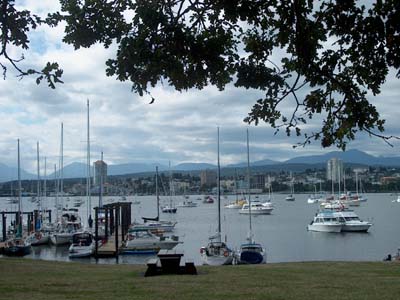
Nanaimo seen from the Newcastle Island
15.9.2004 Vancouver,
Canada
In Nanaimo we met a wooden German sailboat, Miss Sophie,
and her crew Harald and Verena. They have been away for
five years, sailed via Japan to Alaska and overwintered in Kodiak.
Harald, electrician, got our weatherfax programme work better. Instead
of Pactor it receives now via soundcard. Three years we have been
miserable with the programme, now it's working great. However, handling
the cables broke something and later the SSB went silent. After a
fright, three fuses, and Harald's aid everything was working again.
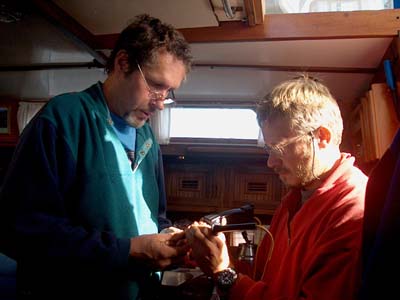
Hannu and Harald testing SSB cables
Fixing the radio cables
happened in Sidney, a small town 40 miles south of Nanaimo.
Sidney became a maintenace stop for us:
mainsail was repaired (the rope along the mast boltrope was broken),
engine injectors were cleaned and one replaced, sideberth and the space
under the v-bert were cleaned (yack, mold again). In addition, we bought
two guide books and copied about a hundred charts (US west coast, Mexico,
Central-America; thanks to Harald and Verena). In five days much was done.
Sindney was a good place for work, because there wasn't too much to see or
do in the town, except the bookstores (where Auli could have spent a
week). We were anchored in Tsehum Bay, where several boat chandlers
and boatyards are located. Dowtown was 1,5 km away.
On Monday we started to sail towards Vancouver (65 miles
from Sidney). After an overnight stop we arrived to tight False
Creek anchorage. Just in time to watch Finland-Canada
icehockey match in nearby pub. We were the only Finland supporters
and our hoorays sounded rather modest compared to the roaring of the
crowd. But after the game a gentleman bought us beers and commented that
it was brave to shout. What we would've been offered if Canada had
lost...Yes, so Canada won Finland 3-2 in this final game of World Cup.
Now we are waiting for Auli's parents, who arrive on Saturday for ten
days' visit.

Approaching two million inhabitant's
Vancouver.
It has been a while since we saw skyscrapers.
22.9.2004 Nanaimo, Canada
Although it really is possible to stay in anchor in the citycentre
of Vancouver, we found inexpensive moorage in the Fishermen's
Wharf (www.falsecreek.com).
The price was a happy surprise: 20 dollars including tax and power. The
comparable price is 40 cents per foot. In one of the most expensive
marinas in Vancouver, in the Coal Harbour, it's 1.80 $ per foot, and
even in Nanaimo and Sidney the price was higher. In addition,
Fishermen's Wharf was clean and centrally located, next to Granville
Island, which has great food market, small shops, restaurants, theatres
and other interesting stuff. In our mind, the place was absolutely the
best deal in Vancouver.
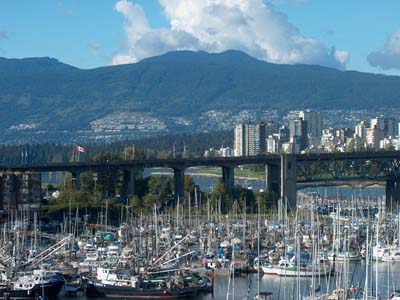
The Fishermen's Wharf in False Creek, next to Burrard bridge
On Friday our friend from
Ontario, Mike, visited us with his friend Elaine. Mike was
our crew during the passage through the Welland Canal three years ago.
After that we met in Key West. Mike is preparing his sailing over to
Europe, start next summer. It was cool to meet him thrid time on our
journey. Mike and Elaine drove us to fill the propane tanks. Here we
were able to fill also our Finnish 11 kilo tank, which nobody wanted to
fill in US after the new regulations.
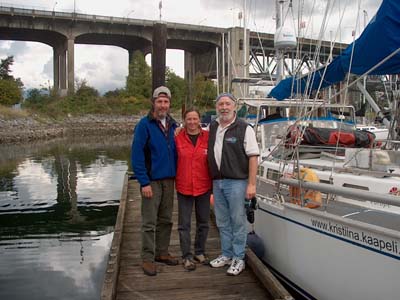
We met our friend Mike thrid time on our
trip
On Saturday, Auli's parents,
Bibi and Olli arrived, and we started the real tourist life. Maritime
Museum, Aquarium, Stanley Park and downtown were visited. Vancouver
is a pleasant town and lot remained unseen. On Tuesday we sailed 30 miles
over to Nanaimo in a nice, sunny tailwind.
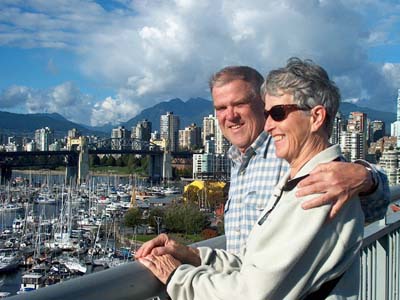
Olli and Bibi on the Granville Bridge. On
the background downtown Vancouver.
28.9.2004 Victoria,
Canada
The visit of Auli's parents was too soon over, time flied. In Nanaimo we
catch crabs, and walked in the dense forest of Newcastle Island. The
nightly visit of racoons was funny. We met Mikko Viren,
who has been living in Canada for 30 years, the last ten in the
anchorage in Nanaimo. Mikko has built his SV Heija himself. We
swapped books, magazines and sweet gifts: Mikko gave us maplesyrup, we
gave him Finnish chocholate.

Mikko Viren is one of the ten permanet
live-aboards in Nanaimo.
It was meaning that we visit
several of the Gulf Islands on our way to Victoria, but - as so often -
time run out. We stopped on Prevost Island, and next day we arrived to Victoria,
the capital of British Columbia. The famous floats in front of the
Empress hotel were reserved for a yacht club, and we were given moorage
next to floatplane dock. Noise and kerosine fumes were disturbing, as
well as the music from a nearby disco during the nights. The negative
sides of a big city. But it was conveniet to be next to downtown.

The inner harbour of Victoria, which was
unfortunately full.
A government building from the late 1800's at the background.
When Auli explored the city
with her parents, Hannu consentrated on maintenance. Bibi and Olli had
brought spare parts for the anemometer and bowthruster, so Hannu was
busy.
As in so many Canadian towns, Victoria has lot of parks with beautiful
flowers and plants. The downtown of Victoria is European style with
pedestrian streets and small shops. There is lot of tourists, and
therefore also all kind of tourist attractions and souvenier shops. The
weather was warm and sunny, showing Victoria as its best. We didn't dig
museums, but walked in parks, along the streets and on the beach.

Canadian police on march. The Empress
Hotell at the background.
On Monday it was time for
goodbyes, and on Tuesday we left Canada to enter US again. It's only 16
miles over the Juan de Fuca Strait to Port Angeles, which is one of the
many port-of-entries. Next we have 700 miles to San Fransisco along
the US west coast.
Previous
- Next
|