|
8.10.2004 San
Fransisco / Sausalito, California, USA
High pressure was still hanging around Vancouver Island, although it
was soon October. It was best to hurry south, because a low pressure
would give us head winds. On the 30th of September we motored the 50
mile long Juan de Fuca Strait to Neah Bay, from were we
started the journey to San Fransisco on Friday, the 1st of October. It
was dead calm. This time the Friday departure turned out to be very
lucky. A couple of days after we left, a storm warning, 50 knots, was
given to west coast of Vancouver Island. Weatherfax looked awful with a
deep low; windarrows had a triangel, predicting 55-60 knots. On the
US west coast the low appeared as 20-30 knots southerly winds, but we
escaped the headwinds narrowly. We were already prepared to pull into Crescent
City, 300 miles north of San Fransisco, and wait for the wind to
turn, but because it was predicted northerlies for the area ahead of us, so
we decided to continue. The whole 700 miles was alike; just a daytrip
behind us the wind was veering south, when we had either calm or
northerly winds. We were pleased that we didn't leave a day after! The
German Miss Sophie departured the same time than we, but
with the 50 litres (190 gallons) of diesel she couldn't motor far
during the first calm day, and was left behind getting the headwinds.
The west coast of USA from Washington to California is straight forward and
difficult to approach. There are no natural shelters. Harbours are
difficult to enter because of the sand bars and breaking waves. In
addition to continious weather forecast, VHF sends swell and bar reports.
It was odd to be six days at sea, but only 10-20 miles from the
shoreline. To our mind, it was more sensible to be near the coast than
100 miles offshore as some of the cruising guides advice. Near the coast
the Californian current is stronger giving 1-1.5 knots to southbounders.
If needed, we could easily pull into a harbour. The disadvantages of the
inshore route are said to be fog and traffic. We often had fog, but that
is handled with radar. There was much less traffic than we
expected (nothing compared to the busy Baltic Sea). Some pleasure boats
and a few ships further out. Fishing vessels seemed to gather in certain
areas and they had very bright lights. A real disadvantage we
experienced was nasty waves. Maybe the relatively shallow water (50-100
m), closeness of the shore, and currents made the waves grazy as soon as
the wind got up. The last night we had 20-25 knots wind, which was
enough to make the sea very uncomfortable. We had to handsteer,
otherwise Kristiina would have been like a wild horse. A few times we
got water inside the cockpit, so that Hannu and his recently washed
overall as well as his "sailingshoes" i.e. "grandpa"
slippers got wet. During the six days the wind varied a lot, from calm
to fresh, but always a tailwind. Twice we hoisted spinnaker for about
ten hours, a couple of times we had to take a reef or two, and the last
night we took the main down and sailed with the genoa only. At least the trip
was not boring.
The highlight of animals we saw, was three bluewhales.
They swam on the surface towards north and dived when they met us, but
we had time to conclude that they really were bluewhales, the largest
animals on earth. Neither of us have seen bluewhales before. The colour
was indeed "blue", or almost purpleish with brown dots,
probably diatomaceous. The dorsal fin was small, and two of the whales
had a different shape fin. They had "big noses", i.e. the
nostrils were surrounded by fleshy mounds. And the whales were huge! The
back continued and continued, then came the fin, and still the back
continued until the animal dived.
One day we got passangers. A flock of sparrows flew onboard. Hannu gave
them sesameseeds and water. One different bird, a yellow-green, didn't
care for food, and soon it died. Sparrows were not afaird, they ate from
our hand and sat on us. As suddenly as they had come, they were gone.
Only white poop spots were left. Except one little sparrow. It must have
decided that Kristiina is a good place to be. It walked around in the
cockpit, ate a little, and then fell asleep. Head hidden in the feathers
it balanced on the cockpit floor. But it must have been cold, because
soon the bird came in, and finally it slept the whole night at the back
of our bunk, balancing on the bedcover rope.
An other peculiar observation was a sunfish. Unfortunately we didn't take a
photo. Sunfish is a round, flat fish with a long and narrow dorsal and
anal fin. They have no tailfin if the round hemline is not counted. The
sunfish can be as big as one metre in diameter, but the ones we saw, were smaller.
They floated sideways on surface - sun bathing!?
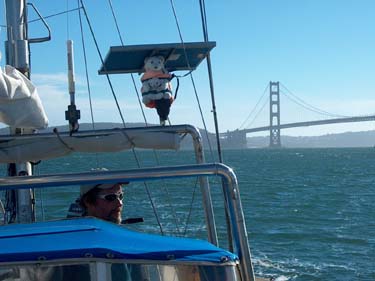
On Wednesday, the 6th of October, we sailed under the Golden Gate.
Impressive! Two kilometres (1.2 miles) long bridge was finished in 1937.
The construction has been very difficult work, hindered by fog, currents
and wind. Very often the bridge is hidden in fog, but we were lucky: it
was a clear afternoon and we got a few photos.
After the Golden Gate we
entered the anchorage in Sausalito, located on opposite San Fransisco. Jean ja Sylvie from Patago were waiting,
and we shared the anchorage drinks, and news from past two months.
Sausalito is a tidy and wealthy town next to San Fransisco. A bus or ferry
takes you to downtown San Fransisco, from where it is almost impossible to get
a transient slip. So Sausalito is nice, more quiet and fresh than the
big city. After one night in anchor, we moved to Sausalito Yacht
Club buyo. The elegant YC has a clubhouse, bar & restaurant,
and shower, but
no slips for the members. They keep their boats elsewhere. The
hospitality was really welcome for us, because the anchorage is shallow,
and with Kristiina's 7 feet draught, we were far from the dinghy dock.
Now it's close and we don't have to get wet if it's windy. And the
hot, tidy shower wasn't bad either.

15.10.2004 San
Fransisco / Sausalito, California, USA
The past week has gone really fast. We have mainly been tourists,
but one day Hannu fixed the leaking toilet, and Auli was shopping. She
came home with five shirts and one skirt. All together 20 dollars. San
Fransisco has several second-hand stores, where you can make good deals.
Inexpensive mark clothes donated by rich people.
The city sights include the Fishermen's Wharf
and Pier
39, where you can watch urban sea lions. These Californian sea
lions moved after the 1989 earthquake to the city harbour, and the
population has grown since. Today, about 900 sea lions overwinter on
Pier 39. During the summer most of them move 300 miles south, to the
Channel Islands.

About 900 Californian sea lions live in central San Fransisco.
The smell and noise of animals beats the fumes and noise of the
city.
|

San Fransisco is build on
hills.
There seems to be more uphills than downhills...
|

Cable car moves attached to a
wire
running in the middle of the rails.
|
After four days of
shower-buoy life we moved back to the anchorage. There is a lot of
traffic and time to time it's very rolly. There is no shower facilities
on land, so we use the cockpit. The weather was almost tropical, round
85 F, for a few days, but now it's normal 70 F again, 58 during the
nights.
The next big port will be San Diego, the border city 400
miles away. Probably we stop on our way. The Channel Islands, eight
islands all named after a saint, lie about half way. Soon we have a new
country to explore, Mexico.
California
is the third largest state of US, the land area is larger than Finland.
The biggest cities are San Fransisco, Los Angeles and San Diego. Sacramento
is the state capital. California is the leading agricultural area in US.
In addition to its well known wine and grapes, also vegetables, fruits,
meat, poultry, dairy products and eggs are produced. By the coast
fishing is still an important livelihood (tuna, salmon, halibut,
mackerel, anchovy). A third of California's population are Black, Latino
and Asian. The China Town in San Fransisco is the largest community of
Chinese in US. USA gained the area of present day state after the
Mexican War (1846-48), but the California Peninsula, Baja, belongs to Mexico.
(Mexico became independent in 1821.)

Fransiscan monks established
about 20 missionaries along the coast during 1769-1823 under the
rule of Spanish King, in purpose to hinder Russia - and other
countries - to gain power in the area. Russian fur trades lived
near San Fransisco until 1823. |
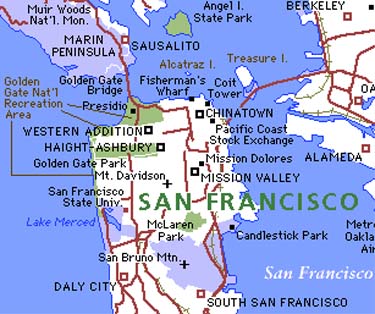
Sausalito, where Kristiina is
anchored,
is located on the top of the map. Bus to San Fransisco
dowtown takes 30 min. and costs 3,10 $.
|
22.10.2004 San Fransisco
/ Alameda, California, USA
Our departure is delayed. Presently, we are in a marina reparing
damage caused by British SV Vanessa Rose, which run into
us after dragging her anchor in early Monday morning. A gale warning had
been given, and during the night it started to blow. Not too much, about
30 knots, from south. The open and shallow bay was soon affected by 3
feet (1 metre) waves, which became very sharp and nasty when the tidal
current was against the wind. At 4 am we moved to cabin sofas from our
v-berth where it was too restless. Hannu didn't sleep much, he was
keeping watch. When it had just become light in the morning, we heard a
bang. A 50 feet fiberclass boat had bumped into Kristiina. We rushed out
into rain and wind, and started to blow the horn. Nobody came out from
the boat, so we thought it was empty. The boat was stuck from its stern
to Kristiina's bow. It's dinghy was on port side and the boat on
starboard side, bow towards Kristiina's stern. Its whole weight was on
our anchor chain. We continued to blow the loud fog horn, and finally a
sleepy and confused man came on the deck. We shouted to him to start the
engine, which he did, with the help of a big generator sitting on the
aftdeck. So everything was taking time, while the boats were madly
smashing each other. We tried to prevent the beating with fenders. It
wasn't easy, the boats banging with such a force. Kristiina's sturdy
bowsprit was hammering Vanessa Rose. Pieces of styrox were floating on
water: Vanessa Rose's life buoy. Vanessa Rose was unable to get away,
she didn't have enough power to back. At last Hannu forced Kristiina
forward - after Vanessa Rose's dinghy had been moved to the other side -
and the two vessels came off. We started to lift the anchor, and the
skipper got Vanessa Rose up to wind after drifting a while.
The pulpit of Kristiina bended and came almost loose. Teak toerails were
broken and the hull got a few deep scratches. Vanessa Rose's backcorner
stanchion was bended, flagpole and antenna came off, and the life buoy
was destroyed when its holder was bended. All in all, very little
damage. It could have been worse, fortunately nobody was hurt. The
British skipper didn't have an insurance, so we made a deal that he pays
a slip for four days, so that Hannu can repair our damage. Good deal for
him. On Thursday we motored to Fortman Marina between
Alameda and Oakland. Price level here
is different than in Sausalito, a slip costs only 15 dollars per night.
Also the boats look different (normal!) than in the rich area. And the
people have been very frinedly.

Vanessa Rose, 50 ft and 35 tons, in next day's
sunshine.
She has
a 45 lbs CQR. (Kristiina, 26 tons, has a 60 lbs CQR.)
The boat weights are in
pounds, the eq. figures in kg are 16 and 12.
Although the marinas in
Sausalito are full of luxorious yachts, in the anchorage you can find
boats like this:
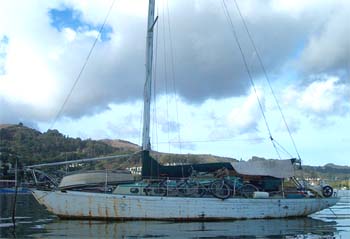
We said goodbye to
Sausalito, as well as to Claude and Dominique on Apollo. Patago
and Miss Sohie we will meet in San Diego, if not under
way. We had a lot of fun together in Sausalito, here one moment in the
cockpit of Kristiina:

Sylvie, Jean, Claude, Dominique, Verena, Harald
26.10.2004 Alameda, California, USA
Five days we have been working on the boat, and tomorrow, Wednesday,
it's time to leave towards San Diego 450 miles away. The repare of the
damage took only one and half days, but we have been taking the
advantage of the slip by doing a lot of other things as well: removing
rust, painting, washing, waxing and cleaning the boat inside out.
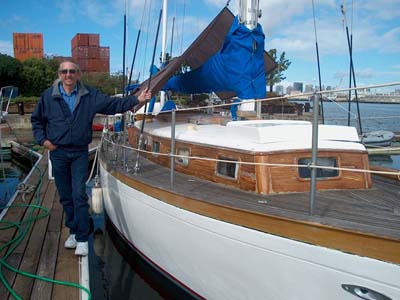
Our neighbour in Alameda, Robert, helped us with a lot of things.
Thanks!
2.11.2004 San Diego, California, USA
Four days and 450 miles behind. We arrived to San Diego on Sunday
morning. We had very light winds, from behind though. Usually the breeze
started in the afternoon and it lasted until midnight. Either spinnaker
or main and genoa+pole spread on each side. The nights were gorgeous:
full moon, bright stars, no fog. In the first night we saw the full eclipse
of the moon. That was beautiful! Slowly the shadow of the earth
covered the moon and it became a huge, orange ball floating in the
space. The next full eclipse will be in 2007.
Also Patago and Miss Sophie left San
Fransisco same time with us. Patago arrived to San Diego six hours after
us, Miss Sophie 24 hours later than Patago, because they had stopped on
the way to wait for better wind. 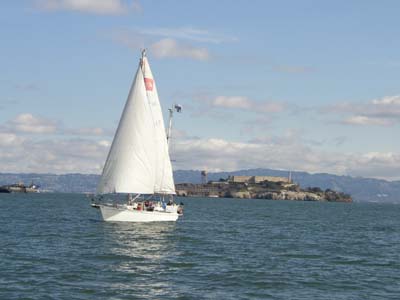
Kristiina in the Bay of San Fransisco. On
the background is
Alcatraz, the former prison island. Photo:
J-F André
Before we got ashore in San Diego, we
were anchored in three different places. The anchorages are monitored by
the Harbor Police, and you need a permit to anchor. Each of the four
anchoring areas have own rules (for instance one, La Playa, is used only
on weekends), and the Police decides when some area is full or closed.
Next to the Harbor Police Office there is a municipal dock, only 10
dollars per night, so you can imagine it's a popular spot. Boats can
stay for five days, so fortunately there is a constant turnover. After
two days waiting, we got a slip, and writing this, we have just settled
in. Easier than life in anchorage. Next to us is a Swedish Swan - first
Scandinavian boat since New Zealand.
|

Glorietta anchorage and Patago.
On the background hotel Del Coronado, where Edward, the
Prince of Wales met Mrs Simpson, and where some movies have been
made.
|

Miss Sophie arriving to
Glorietta.
|
The anchorages are like
flyspecks in San Diego Bay. There are thousands of boats in marinas,
yacht clubs and moorings. We heard that you have to wait two years for a
buoy mooring. In addition, the navy is very visible in the Bay. An air
base takes half of the Coronado Island. We saw three gigantic aircraft
carriers. Fighters and helicopters are flying above the area, warships
and smaller navy vessels are using the narrow channel - as well as
police boats, coast guard vessels, tugs and cruising ships. It's a busy
bay. And the traffic on VHF is constant.
9.11.2004 San Diego, USA
Today we leave for Mexico! We cleared out yesterday, and in a couple
of hours we are ready to go. There is only 8 miles to the border and 60
miles to Ensenada, our first Mexican port. The forecast promises
normal light northerlies, so probably it will be a lot of motoring
again.
The week in the "policedock" has been very social. All the
twenty-some boats are heading to Mexico (except Patago, who will sail
directly to Panama). The atmosphere is different than is normal marina,
because all are transients and all are cruisers, will that mean several
years' cruising or the first trip to Mexico.
San Diego has a lot of boatgear stores and other services for boaters,
and the concurance must be hard. Customers are attracted by free
internet (good idea), with barbecue (free beer), lotteries and other
stuff.

Ready to go south!
There is enourmous amount of
information concerning Mexico: handbooks, guides, leaflets, magazines
and papers. Above that comes the
experiences and stories of sailors that have been there (or haven't).
Nowhere else have we met this kind of situation, usually you know a bit
of the country and its regulations, the rest will be clear when you
arrive. There is so much information, that you don't want to listen it.
But also we went for a piece of advice: we bought a liability insurance
(150 dollars). It's valid only in Mexico and the underwriter (company)
is Mexican, because that's how the story goes: marinas ask for the
insurance and it has to be local. I hope we don't have to test it in
practice.
Otherways we have been mostly turists again, visiting among other things
the aircraft carrier Midway. During its 47 years of service (from
World War II to the Gulf war) 225.000 soldiers have been aboard.

The flight deck of Midway can carry tens of
aircrafts.
Previous
- Next
|