|
12.12.2004 Melaque / Barra Navidad,
Mexico
We left Puerto Vallarta gladly behind and sailed overnight to Chamela,
a bay 97 miles south. We anchored behind a small cactus island, away from the
main anchorage with several boats. Chamela may remain the only
"private" anchorage for us in Mexico, so many cruisers there
are here. The next bay, Tenacatita had 26 boats at busiest - all Americans.
It's a bit weird: nowhere, not even in US, have we seen only one nation
represented. Well, Mexico is the
neighbour, that must be the reason. Among the sailboats were three
motorvessels, which tells something about the conditions here.
Chamela was very nice, in addition to the privacy. The island
with huge cactus plants was beautiful, although barren and dry. The only
negative thing was the stink from the bird poop: the island was full of
gannets, frigatebirds and vultures. The gannets were tame, they just
stared us when we were walking by. Birds were sitting on the top of the
cactus trees, obviously not bothered by the spines. Many plants were
worn out and bald, coloured white from the bird excrement.
In Chamela we finally got into the water,
swimming and snorkling. Sea temperature is approximately 27 C, no need
for any kind of wetsuit. Last time we had such numbers in Hawaii one and
half years ago. After Alaska we really appreciate the warmth again.
We found beautiful and healthy coral in the reefs close to the island,
and lots of various, colourful reef fish. Auli saw even a sea snake.
We celebrated the Independence Day (Finland 87 years) this time
not with Sibelius, but the following Finnish musicians: Edu Kettunen, J.
Karjalainen, Topi Sorsakoski, Juha Vainio, Eppu Normaali, Hurriganes, Vesa-Matti
Loiri, Samuli Edelman, Hector, Riki Sorsa, Kirka.
After three days and nights we motored (no wind) to Tenacatita 20
miles away. The thing in this bay is the "jungle river", a
narrow route surrounded by mangroves. Our canoe was perfect for the
trip. The river got narrower and narrower, and finally the mangroves
were touching each other above our heads, forming a green cave. It was
nice and cool. We paddled about two hours upstream and came out to a
beach full of cafes and a few modest hotels. We ate a simple and
inexpensive lunch and paddled back. Next morning we paddled to the beach
via seaside, ate lunch, and took the river back to the boat. That
evening we were in bed at seven.
From Tenacatita we motored
13 miles in flat calm to Bahia Navidad, Christmas Bay. It has two
different anchorages: a partly open bay opposite the small village of Melaque,
where we are at the moment; and a lagoon nearby the village of Barra
Navidad. We bicycled today to Barra Navidad. The village is pittoresque
and the anchorage shelterd, but there are more boats and hotter. We also
heard that the water in the lagoon isn't clean. In our bay there are
only three American sailboats, one from Alaska. Melaque has local
tourists and RV's (motorhomes). No, not from US, from Quebec Canada.
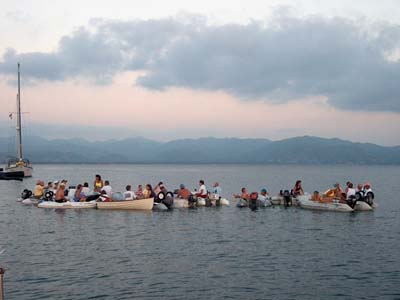
Twenty-some American boaters in
Tenacatita arranged
a dinghy-party one evening. We shy Finns didn't join, so the whole
gang drifted next to Kristiina to chat.
17.12.2004
Zihuatanejo, Mexico
This difficult name derives from Aztec words cihuatl (woman)
and tlan (place) i.e. the Place of Women. Spaniards added the
diminutiv nejo because of the small size of the bay. Name is also
referring to goddess cihuateteo. Z-town, as it's called among the
cruisers, should be a nice place. We hope so, because we are spending
almost a month here, including Christmas and the three- week holiday of
Auli's brother and his family.
After three pleasant days in Melaque we left for the 200-mile
passage to Zihuatanejo. Forecast promised fresh wind, but because we
didn't have any wind during the day, we anchored for the night near
Manzanillo. The first sailday was miserable: the wind rose to promised
15-20 knots, and further to 30 knots, which together with a strong
current made the seas very confused. Especially when the wind died in
the evening. The waves were like at Baltic Sea, coming from every
direction, beating Kristiina and killing the speed. The next day we had normal sea breeze,
which gave an average of 4 knots with main, genoa and mizzen staysail.
However, the 180 mile passage took 48 hours, it might be a record of
slowness.
The days were opposite also in terms of fish luck. First day we lost a
good size mahi-mahi, the best tropical fish in my mind. It was
already hooked, when the line broke and the fish fight itself lose. We
felt bad, also for the mahi-mahi, because it had the lure and hook in
its mouth and a bleeding hole in its body. Mahi-mahi is a fighter, it
jumps and kicks. The excitement and joy was at top the next morning,
when another mahi-mahi caught the line. And this was big! We were wiser
from the previous time, and Hannu fight one and half hours with the
fish, trying to tire it down. Finally we got it up! The fish was kicking
in the cockipit so that we had blood everywhere and the fish hook was
broken. It was almost five feet long and weighted about 35 pounds
(according our rusty weight, hm). Lifting a heavy fish aboard over the
aft pulpit and windvane is not easy. That's the critical moment, you
think you have it, but while you are hoisting the catch, it gets free.
|

Mahi mahi or dolphinfish
(coryphaena hippurus)
has beautiful colour and is very tasty tropical fish.
|

A bit cleaning to do afterwards.
|
On Sunday, the 12th of December, is the
day for Virgin of Guadalupe,
the dark skinned Virgin Maria. We were by coincidence in
Melaque and saw the village parade: dancers, players and town people
singing and carrying flowers. The legend of the dark Virgin Maria dates
back to 1531, when an Indian man, converted to catholic faith by the
Spaniards, was walking to a mass. The Virgin revealed to him, telling
that a temple should be built for Her. The man went to see the Spanish
bishop, who didn't believe the story. On his way back, the Virgin
revealed again, saying that if the man would take roses to the bishop,
he would believe him. The man was wondering where to get roses in this
barren land, but saw for his astonishment that the usually dry hill was
full of flowers. He picked the roses, took them to bishop, who now
believed him. A small temple was built in Tepeyac, same place where
conquistadors had destroyed an Aztec temple. The Vatikan recognised the
miracle in 1745, and in 2002 the Indian man, named Juan Diego when
babtised, was declared as a saint. His mantle is kept in a basilica,
which was built in 1976 to same place than the original temple. The
Virgin of Guadalupe gathers about 15 million pilgrims to Mexico City
each year, which makes it one of the most popular pilgrim destinations
within the romancatholic church. (Source:
The Colony Reporter.)
|

The Virgin of Guadalupe
|

Many villagers wore traditional
costume
|
|

Different dance groups were...
|

...participating the parade.
|
MERRY
CHRISTMAS! - FELIZ NAVIDAD!
1.1.2005 Zihuatanejo,
Mexico
Happy new Year. Sorry about the delay in updating, the holiday streched. Also the Christmas Day news from Asia made
our life look small and it felt idle to tell about every-day things. We
have cruiser friends in Thailand. Opposite to so many, the sailors
survived: about a hundred yachts were able to escape the tsunami waves
from Phuket anchorage to the open sea. Among them our Swedish friends
s/y Li and s/y Elenor.
On Christmas Eve we went out for dinner with Miss Sophie's Harald and
Verena. The food was middling, margaritas watery, bill wrong and service
slow. But the soft sand under the feet, rush of the waves, moon in the
sky and good company made the evening superb.
|

Hannu saved a pelican that had a fish
hook
in it's bill and wing.
|

First the bird struggled, but then it
maybe realised
that it is helped and was calm. Hannu had to
cut the hook in three parts to get it out.
|
After Christmas we moved from Zihuatanejo five
miles south to Marina Ixtapa. Ixtapa is only hotels and tourist services.
On the late 1970's it was decided to improve and invest on tourism in
Zihuatanejo. Local people opposed building hotels in town, so the construction
plans were moved to Ixtapa. A good decision, Zihuatanejo maintained its charm.
Marina is dull and hot, but we were able to use water as much as we liked (in
Zihuatanejo you get only drinking water in 20 litre bottles), and we could leave
Kristiina safely when we took an overnight trip to Acapulco to meet Auli's
brother and the family.

In Ixtapa only crocodiles and fish are
swimming.
In the evening we saw a big croco close to the boat.
It was interesting to drive inland, through small
villages. The 240 km (150 miles) trip took four hours, and an additional hour
driving through Acapulco to the airport. We thought that an easiest way to find
a hotel was at the airport. Wrong. Acapulco's airport is very small and the only
information desk was national aviation board's, where the girl couldn't speak
English. Back to the road to ask. Nada. Nothing. All the hotels near the airport
were full. We were already desperate, when things arranged like they do only in
Mexico: we rented a whole house! With less money than two double rooms in a
hotel. Next we had to buy drinks to the fridge, because the house lacked room
service. Our inquires about a crocery got a very peculiar answear, Auli was
dubious on her Spanish. But it was a peculiar system. A wall around the
neighbourhood had a hole and there was a rope. When you pulled the rope, a bell
rang in the shop, and the shopkeeper came to the hole. By road it was a long way
to the crocery. System a la Mexico!
|

We couldn't find hotel rooms, so we
rented a house!
It had two big bedrooms with bath.
|

Line in the crocery window
|
Antti, Kristiina and Anni arrived
according the timetable after 24 hour trip from Helsinki. Anni was very pleased
to have a private swimming pool and a late night swim. Next day - after a
morning swim - we drove to Ixtapa and on the New Year's Eve we anchored in front
of the Isla Grande beach. It's a busy place in the afternoons but fortunately
quiet other times.

A reading hour.
8.1.2005
Zihuatanejo, Mexico
Remarks of Mexico by Anni,
10 years:
In Mexico, there is so hot, that you don't need warm clothes. In Mexico,
some food is so hot, that you should consider before tasting. In Mexico,
musicians ask people in restaurants if they want to listen to music.
Jewellery sellers stroll on the beaches.
Life in Zihuatanejo
We have been living on
beach, either on one of the many Zihuatanejo's beaches or at Isla Grande,
9 miles from the town.
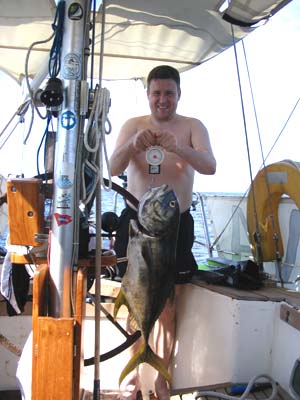
Antti got a 7 kg (15 lb) jurel,
yellowtail.
The meet was red and it was used for a wok with vegetables.
* * *
Story of the tsunami waves
by Boris and Lisbeth on the Swedish sailing yacht Li.
At about 09.30 (local time) Boris had coffee in cockpit with some friends, Jerk from
Vindela and Tord from Yana. Suddenly ha asked "what's going on among the boats"?
All the boats in the bay were turning around in different directions. Jerk and Tord took their dinghies back to their own boats for watching them.
A swell lift the boats and went to shore. We watched our little beach and it was absolutely full of water. Because of high tide and full moon we thought, that was the reason. But when it returned we understood, this was something special. Afterwards we saw two cars, moved by the swell, standing on the beach.
The second swell reached the small restaurant, where we had our Christmas-eve-party, and even filled the big beach in front of us. Boris guessed "this must be a Tsunami or something like that". The third swell was the biggest one and when it reached shallow water it raised to a wave and splashed over the wall on the biggest beach and took all the small restaurants and shops, the chairs and umbrellas, the massage-tents and trees into the sea. We were also watching the sad desolation of our small restaurant. It went to the sea including everything in it, and the two cars and another one was tumbling around like toys.
There came more swells, but for the bay of Nai Harn it was over. The fancy resorts are more protected and have only small damages.
One small resort and village, on a third beach not sighted from us, all the small bungalows were totally destroyed and even the road rails were damaged.
We have heard that seven people lost their lives in our bay, and compared to what has happened in other bays this is a low number.
What did happen with all, more than hundred, yachts during the swells? Nothing! We were anchored on 15 meters of water and just followed the water up and down.
Our opinion is, that it is much safer to be at sea.
During our travel, the last days, along the coast up to Ao Chalong and Phuket Town, we have not seen big damages and the life seems to continue with selling and serving along streets and beaches, as usual. The Thai people are very kindly, very hard working and very many and we must remember, this is their only way of earning money.
Boris & Lisbeth, s/y Li, Nai Harn, Phuket 07 46N 98 18E
Previous
- Next
|