|
16.1.2005 Acapulco,
Mexico
Days in Zihuatanejo and Isla Grande passed by quickly, and on
Tuesday morning, the 11th of Jan., we hoisted anchor and turned
Kristiina's bow to Acapulco, 100 miles south. Already in the morning we
had wind, but southerly, so we motored in the light headwind. In the
afternoon we were able to cut the engine off for times, but it wasn't
until night the wind got up so much that we were sailing.
|

Looking for souverniers.
Handwoven wollen
rugs by the Zapotec Indians.
|
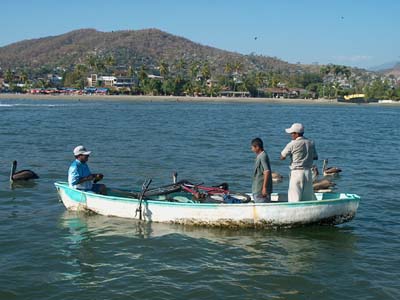
We gave the bicycles we got from Patago
to the fishermen in Zihuatanejo.
|
In terms of animals our sail was
fruitful: we saw several seaturtles, a big whale, a lot of dolphins, and
two sharks. We had seen turtles before, but from a distance, they
usually dive, but now we saw a mating pair who was too busy to escape.
They were quite big, the greenish-yellow shell was about one metre (3
ft) wide.

Mating turtles. The most common species in this area
is green turtle, which can lay 500 eggs in a term.
(Photo: Antti Irjala)
The Bay of Acapulco, a
couple of miles wide, is shelterd but hot, as is the million city itself.
Fortunately Club de Yates
is like a green oasis in the middle of dust and noise. We didn't leave
the Yacht Club area if not necessary. The days were spent by the
swimming pool and lunches eaten at the club restaurant. What a luxury to
a cruiser! The Acapulco Club
de Yates is the first international yacht club in Mexico,
established in 1955 (so they celebrate the 50th anniversary this year).
The first class service included everything, even huge, soft towels. There
is a gym, but we were content with "water gym", i.e. playing
dolphin and whale games with Anni.
The rate is about the same than in the marinas of Puerto Vallarta and
Ixtapa, 42 dollars per day (incl. potable water and power). We left
happily the clearance for the Yacht Club, even it costed 63 dollars, but
we wanted to spend the last, few days together and not run around in the hot town.
Five persons in a 37 feet boat - hot! Kristiina has five bunks, but if
we all slept inside, it was like a sauna. So Hannu ended up sleeping in
a hammock on the deck for the whole time, and rest of us circulated the
bunks according to where Anni happened to fell asleep or which place
someone wanted to try. Kristiina looked like a camper with two
hammocks, a lot of drying clothes and other stuff on the deck. In
Zihuatanejo our guests rested two nights in a hotel, and in Acapulco
they wanted to do the same. A resonable hotel with aircondition was
found near the Yacht Club, so after the dinner we said good night and
separated. At 01 am we woke up hearing Antti's voice. What is he doing
here? He wasn't alone, all three had come back to the boat in the middle
of the night. The hotel had been cheating: they got another room - a
small and stinky - than the one they had checked out earlier that day.
After complaining, they got even a smaller one, without
aircondition. When they opened the window to get fresh air, million
mosquitos rushed in. Forget the hotel.
Also cooking for five persons in 34 C turned out to be painfull -
especially for the cook. It was easiest to eat in a restaurant. A dinner
with drinks for five people costed 500-1000 pesos (45-90 dollars). In
Mexico the price level is variating: with 5 pesos (45 cents) you get a
filled tortilla by a street vendor, an hour in internet, ten bread rolls
or one kilo (two lbs) tomatoes. With 15-20 pesos (about 1.50 $) you take
a taxi from the yacht club to downtown, get 2 kilos clothes washed, or
drink a beer in a bar. With 100 pesos (9 $) you buy a bottle of tequila,
get a footcare or buy six ice-creams.
|

No salt or sticking jellyfish
in freshwater pool!
|

The tidy and luxorious yacht club
was
a welcomed brake to cruiser life.
|
|

Long pants and socks...
|

...and towards Finland.
|
It is believed, that the
name Acapulco derives from the Aztecs,
although the rich valley was ruled by the fierce tribe of Yopes
until the arrival of Spaniards. In 1523, the Spanish named the bay Santa
Lucia, according to the saint of the day. Whatever the name, the
sheltered bay offered the Spaniards a splendid harbour and a place for
building ships. Later Acapulco became the hub of the westward
expeditions, which finally led to Asian trade. Many ships left without
returning, until a priest, Father Andrés
de Urdaneta, sailed back from China loaded with silk and other
valuables. After that, the arrival of a Manila galleon started a trade
fair, to which people came all the way from Spain and Peru. The
treasures temptated pirates, among them Sir Francis Drake.
Drake missed the Asian galleon, but robbed the town of Huatulco thoroghly, even
taking the church bell, in 1579. Where Drake had failed, Thomas
Cavendish succeeded. He captured the ship Santa Ana in 1586, and
got such a booty, that the gold coins alone -1.2 million pesos, depressed
the London gold market.
In 1821, after the Independence war, Acapulco had a population of 3000
and consisted mainly grassroof huts. The fights had been hard on the
people. In the middle of 1800's the bay started to gain wealth
thanks to many steam ships that stopped here - the traffic to north had
started. A hundred years later the beauty of the bay temptated
travellers. The first luxury hotel was built in 1933. Presently, the
once clear sea is dirty, but still the shores of Acapulco are full of
hotels and tourists. (Source: Bruce
Whipperman: Acapulco. Moon Handbooks 2004.)
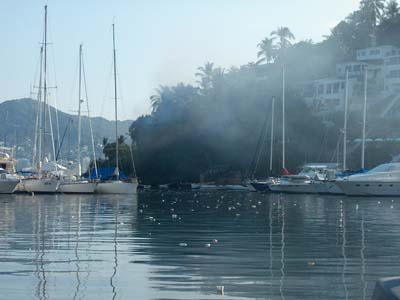
Burning garbage stinks. All the rubbish
doesn't end up to fire,
however: the white spots in the water are mainly plastic bottles.
23.1.2005
Acapulco, Mexico
We made a trip to the capital, Ciudad
de México. The idea we got from Swedish couple on sv Stargazer,
who had been there and liked it. The bustrip from Acapulco took 5 hours
and costed 290 pesos per person. From the busstation we took metro (2
pesos) to downtown, and popped up on the ground to a huge plaza, which is
the heart of the oldtown. What a difference! It was cool, because
México is located on an altitude of 2 km. The Swedes had adviced us to
take warm clothes, a good thing because it was unthinkable in the heat of Acapulco. The
central plaza, Zócalo, was like in some former East-European country.
Massive, dark buildings surrounded the huge area, in the middle stood
enormous Mexican flag. The feeling was emphasised by a leftist
demonstration with red flags and march music (I think they even played
International). We took a hotel near the plaza. A tidy room on 3rd floor
with a French balcony costed 240 pesos per night. Then we started the
touristlife.
.
The central plaza, Zócalo, is 200 m per
side.
In the middle a huge Mexican flag.
When the Spanish Hérnan
Cortés and his troops in 1519 started the conquest of
Central Mexico, the area was mainly ruled by the Aztecs. This tribe, who
called themselves méxica, had left Aztlán, an area in northwest in
the 1100's. Aztecs subdued other indian tribes, among others the
Toltecs.
The conquest of Aztecs is one of the odd stories of world history. They
were fierce warriors and they were numerous. The 500 men and 16 horses of
Cortés were not a big threat to the best warriors of Mesoamerica, but a
legend became to be their destruction. It was the legend of the plumed
serpent god, Quetzalcóatl, and to tell that we have to go back to Toltecs' era.
In 947 a Toltec prince was born, called Topiltzín, who
became a wise and educated ruler of the city-state Tula. Contrary to the
common habits, Topiltzín opposed human sacrifice. This made him popular
among the people, but hated by the priests. People started to call him
living Quetzalcóatl, the incarnation of plumed serpent
god. The priests tricked Topiltzín and he had to leave Tula in 987. He
sweared to return on the annniversary of his birthday. According to the
story he rose to sky and sailed east.
When Cortés was proceeding towards the capital of Aztecs, Tenochtitlán,
he got allies from other tribes that were not content with the Aztec
rule (finally totalling 100.000 men). However, access to Tenochtitlán
almost without fights happened because Cortés played Quetzalcóatl,
the plumed serpent god. Also Aztecs believed and were afraid of this
god, and maybe for good reason because they were the masters of human
sacrifice. Cortés was pale, bearded, he opposed human sacrifice, and
arrived on the right year - everything matched with the legend. Moctezuma,
the ruler of Aztecs wanted to save his people from the revenge and anger
of the plumed serpent god, and therefore he let Cortés into Tenochtitlán.
That was the beginning of the Spanish victory. Cortés had a local
interpreter, negotiator and lover, Doña Marina or Malinche,
who later bore him a son. It's likely that she had a crucial role in
talking the tribe chiefs to Cortés' side, and using the plumed serpent
legend.
Tenochtitlán fell finally in 1521, after different
phases and happenings, but the main thing had been the Spaniards' easy
access into the town. It would have been very hard town to conquest. It was like
Venice, located on 2 km altitude, surrounded by mountains, in a rich valley with lakes. There
were 200-300 thousand inhabitants, five times more than in London that
time. There is a legend about Tenochtitlán as well. One of the Aztec
gods announced that if they would worship him and establish a town to a
place pointed out by the god, they would become the rulers of the world.
The god would point out the place in a form of an eagle, a snake in its
mouth. This happened. The Aztecs arrived to Lake Texcoco and saw an
eagle sitting on an islet in the lake, a snake in its mouth. (Mexican
flag has an eagle sitting on a cactus branch a snake in its mouth. This
is the national emblem.)
The main
source: Talvitie & Mujica:
Meksiko ja Keski-Amerikka. WSOY 1995.
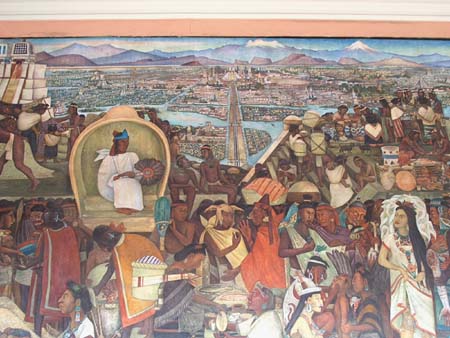
One of the Diego Rivera paintings in Palacio
Nacional
depicts Tenochtitlán.
The centre of Tenochtitlán located in
the centre of present Ciudad de México, in the plaza where we first
came. Of the Aztec buildings only the ruins of one temple, Templo Mayor,
are left as well as some amount of stones, because the Spanish torned
down the buildings and used the stones for churches, houses and paving
the plaza. On one side stands Catedral Metropolitana,
which construction began in 1573. The ruins of Templo Mayor was
digged out in the 1970's, and it's the only Aztec building left in the
centre. The construction started in 1375 and it got several layers
during the years.
|

Cathedral dominates one side of
the central plaza, Zócalo. Construction took 250 years.
|

Templo Mayor was located next to
present cathedral. Only stone walls are left. It is said to be
on the exact place where the eagle sat a snake in its
mouth.
|
First day we saw the sights of the
oldtown. In addition to the previously mentioned two temples of
different cultures, we visited Palacio Nacional and Palacio de
Bellas Artes. Both have works of Diego Rivera. It was
a great experience to see his genuine paintings. Palacio Nacional is
home to offices of the president and treasury, and it has some ten huge
wall paintings presenting the history of Mexico that Rivera painted in
1929-35. They are fabulous! In the Palacio de Bellas Artes, which is a
concert hall and art centre, are paintings from other
"muralists" as well, but the most interesting was Rivera's "El Hombre, Controlador del Universal"
(man, controller of the universe), which Rockefellers in New York
ordered and later destroyed because of its anticapitalism. Rivera
recreated it to Palacio de Bellas Artes in 1934. No Diego without Frida,
so we visited the suburb of Coyoacán where Frida
Kahlo and Diego Rivera lived. The house is nowdays a Frida Kahlo
museum.
|

"Frida and Diego lived in
this house 1929-1954."
|

It was not allowed to take photos
inside, but even this patio gives an idea of the rich colours.
|
The second day we made a trip 50 km
north, to an area which used to be the city of Teotihuacán.
It was mainly built between 250 and 600. During the hightimes it had a
population of 85.000. Presently, only the religious centre is
left, including two high pyramides and 2 km long "street of the
dead". The pyramid of Sun gains with its 70 metres hight the
position of the 3rd tallest pyramides in the world. It was built around
100 AD. Two hundred years later the pyramid of Moon was built, a
bit lower though. On the contrary to the pyramides in Egypt that are
tombs, these were built to worship the gods. The temple was on the top,
and there was nothing inside the pyramid. For some reason Teotihuacán
was abandoned in the 700's, but it remained as a pilgrim site. Also the
Aztecs visited the area.
|

248 steps to the top of the Sun
pyramid.
|

Moon pyramid is at the end of the
Dead's street.
|
Two and half full days in México. Then
we took the bus back to hot Acapulco. It was a memorable trip that
changed our belief of México as a dangerous and polluted city. The
little we saw, oldtown and a few suburbs, were like in any metropole.
Our eys and noses were running, skin dried, and Hannu got a flu - maybe
because of the polluted air, maybe because we suddenly came to a cool
climate.
Now we ready to leave Mexico, but that happens 250 miles south, in Huatulco,
which is a good place to wait for weather to cross the bay of the
infamous Tehuantepec.
|

A view from our hotelroom to Avenue
5 de Mayo.
|

Polluted air.
A view from the 44th floor of Torre Latinoamericana
|
27.1.2005 Huatulco, Mexico
This is the last update from Mexico. We arrived to Huatulco, a small resort
and tourist town, on Thursday morning. We will clear out of the country here. We
have ahead of us the Gulf of Tehuantepec, and then either El Salvador or
Nicaragua - or both - we haven't decided yet.
The Gulf of Tehuantepec is located by a narrow isthmus. Only 200 km of
land separates the Pacific from Gulf of Mexico, Atlantic. The isthmus is
surrounded by mountains creating a wind funnel: when there is a northerly wind
on the Gulf of Mexico, Tehuantepec has a gale or storm. January is the worst
month, and in general there are 140 stormy days in a year (every 4th day). Storm
can last a day or a week. Boaters gather to Huatulco to wait a "weather
window", i.e. less windy conditions to cross the 260-mile wide bay. Sailing
out to the sea is no use, 50-60 knot winds can reach 100-200 miles offshore.
It's best to stay close to the shore, because even you would be catched by a
"tehuantepecker", waves are not rising too high close the land.
|

When a high pressure builds over Texas
Tehuantepec has a storm.
On right: March 2003 Tehuantepec experienced
record winds. Note how the wind arrows jump up
from calm to hurricane force.
|

triangle = 50 knots, arrow = 10 knots
|
Previous
- Next
|