|
26.2.2005 Panama City,
Panama
Circle - or more precisely a figure eight -
was completed on Thursday, 24th of February, when we arrived to Panama.
Three years we have been sailing on the Pacific Ocean. Two times across,
and lastly 8000 miles along the coast. Mileage is same than Ellen's
around-the-world trip (which is, by the way, incredible achievement),
27.000. Here is some statistics:
| Panama - New
Zealand |
8300 |
May 2002 -
November 2002 |
6 months |
| In New Zealand |
1700 |
November 2002 -
April 2003 |
6 months |
| New Zealand - Alaska |
7900 |
April 2003 -
August 2003 |
3 months |
| Autumn in Alaska |
1000 |
August 2003 -
November 2003 |
3 months |
| Cordova - Aleuts
- Sitka |
2600 |
April 2004 - July
2004 |
3 months |
| Sitka - Panama |
5500 |
August 2004 -
February 2005 |
7 months |
It was a big relief to
arrive to Panama. Actually, not until now we realised how stressful the
long sail and tight schedule had been. We passed Costa Rica, but stopped
a hundred miles before the Gulf of Panama in a solitude and beautiful
bay to rest and wait for good weather to gross the Gulf. The wind is
almost always blowing from north in the Gulf of Panama, usually 20
knots, and there is also a strong south setting current.
The anchorage was a paradise. It was wonderful to be alone. We swam,
read and rested. We explored the two small paths that started from the
beach, but they didn't lead anywhere. We made a fire on the beach and
cooked baked potatoes. We watched pelicans dive and wondered jumping
rays. They made high jumps into air, three times around or five metres
ahead flapping their "wings". Funny. We tried to see monkeys
making noise in the trees, but couldn't catch any by binoculars. The
last morning we had a swim and Auli saw a shark! Fortunately we were not
far from the boat, Auli was by the stairs, Hannu on the other side.
Despite that he came up faster than Auli. We watched huge, dark creature
and the surface cutting fin coming closer to the boat. We got goose
flesh despite the heat and a killer shark movied started to roll in our
heads. The shark was big, about half Kristiina (18 ft) and very dark. We
have only a fish guide from New Zealand waters, and the only big shark
is Basking Shark, but was this it or just some other big shark, we don't
know. But it was creapy, that's for sure. Especially after splashing in
the water several times in a day. What if Auli hadn't seen the fin...
|
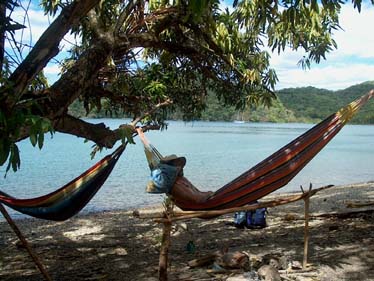
It was so hot in the boat that we moved
to the beach for the midday hours.
|
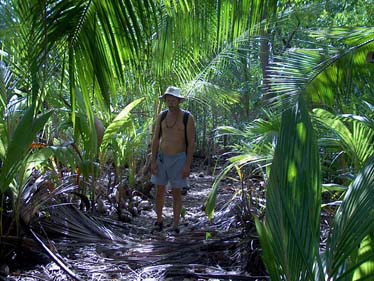
We had arrived to rainforest. The dry,
brown scenery changed to green in Costa Rican coast
|
After three relaxed days the
weather fax forecasted five knots wind to the Gulf of Panama, so we
hoisted the anchor. We rather wanted to motor in light winds than spend
ages tacking. By the infamous Cabo Mala it was blowing 20 knots, but the
wind decreased quickly and we motored and motorsailed the 100 miles of
the gulf. On Thursday morning we approached the Flamnco anchorage, and
what we saw, a Finnish flag! The first one we have seen on our trip. It
was Arctic Lady, a 40 feet steel sloop, with Ari and Eija
aboard. They have been 10 years in the Mediterranean Sea. On the deck
was also Jukka, their crew, whom we had met three years ago here. It was
great to meet Finnish sailors. Arctic Lady had transited the canal a
couple of days earlier and now the Pacific was waiting. We invited Ari
and Eija for a dorado dinner, we had got a nice catch of mahimahi
previous day. There was a lot of talk and we even knew same people.
Arctic Lady is originally from our yacht club, Sindbad.
The Finnish company wasn't there, however. Next day another Finnish
boat, Marita, came through the canal. We had met Irmeli
and Tapio three years ago at the home of our friends in Buenaventura,
Atlantic side. We could maybe count s/y Noomi to the gang
also, with a Finnish skipper although a Swedish flag. So there was nine
Finnish speaking sailors on Friday night at the Balboa yacht club bar.
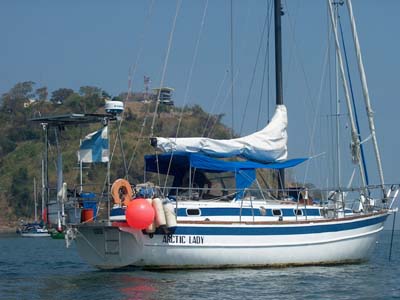
Arctic Lady - the first Finnish yacht we've met - is originally
from
Sindbad, but has been 10 years in Mediterranean and last two in
Caribbean.
6.3.2005 Panama City,
Panama
The week has gone quickly, taking care of paperwork, helping and
socialising with other Finns. We are so happy to talk our own language
and share the cultural background, that we haven't made friends with
other cruisers. The farewell pizzas for Noomi was eaten on
Thursday, and on Friday Jarmo, Hannu and Junnu set off to Galápagos. Arctic
Lady went on hard to Balboa Yacht Club for bottom paint and
lifting the waterline (seems to be the task for every cruiser :-). We were
helping with the haul-out, which was done by a cradle (sledge?) moving
on a rail. The second attemp was succesfull, on the first one Arctic
Lady was too far back and leaning to other side. The yard is small, there is room for two boats.
|
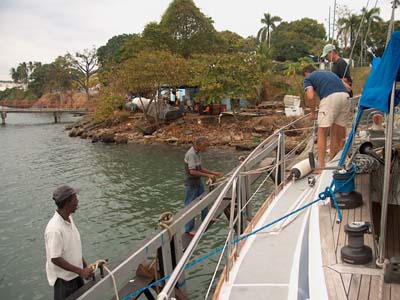
Ropes tight and up on the land
|
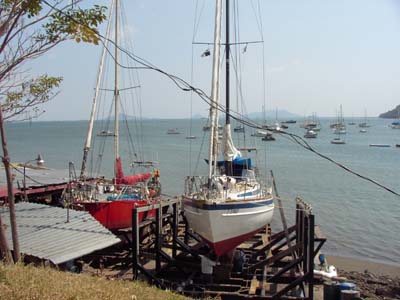
The Balboa Yacht Club yard can
take two boats
Photo: Eija Luoma
|
Clearance took two days.
First we took a cab to Port captain's office, because the vessel control
Flamenco Signal informed that no officials are coming aboard Kristiina and we
should do the clearance ourselves. But the papers have to be made on the area where
the boat is, so we drove back to the anchorage with the officer. No
need to go on the boat, however, we sat in a small cafe by the dinghy
dock. Paperwork costed 30 dollars, we even got a receipt, but heard
later that it maybe wasn't fully "official" payment. We got a
ride to the Immigration office, where our passports were stamped, free.
On Monday we went to maritime authorities for a cruising permit. It's
valid three months and costs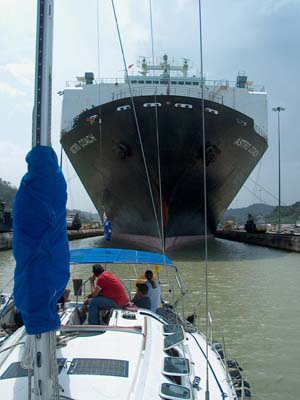 69 dollars. After a trip to bank to
change a 100 dollar note, we were done with clearance. Next to the canal
office. We were asked to fill in our request on the computer. Because we
have transited before, our data was already there, and there is no need
to measure Kristiina again. There is a rumor that you should be able to
make 8 knots (three years ago it was 6 knots), otherwise they double the
fee. How hard we tried it wasn't possible to change the 6 to 8 on the
computer file. We'll see what happens. Few sailboats can make 8 knots
with a crew of five, full of proviant in headwinds.
Even Kristiina didn't need a measurement, chocks, fenders and ropes have
to be inspected. After inspector's visit you go to the bank and after
bank you enter the line. The same happened than three years ago: the
inspector didn't arrive the day informed. After one and half days wait
and two phone calls a big pilot boat dropped the officer on our deck. In
addition to the inspection, the final papers were made. There we put 8
knots as top speed. The inspector reminded that you get fined if you
don't make it. However, it's worth to take the risk. Especially, because
lately all the boats have been transiting in two days, overnighting on
Lake Gatun.
On Friday morning we paid the fee - or rather made a visa reservation
for 1450 dollars. After transit they withdraw either 600 dollars, which
is the normal payment for boats under 50 feet, or more up to 1450
dollars, if something, like a delay, has occured. Actually it's a good
system. If you pay cash you have to wait for the refund. On Saturday we
got our preliminary date, 19th of March, but it will change. We are
ready to transit in any way: center chamber, nested, along a tug or
sidewall. Most boaters avoid the last because they are afraid of
damaging the boat or spreaders. But it might speed up the things. We
have 8 huge fenders found on the strands iof the Aleuts and 6 tyres, so
those should keep Kristiina out of the wall.
Our canal experince from three years ago is found here,
dates 7. and 12.5.2002.
The construction of the Panama canal
began by the French in 1881, but in 1901 France gave the task up because
of financial problems. USA bought the construction rights from the
French in 1902, helped Panama to gain independence, and rented the canal
area. Canal was opened in 1914 and USA was in charge of it until year
2000. The canal is 40 nautical miles long and has six locks, three on
the Atlantic side and three at the Pacific side. The locks are double
chambers, so traffic is possible two ways at the same time. Between the
locks is 30 miles long Lake Gatun. A lock chamber is 33,5 metres wide,
305 m long and 26 m deep. It can take a 294 metres long ship with a
draught of 12 metres. More info www.pancanal.com
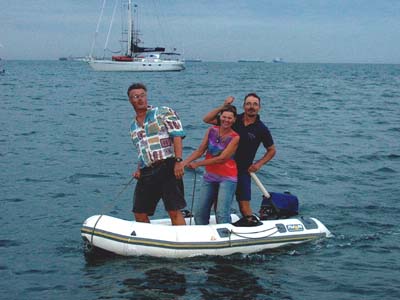
Dinghy style by the Arctic Lady: Jukka, Eija
and Ari coming for a visit.
15.3.2005
Panama City, Panama
Our transit date is still Saturday, the 19th of March, although for a
while we were told the 17th. Time has gone by waiting and provisioning.
Panama is much cheaper than the next stops Bermuda and Azores, so we
will fill up the stocks. Hannu has been helping sv Marita.
A new autopilot was installed, but before it was tested several
drawbacks happened. First the windlass didn't work, then next two
mornings the engine wouldn't start. On the fourth day they were able to
motor out to calibrate the autopilot. Hannu had a busy week.
On Thursday, the 10th of March, Arctic Lady hoisted anchor
and set sails for Ecuador and onwards to Galápagos Islands. Farewell
party and skipper's birthday was celebrated in the already familiar
pizza place (tasty pizzas for 3.50 to 7 dollars, on Mondays two for
one).
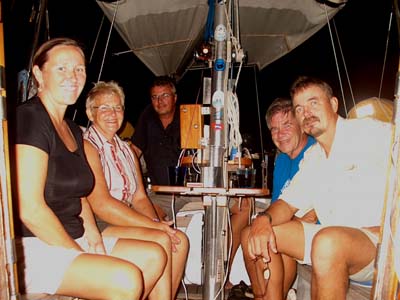
The post-farewell party in Kristiina:
Auli, Irmeli, Jukka, Tapio and birthdayboy Ari.
Finally we also met our Panamian friends,
Heka and Marja, who picked us up on Saturday. We went
wholesale shopping and came home with 12 litres of milk, 8 litres of
juice and considerable amounts of beer and wine. A beer can costs 32
cents and a wine packet 1,50 dollars. Cheap.
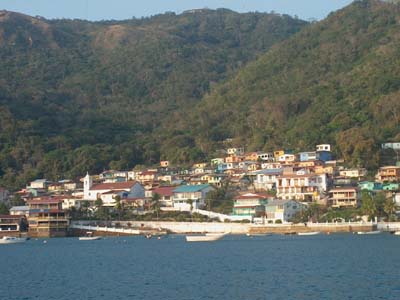
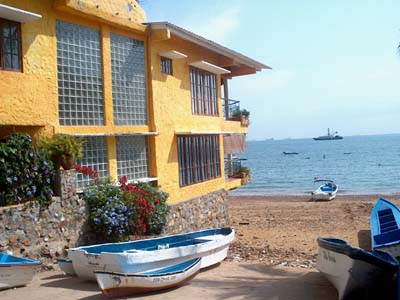
The idyllic Taboga village is only one
hour's trip from Panama City.
On Sunday we left to Taboga Island
seven miles away. On weekends it's very popular destination. Beach was
full, music loud and jet scooters fast, but on Monday we woke up to a
peaceful morning: we were the only boat in the bay. It was good to get
out from the Flamenco anchorage, where we had already been two and half
weeks. And the best, on Taboga you can swim, which is not temptating in
the dirty Flamenco. Water was lovely and cool, 27 C (air is 34 C). Hannu
cleaned the bottom, which had some growth and barnacles. Also Marita
arrived to Taboga, after we had told on VHF about the pleasant place.
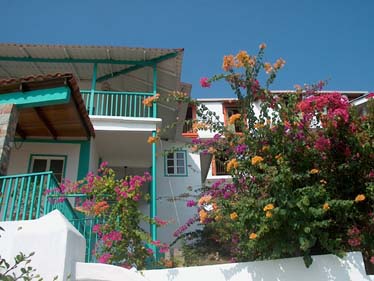
Taboga has a small village, which is tidy and beautiful. Houses are
painted with bright colours, and there are flowers everywhere (the
island is also called Isla de Flores). Spanish settled the island in
1515, only two years after Vasco
Nuñez de Balboa and his men had made their way across the
isthmus.
Energetic redhair, Vasco
Nuñez de Balboa, first arrived to Caribbean as a stowaway on
a Spanish ship in 1501. Ten years later he used the same travelling
method to come to Panama. Balboa started to explore the land and look
for gold. In 1510, he established a Spanish village, Santa Maria la
Antigua, in Darién. It was the first European settlement on the
American continent. Balboa was named as the temporary governor of
Darién. He continued expeditions, and couldn't forget what Indians had
told him about a sea behind the mountains. In 1513, Balboa took hundred
Spanish soldiers and as many Indian porters and left. The journey
through the dense jungle took three weeks. On the 25th of September
Balboa alone ascended on a hill from where the Pacific Ocean was seen.
However, he named it the South Sea, Mar del Sur. Balboa continued the
expedition along the coastline, and he also later explored the Pearl
Island, Islas las Perlas. The rest of his life wasn't as succesful.
Before Balboa's letter telling about his achievements reached the king,
a permanent governor of Darén was named. He was Pedro Arias de Ávila,
who hated Balboa, and finally got him executed in 1519. The same year
Pedrarias, as Avila was called, established Panama City. Nowdays Balboa
is one of the suburbs in Panama City.
Why pacific? The incorrect name was
given by Portuguese Ferñao do Magalhães (Ferdinand
Magellan) after sailing from South America to Philippines in 1520-21,
where he died. But Balboa's South Sea wouldn't have been much more
precise name for the largest ocean of the world, if not for the south
part.

Balboa's route across the Panama isthmus
in 1513.
21.3.2005
Buenaventura, Panama
Friday, the 18th of March, was our transit day. So the waiting time was
exactly two weeks. The previous day we cleared out from Balboa, as we
had been told to do. Should not have done that, too much hassle that
costed 10 dollars. First we filled up a form and gave the crewlist. Two
papers were made, and we got a receipt for 4.20 but had to pay 8.20 $.
Stamps were shown for the remaining 4 dollars, maybe same ones strolling
around that office. Then we went with the papers to another office, and
filled another form. Number of crew was asked and we said two. But these
papers were just for the Balboa-Colon passage, ie. the canal, where the
minimum number of crew is five. So presumably we should have had a
crewlist with the names, passport numbers and birthdates of our
linehandlers. Well, we didn't (and I wonder how many does!). The
situation was explained to a very angry boss, who kept repeating about
the crewlist. Finally we made a crewlist of five names without more
detailed info. A receipt was written, we paid 1.50 $
and got a zarpe. Earlier on the week we were visited by a sanitary
inspecor and had to pay 15 dollars.
|
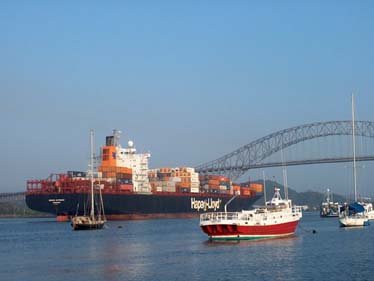
The mooring buoys of Balboa YC are very close to shipping
lane. Fee is 0.35 $ per feet.
|
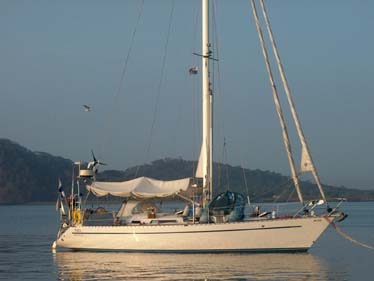
Irmeli's and Tapio's S/Y Marita, Pendrick 40
|
At six o'clock in the morning the Flamenco signal
called us on VHF to confirm our position. We were at the Balboa Yacht
Club, at one of the outer buoys next to shipping lane, so we were
allowed to wait for the advisor there. At seven the launch brought
captain Manuel
Mendieta aboard. Irmeli and Tapio jumped in from
Marita next to us, and the fifth linehandler, Heikki, had
arrived the previous evening. We headed towards the first lock.
Manuel was excellent advisor. We were nervous because of our experience
three years ago, which was a big hassle. But we started to relax when we
saw how competent and calm Manuel was. He has been at sea for 9 years
and is presently working as a tug boat skipper. Manuel started to arrage
the fenders and lines, and gave very precise orders. We went to the
locks alongside a 100 feet motor yacht, which in turn was tied to a tug.
The raft was untied after each lockage. It was easy to us, because we
only had to see that we were tightly tied to the
motorboat, and that the fenders were on right places. The motorboat had
all her fenders on the other side, but the big crabpot buoys we had
found in the Aleuts were enough. The yacht had a professional paid crew,
which also made everything easy. The two locks of Miraflores and one of Pedro
Miguel took Kristiina 26 metres above the sea level.
|
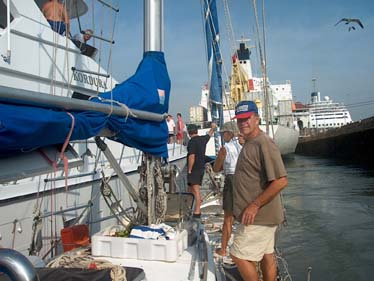
Miraflores lock side by side a big motoryacht.
You go up behind a ship.
|
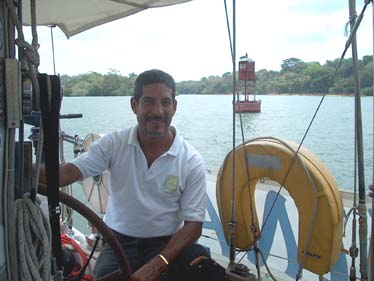
Our advisor Manuel was calm and competent,
couldn't been better.
|
After the first three locks we had 30 miles motoring along
the Gaillard Cut and across the Gatun Lake. We were worried again. No
way we could keep even near the motor boat's speed. Hannu was also
worried about the engine cooling. Running full speed rised the
temperature to 100 C. But there was no reason to worry. Six knots would be
enough, said our advisor, the lockage is not until 3 pm. The average
speed was 5.5 knots and the temperature didn't rise over 88 C. Manuel was
steering giving Hannu a break. We had salmon salad for lunch, later
coffee with applepie.
|
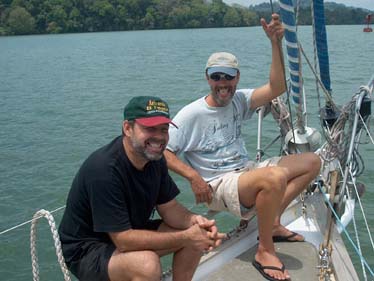
Lake Gatun and no worries.
|
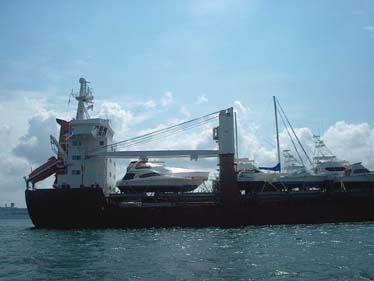
This is another way to move your boat from
ocean to ocean.
|
We were at Gatun locks around 3 pm, but
the schedule was a bit delayed. We would get down at 4.30. "Time to
relax", said Manuel. We moored on a buoy. Hannu and Auli went
swimming (no crocodiles in sight). It was good to swim in fresh water.
Also the motoryacht was waiting - had been for several hours - and for
some reason it remained there when we started proceed towards the locks.
This time we went sidewall, which means that we had lines from bow and
stern tied to canal bollards. Linehandlers gave slack when the level of
the water is descending. It is easy, there is no turbulence when you go
down. Behind us was a small passanger ship. There are three lockchambers
and the total height is 26 metres. By the dimlight were on the Atlantic.
Relief!
|
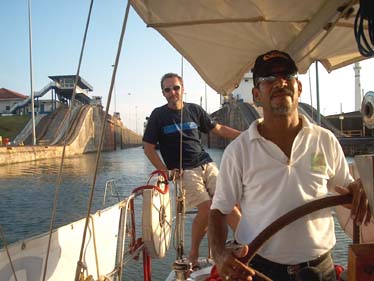
In Gatun locks our advisor was at helm and the skipper was
taking care of the stern line.
|
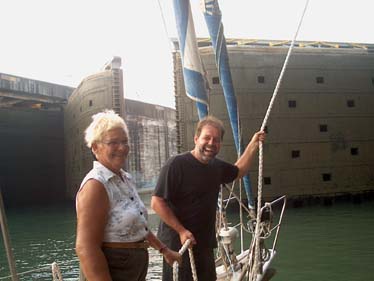
Bow linehandlers Heka and Irmeli
|
We motored to Colon Yacht Club and right
away there were people asking for our tyres. There is less traffic from
Pacific to Atlantic, so you almost have to fight for the tyres. Heikki
went home, Irmeli and Tapio stayed overnight. We went for a dinner to
the yacht club, and first what we heard in the restaurant, was Finnish.
SY Mindora from Helsinki was waiting for a transit. On
this side it can take a month.
On Saturday we cleaned the boat, filled watertanks, and tacked in 15-20
knots headwinds to Buenaventura. It was odd to anchor in
shallow water, we have only half metre under the keel. But there is hardly any tide. This is Atlantic!
Happy
Easter!
30.3.2005 Colón,
Panama
We spent a lazy Easter with Marja and Heikki in Buenaventura. Hannu
fixed the leaking inflatable thrid time, but other than that we didn't
do much. One day we drove up to a monkey institute, where Heikki is
working, and saw howler monkeys. They were so high up in the trees that
I couldn't get any photos. On Tuesday we sailed back to Colon Yacht
Club. There were two Finnish boats, Necesse (Avance 36)
and Satu III (S&S 38). Both are going around the world.
|
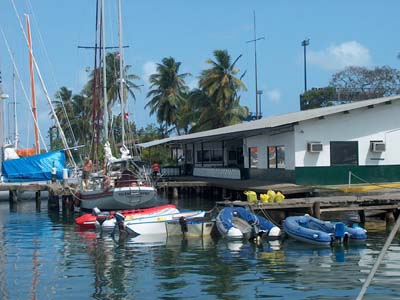
Colon Yacht Club. Slip costs
0.65 $ foot.
Nearby is a free anchorage, "the Flats".
|
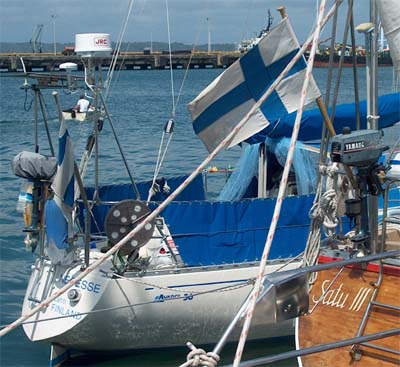
Necesse and Satu III
|
We are heading north, home. There is
still 7000 nautical miles, as much as from Panama to New Zealand.
Because of the NE tradewinds, we are heading first to Cuba. Some tough
people sail (i.e. tack) east from Panama - like our French friends
Sylvie and Jean, and they did it in December storms - but we are not
that tough.
|
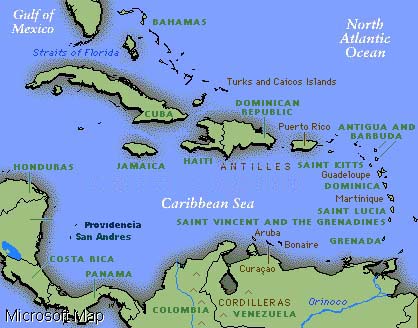
The route goes from Colon to
Providencia, a small Colombian island.
From there we head to Cuba but might stop in Mexico, either on
Cozumel
or Isla Mujeres. From Cuba we sail between Florida and Bahamas
to Bermuda. The Gulf Stream is giving some extra knots, but
if the wind veers north, the sea builds quickly (wind against
the
current) and then we might have to stop at Bahamas.
Because of NE trades and strong currents the route between
Cuba and Haiti is not a good option.
|
Distances:
Panama - Providencia 280 nm
Providencia - Cuba west tip 540 nm
Providencia - Cozumel (Mexico) 530 nm
Cozumel - Cuba west tip 150 nm
Cuba west tip - Havanna 180 nm
Havanna - Bahamas 300 nm
Havanna - Bermuda 1100 nm
Bermuda - Azores 1800 nm
Azores - England appx.1300 nm
England - Helsinki appx. 1500 nm
Panama - Providencia - Cozumel - Havanna - Bermuda - Azores -
England - Helsinki appx. 7000 nm
|
Previous
- Next
|