
San Blas Islands are located 70 miles east from Panama canal
Main page (English) - Main page (Finnish) - Logbook index - Latest log
Panama 2.4.-12.5.2002
updates: 2.4. 17.4. 24.4. 26.4. 3.5. 7.5. 12.5.
2.4.2002 San
Blas, Panama
The sailing from Cuba to Panama, 760 miles, took one week and was pleasant
after we had adjusted to sea life again. The last long sailing was on the
Labrador Sea, a half year ago. No wonder it took a couple of days to get the
right balance and to get used to short sleeps. It was new to sail amost naked, we got
some bruises and wounds without covering clothes and shoes.
The night to Sunday we arrived to the San Blas islands, which are
located about 70 miles east of Panama canal. There are a couple of clear and
wide entrys in the reefs, so we decided to sail in at night, although there are
warnings about sailing among the reefs in the dark. A year ago a Swedish boat
wrecked here at night. Because we had not planned to visit San Blas, we had only
some kind of chart on computer and a pilot book we got from Maciej in St. Pete.
Passing the reefs went well, but when we came closer to the anchorage we had
chosen, we got trouble. According to radar we were close some islands, but GPS and chart told
other way. In the cloudy night with a little moon light we could see three tiny
islets with some palm trees, which gave no protection from the 25 knot wind.
Very near we could hear the reefs. We decided not to go in a such place. We
started to motor towards Povernir island five miles away, we would
have gone there anyway in a couple of days, because customs is there. There is
also an airstrip. GPS and chart told that we had still a mile to the shore,
when Hannu shouted that we are close, almost on the shore already. On the other
side of us was a big reef. Then we figured out that our chart is not accurate.
Earlier I had wonderd the coordinates the pilot book gave to the anchorage, but
thought that they were incorrect. The radar does not lie, so we enterd the half
mile broad entrance with it. Soon we saw other boats and anchored near them. It
was two o'clock in the morning.
At six, when it lightens, I stood up to see in which kind of place we are. At
the same time a small boat came to us and the man told that we should move -
away from an aeroplane. We had anchored at the end of the airstrip! Povernir is
not a big island either, but there is the 400 meters long airstrip, a couple of
houses and a palm tree forest.
San Blas Islands are located 70 miles east from
Panama canal
San Blas is the autonomous area of Kuna indians, named Kuna
Yala. After
bloody rebellions, Kunas got an autonomous position in the area in 1938.
There are about 55.000 Kuna-indians in Panama, which has 2,5 million
inhabitants. Kuna Yala is divided into three districts, each having an elected
chief. The governing is based on Carta Organica,
the constitution. Local matters are dealt in each village by its chiefs, who
have daily meetings in a special meeting house. The important chiefs lie on
hammocks while less important have to sit on hard wooden benches. Previously
only men went to school. Therefore the elderly Kuna women do not speak Spanish.
Nowdays all the children go to school. Women are wearing traditional colourful
clothes, a red scarf covering the head, golden jewellry including a nose ring,
small colorful pearls around legs and the mola, an embroidered blouse
front. Nowdays mola means all kind of embroydery work from masks to small pieces
of different figures, which the women try to sell to the numerous visiting
yachts. Men are wearing western clothes, which usually mean sun faded t-shirts
and caps. Kunas use narrow canoes made of one piece of wood. Very few have
motors, paddles are used against the wind and a small sail with the wind. Kunas
live in reed huts, either in the small isolated islands or in villages.
We visited Wichubhuala islands
next to Povernir. Basically, the island is one village, where narrow, tidy paths
wind between the reed huts. The school and some other buildings are made of
concrete. The village has three shops, and when we were looking for bread, a man
pointed us to come with him. Through the paths we ended to a house where an old
woman sold us still warm bread - it is delicious. This saved us some extra heat
which baking in the boat produces. We found some food fill up from the store,
but there was nothing fresh after the Easter. For a while I had a packet of
butter in my hand before I realised that it would smelt before we were even near
Kristiina.
After we cleared in (alltogether 100 US!) on Monday, we left Povernir and
motored to the same place we first tried at night. Now we had learned that an
island means a low sand mound and some palm trees, and not so much protection
from the wind. There is a good sand bottom to hold the anchor, reef to protect
from the waves and swell, and the ever blowing wind is cooling down.
Today we visited the family, alltogether 12 persons including grandparents and
two generation of sisters, living on the nearby islet. According to the Kuna law
the land is owned by everybody, but each palm tree has an owner. Therefore you
should not pick up coconuts here.
|
|
|
17.4.2002 Colon, Panama
Before reaching the canal, we visited Heikki and Marja Rissanen
on the Bay of Buenventura, where they live with their 13 dogs.
They came to this place 10 years ago after carrying cargo around the Caribbean
with their ship Rebecca. We were going to do a quick visit, but Heikki
took us to a three days jungle river trip, which we did not want to miss. And it
turned out one of the best experiences on our trip.
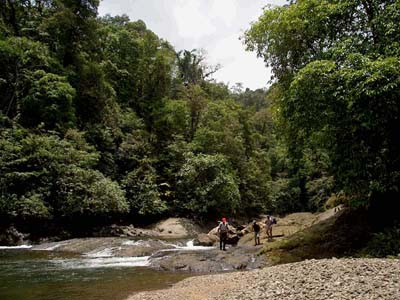
First we, Heikki and another Finnish guy Jorma, walked up to the mountains with a horse carrying our backpacks, so that
we would not get tired right away. From the top we went down to the other side,
and across the forest to the river. The river is the only walking path in the
steep walled and dense jungle. And that is not easy either with all the stones,
rapids, deeps and ponds. Sometimes we used an hour for making a 50 meter
progress, sometimes we had to wade in the water up to our armpit. We had endlessly
pure and tasty drinking water - in which we also swimmed when we got too tired.
 |
 |
We spent the first night in an uncredible beautiful natural spa. Round bath
tubes have been formed in a small fall, creating natural jacuzzis. The whole
thing ended to a bigger pond where you could swim and dive all you wanted. The
view was magnificent with the river coming down and surrounded by luxuriant
jungle slope with several different plants and trees. We hung the hammocks to
couple of lonely trees, lighted the camp fire and had our first hot meal that
day. The noise from the rapids covered most of the jungle voices, but we admired
colorful butterflies and fire beetles when it got dark. Even we were tired of
the day's walk, we tried to catch the river shrimps. Their eyes burned as two
red dots in the light of a torch. We tried to catch them with a hook and shorizo
sausage, but maybe it was too spicy for them, we got none.
The hammocks temptated and soon we were asleep, maybe giving a thought or two to
a jaguar and wild big before that. The bottom of our cloth bed didn't seem very
safe, even smaller teeth would go through that. But we woke up without any
teethmarks, sound and happy, only the unused muscles felt yesterdays walk.
 |
 |
 |
 |
The most curious animals we saw were spider monkeys, who started to shout to us,
probably nasty things. Especially the biggest male was very upset and shaked his
fist at us. However, more dangerous animals were the black-and-green poisonous
frogs and a small, green snake, on which Auli almost stepped. The most funny
animals were small lizards who "walked on the water", at least it
seemed so when they quickly moved from stone to stone sliding on the water.
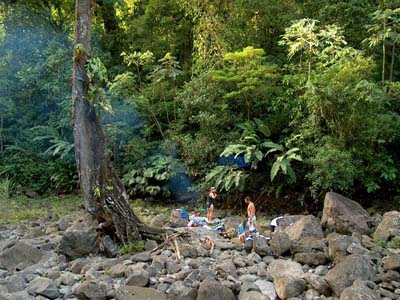
Our second camp was made into the forest, because there were no suitable trees
by the riverside. There the small creatures, cockroaches, ants and a huge spider
were too much for us two, and we moved beside the camp fire. But that was a fine
experience too, fallimg asleep while watching the stars and fire beetles. The
next day we walked the last bit of our way, and the scenery turned out softer
and easier. And the animals were mostly bulls.
After we had recovered one day, Heikki and Marja had a new idea: we went riding.
Well, they have seven horses. This was new for us. Auli got a calm horse, but
Hannu's Puru was eager to run and jibbing. But uncredible well he stayed on the
back of the horse, even then when it run wildly under a low tree branch. Hannu
threw himself to the other side of the horse like an old cowboy and made it.
Afterwards he showed who is the master.

With sore buttocks were hoisted our anchor the next day and sailed to Colon, to the dock of the Panama Canal Yacht Club. Here we started the arrangements for the canal passage. The measureman is coming on Thursday. We do not know our date yet.
24.4.2002 Colon, Panama
A week and a half have gone with arranging all the necessary things. The
admeasurer did not come when agreed, but the next day, and just because Auli was
looking after him patiently and almost pushed him to Kristiina. It was Friday
afternoon, so the next phase, paying the fee, moved over to Monday. Now we have
got the canal date, it is the 2nd of May, but might change.
It seems that everything here is unsure.
Some of the horros stories about the canal and yachts are true. On Monday two
boats were damaged because of powerful turbulence caused by a ship's
propeller. The center boat of the three yachts raft got it worst: it's deck was
cracked.
Also the rumours of rising the fees are true: from the 1st of May onwards the
yacht have to do the passage in one day, otherwise fined by an extra 440
dollars. From 1st of June, 50 dollars will be added to the fee. At the
moment the price for a boat under 50 feet is 550 dollars. A 900 dollar
deposit has to be paid as well. That is no limit for extra costs, f.ex. breaking
your engine can be costly: towing is 1000-1700 dollars per an hour. So our
Perkins is better to run all the 50 miles!
At the Yacht Club we are like in a
voluntare imprisonment. Outside the gates waits the Colon jungle, where you
should not go by foot. Some of the streets in the city centre are ok, but the
zone from the marina to the centre is hazardous, and you have to cross it with a
taxi. It feels funny to take a taxi for a couple of hundred meters trip, but
this is the safe way. A taxi costs one dollar.
26.4.2002 Colon, Panama
Things change rapidly: we will stay in Panama at least until the 10th of
May, when we get crew from Finland. Lissu Karvonen is sailing with us to the
Marquesas. We change our canal date with two Finnish guys, Riku and Iiro, who
are in a hurry. We might go through in their date, the 8th of May. For the
while, we will sail back to the Bay of Buenaventura.
3.5.2002 Buenaventura,
Panama
We celebrated the First of May like the Midsummer in Finland: having a
sauna, smoking fish and eating herring. Hannu has been scuba diving with Heikki.

Going to a restaurant
is easiest by the dinghy
Next to Buenaventura is Portobelo,
which served as a Spanish tradeport since the 16th century. Silver, gold and
other treasures were stored to be shipped to Europe. The Portobelo bay is an
excellent nature harbour, and the place is surrounded by hills from where it is
easy to protect the town. But despite all this, the port located a long time in Nombre
de Dios, which gave little protection and had a bad holding. The
villagers, merchants and captains complained about this to the king, but it took
almost 70 years after establishing the village in 1519, and numerous ship wrecks
before king Filip II gave permission to move the village from Nombre de Dios to
Portobelo in 1585. He sent an Italian to plan the fortifications around the
becoming village.
The history Portobelo and Nombre de Dios is connected with Sir Francis
Drake, El Droque, who robbed the Spaniards with the permission of
the queen Elisabeth.

Today Portobelo
is visited by many yachts
Francis Drake (1540-96)
was a son of a protestant clergyman, and he hated catholics - especially the
pope - as well as the Spanish ruling in the new world. Drake began his career at
sea as an age of 23, on his cousin's, John Hawkins' ship, which made
basically slave trade. Drake become a skillfull seaman, navigator and fighter.
When Drake attacked the first time Nombre de Dios in 1572, he had already a
fearfull reputation. This trip got a misfortunate end, Drake was wounded and he
had to be carried to the ship. No treasures were captured by the pirates.
This embarrasment made Drake even more eager to get the valuables of the
village. After a year he planned an other trip together with the cimarrones,
escaped black slaves. This time they attacked on the road where the mules were
carrying the treasures from Panama to Nombre de Dios. But they failured again.
In addition, many Drake's men, including his two brothers, died of deseases
after being in the jungle.
The next robbery was made to a warehouse, but it turned out to be full of papal
pardons, which made Drake furious, and he burned them all. Besides he was
wounded.
It took almost twenty years before Drake attacked Nombre de Dios again, in 1595.
In the meantime he had made a successfull attack on the mule caravan and sailed
back to England with the booty. He had sailed around the world (1577-80) and
joined to the destroying of the Spanish armada in 1588.
In Nombre de Dios most of the village had moved to Portobelo by the time Drake
got there, and nothing valuable was left. The pirates burned the village and set
out to a safe island. In the beginning of the next year, Drake got ill. He died
on the 27th of January 1596 and was buried into the sea in front of the
Portobelo bay. His lead coffin has not been found, although the exact position
can be found on the log. Also Heikki has spent five years systematically diving
the coffin.
7.5.2002, Colon, Panama
We have made a false start and been on the waves of the Pacific, although
Kristiina is still on the Atlantic side. On Saturday the 4th of May we were
linehandlers on Riku's and Iiro's Cassandra. The alarm went at 3.30 am and after
12 hours we were on the Pacific side. We entered the first lock about 8 am with
two other pleasure boats and a ship. The Panama canal has six locks. The three
first, the Gatun locks, are one after another, and they rise the boat 26 meters
above the sea level. Between the locks is the Lake Gatun, where you should not
swim, there are alligators. However, there is no time for swimming or stopping,
because the transit has to be done in one day. The canal is 45 miles, of which
the lake takes about 30 miles. On the Pacific side there is one two-locks
system, the Pedro Miguel, and the last lock is the Miraflores. There are a
couple of tourist boats which drive back and forth the canal, so anyone can
experience the canal.
Panama canal seems to be easier than its reputation. The lockage was normal. Our
experince from the 45 locks in America included some more exiting moments. F.ex.
in the Welland canal the water comes more quickly, it's boiling and bubbling
making the boat to toss. Bay Springs and Kentucky on the Tenn-Tom are three
times as high as one Panama lock; there you really feel small. Once we were in
the lock with two tug boats and the water turbulence almost sug Kristiina on the
wall.
But still, there are accidents - at least in Panama, maybe the others are not so
widely known.
Our turn in on Wednesday, the 8th of May.
Heikki and Marja join us as linehandlers, in addition we take one of the locals,
because there has to be four crew members besides the captain. We have ten tires
wrapped in plastic waiting, we got them from a guy who just passed the canal.
Enough ropes are required: four 40 meter long, 18-20 mm lines. They can be
rented in the yacht club with 15 dollars a day. We may rent one.
We got back to the Panama Canal Yacht Club on Monday, to do the laundry
and buy some food again. We got about ten kilos of mangoes and 20 coconuts from
Heikki's and Marja's garden. Hannu got a mackerell on our way, and we gave a
part to a Swedish boat in the harbour. They had kept an eye on our tires,
because even these are an object of trade: plastic wrapped tires cost three
dollars each.
We still have to tell one not so funny thing: we found a cockroach in Kristiina.
I doubt it's the last, because it is really hard to avoid them even if you would
be careful with everything you take onboard. Cockroach traps were added to our
shopping list.

Ready for the Panama Canal
12.5.2002 Balboa, Panama
ONE YEAR ON THE VOYAGE!
Kristiina's canal transit started with the delay of the advisor.
(Pleasure boats are taken through the canal by an advisor, who does not have the
same responsibility than a pilot; the captain of the vessel has the full
responsibility through the whole canal.) When the advisor launch at last took place at
7.30 am, got both boats, Kristiina and an American Sandy Lee, two advisors. It
was a training transit, a younger advisor took over under the eyes of an older -
who was in his 30's (!). Four advisors was not a good combination, it was hard
for them to share the opinions. In addition, our advisor, Edwin, was clearly nervous. We
started to motor between two big ships towards the first locks. We were supposed
to tie the boats together before the lock. We left the American boat behind us,
and soon we heard five toots, they were too close the ship coming behind. We left
the channel and waited for them alongside a pier. There we would also tie the
boats together, said our advisor. Good idea, there we would not disturb the
ships and we could do it in peace. But the advisors of Sandy Lee disagreed and
drove by. So off the ropes again and to catch them. Next there was disagreement
on which side the boats will be tied. While all the shouting we were getting
closer and closer the big ship and two tug boats manouvering to get the ship
into the lock. When the side was decided, happened the bounding as chaotic as
the beginning and the result was that our spreaders were almost touching and
there were two springlines the same way. More shouting. We drifted closer the
ship and the tugs. At last the boats were tied together properly, and it was
time to back because we were very close the ship and the current was pushing us
even closer. But it was not easy to manouver, two skippers and four advisors
makes six opinions. With Kristiina's engine on reverse we stayed almost still,
and when the American also figured out to put his engine on reverse we were
backing.
Then it was our turn to drive into the lock, beside a tug boat. As a steel boat
Kristiina acted as a fender for the plastic Sandy Lee. The confusing advice and
two manouvering boats caused a heavy touch to the tug boat's side and one of our
railing post twisted. Hannu drove the next two lock without listening to the
advisors and telling the skipper of Sandy Lee to have his engine on free. Then
everything went well. The locking was normal, but every time leaving the chamber
we had to release our draft from the tug and bound to it again.
On the lake Gatun the boats were separated and everything calmed down. We were
cooking lunch and admiring the scenery. No alligators in sight, however. An hour
before the last three locks, at 1 pm, the advisors announced that we have to
stay in Gamboa overnight in anchor and the transit would continue the next day.
What!? The canal administration demands pleasure boats to make the transit in
one day, with a 440 dollars ultimatum, but now we are left between the locks.
Begging did not help, there was no ships to go down with, was the explanation.
Our friends Heikki and Marja, who were linehandlers, had come the night before,
and at home waited the dogs alone. Our fourth linehadler was a local man called
Dracula (!), who costed us 55 dollars per day. Heikki and Marja managed to
arrange a "dog-sitter". Dracula went home for the night, and we had to
pay him the extra 55 for the next day. If we had had four hired linehadlers and
four hired ropes, the cost for the day would have been 280 dollars - that twice
makes even more than the actual canal fee, 550 dollars.
So we spent the afternoon and evening at the lake. Swimming trips were short
because of the alligator danger, although we didn't see any, despite that Heikki
and Hannu tried to temptate them with some chicken.
The next day a new, more experienced advisor came onboard at 10.30 am. A third
sailing boat had arrived last evening to the anchorage and we all three went
together through the last three locks. The 50 footer, three masted schooner in
the middle. We got a special arrangement without any ships - don't know the
reason. In the last two chambers there were also a French boat and a tug, both
tied to the wall. In the last lock, the Miraflores (where the internet camera
actually is located), the lockmaster started to lower the water before the
French boat had fastened it astern rope. In a second, the boat turned around,
bow heading to the lock wall. The skipper started to turn the boat with the
engine, and for a while it seemed that it will crash into the wall. In the last
moment the boat turned, but then it stared to come backwards, on our ropes. The
shouting was even more loud and luckyly the skipper could stop the boat and the
lines were tied. It was quite a relef to drive out of the last lock and get rid
of the other boats.
We have gone through 45 Canadian and American locks without a scratch, and now
in Panama canal happened the first accident - twisted railing post - on our
whole trip. It is a small thig. But still.

The first lock: Kristiina beside the tug, on the
other side the
American Sandy Lee
We left Marja, Heikki and Dracula to
the Yacht Club of Balbo. For a while we chatted with Iiro and Riku, who were
still in Balboa because of a broken rigging screw. Riku was just on his way to
buy new ones. Then we motored a couple of miles further to a free anchorage near
the Flamenco Yacht Club. And slept 12 hours.
It feels quite unbelieveable to be on the Pacific side. There is only 40 miles
of canal to the Atlantic, but menatlly it is far away. That much bureaucratic,
costly and risky the Panama canal is.
On Friday, the 10th of May, Cassandra with Riku and Iiro got under
their way towards the Marquesas. The guys came to say goodbye and we took the
last pictures, if we don't meet in Tahiti. We will keep in touch via the SSB
radio.
In the evening we picked up Lissu at the airport. She had travelled 24 hours
from Helsinki, had one fog with a cancelled flight and one broken plane with a
cancelled flight. Being persistent she got on to another flight and all the way
to Panama.

