In front of the Capitol you can choose a taxi you like
Main page (English) - Main page (Finnish) - Logbook index - Latest log
Cuba 31.1- 24.3.2002
updates: : 5.2. 11.2. 21.2. 24.2. 4.3. 12.3. 20.3. 24.3.
5.2.2002 Marina Hemingway,
Cuba
We arrived on Thursday (31.1.) after a very rough night at sea. The 40 knot
wind against the Golf Stream created waves, which ended into the cockpit making
everything wet and salty. We got also a couple of waves inside the boat before
we tightened the valves. But the morning was beautiful, the sun rising behind
the Havanna silhouette and the shore sheltering the wind. At 8.30 am we moored
to the Customs dock and the authorities came one by one: health inspector, coast
guard, officials from the Ministry of Agriculture, immigration and finally the
customs with six men and two dogs. Everything was taken care of smoothly and
friendly, and after two hours we motored towards our dockage spot. Then we heard
a shout: Hey, Auli! There was our friend Outi. Amazing timing, it was a
coincidence that Outi was there, even if she knew that we would arrive one of
these days.
What to say about Havana? It's hard to describe. The cultural difference is huge
after four months in the U.S. We liked the style of life immediately, people and
open and sincerely friendly. The traffic fills air with exhaust fumes, and it
consists of everything from horse carriages to bicycles, from sidecar
motorcycles to western cars. The top is the old chevys and dodges from the 50's
of which most serve as "boteros", a kind of mini-bus, driving a
special route and picking people up from the streets.
The houses are almost ruins, but you can still see the old clory behind the
collapsed pilars and disrepair. The old town of Havana was declared as a UNESCO
World Heritage Site in 1982. The narrow streets are full of cuban music. The
city is a mixture of fancy tourist places and local life. And there is a dual
system: you can buy everything with dollars, which are, however, not available
to most of the locals. The dollar stores are full of everything, the peso shops
hardly have anything.
The U.S. embargo has limited the number of American tourists and by that
preserved the speciality of the town from overgrouded tourism - at least for a
while.
Havana was founded in 1519 by the Spanish Diego Velazquez as one of the
seven cities. Gradually, it gained importance because of it's geographical
position, and in 1607 it became the capital of Cuba. Havana - as well as Cuba -
has been an object for several battles during the centuries. Both the French and
British tried to capture the power from the Spaniards. The castle El Morro,
which is guarding the harbour mouth, dates from this era (the construction
started in 1590), as well as the city walls (1674-1740). The British succeeded
of conquering the city for 11 months in 1762.
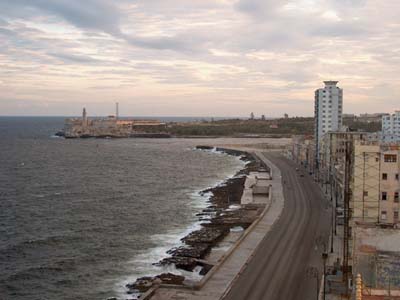
El Morro is also the traffic controll for the ships entering Havana harbours,
and the first thing you hear coming nearer the coastline, is the continous
Morro-calls on the VHF.
In present, Havana has about three million inhabitants.
In front of the Capitol you can choose a taxi you
like
11.2.2002 Marina Hemingway,
Cuba
This update has been done in Finland, where Hannu had to fly to participate
his brothers funeral. Our lucky trip has met it's first sorrow.
Hannu will be in Finland 12.-26.2. and he can be reached by phone 0400-417
357. Auli stays at the boat and will get company of her parents, who are coming
for a week to Havana.
A couple of days ago Hannu was doing a routine check for the boat. He
noticed something wrong with the steering system. A closer look showed that the
bearing was crushed. A call to Finland told that similar bearings are not
available anymore. The steering system of Kristiina is from a 1972 model
Volkswagen. Fortunately, it seems that one has been found in Turku, Finland.
The reason for the breaking is the autopilot, which is mounted to steer the
rudder. This is too heavy load for the steering system. Besides the new steering
system, we need to change the autopilot's motor to another model. If we cannot
find a used part, we have to buy the whole new steering column, which doubtfully
fits as such to Kristiina.
The first impressions of Havana have not changed in a week, this is interesting and quite unbelievable city. We visited Outi's friends, who served us a typical feast meal: fried pork, rice with black beans, fried potatoes and salad. On Tuesday night we were in a reggae concert, reinforced with a local rap band. The music was maybe not all the best, but you couldn't tell that of the high feeling. Even we stiffy Finns were dancing along. After Outi left back to Finland, we have concentrated on work: writing, laundry, maintaining the boat.

Marina Hemingway has some 200 sideberths. Behind is a hotel.
21.2.2002
Marina Hemingway, Cuba
The week with my parents was quickly over. We spent time both on the boat
and wandering around the city. We visited the Art Museum, the City Museum, and
the Museum of Revolution. Each had a lot of interesting to see.
The City Museum is located in the baroque palace Palacio de los Capitanes Generales,
built in the 1790's. It has served as a government building, a governor's house,
a president's palace and as a city hall. After the revolution it was made a
museum. The rooms are full of the most imaginative china, decorative mirrors and
chandeliers, magnificent wooden furniture and other exclusive things all over
the world. The museum is also presenting the early independence attempts on the
1900th century, including the first national flag.
The Museum of Revolution is located in the former presidential palace
and it exhibits all the phases of the revolution from the first attempts to the
days of establishing socialism. A special room is dedicated to Ernesto "Che"
Guevara.
|
|
|
The
largest island of the Caribbean was the home for peaceful Taino
Indians, easy to conquest by the Spaniards in the 1510's. When the
diseases and suicides destroyed the Indians, more slaves were brought from
Africa, to work on the sugarcrane fields. The tobacco and sugar industry made
Cuba as one of the world's most valuable colonies, of which the Spanish did not
want to give up, and which the British, French and Americans tried to get to
themself. Britain succeeded to conquest Cuba for 11 months, but the Paris Peace
in 1763 returned the country to Spain, who in turn gave Florida to the British.
The Spanish rule in Cuba continued.
Among the Cuban people rose a desire for
independence. The Spanish born in Cuba, the Creoles, were
uncontent with the heavy taxation and the government. The country was ruled by
the Spanish born in Spain. Between 1810-25 Mexico and the South American
countries had gained independence, only Puerto Rico and Cuba were still colonies
of Spain. The independent America supported the Spanish rule, the independence
of Cuba could have ment a slave uprising or problems with sugar trade. Twice USA
tried to buy Cuba from Spain, in 1848 and 1854.
The independence attempts led to a ten-year war in 1868-78. It ended to the
victory of Spain, but strengthened the national feeling and made an end to the
slavery.
The central chacarter of the next armed conflict was journalist, poet and laywer
José
Martí , who in 1895 returned to Cuba from exile to start an
independence war with general Máximo Gómez. Marti died just one
month later, and neither did this attempt lead to independence. José Martí is
one of the biggest national heroes. The famous song Guajira guantanamera
is his text.
The next battle was against the USA. It began when the US military boat Maine
exploded in the harbour of Havana in 1898. Americans blamed the Spanish, and
declared a war. It was soon over and Cuba was given to the USA.
Cuba gained independence in 1902, but both the economy and politics were tightly
in the hands of USA. Even the constitution was written so that it allowed US
intervention. The Guantánamo Bay military base was founded in
1903. Cubans had either to accept the constitution as such or be totally
occupated.
A serie of puppet governments and dictators followed. Corruption flourished and
black people we discriminated. The US companies owned two thrds of the farming
land and almost all the mines.
The general strike in 1933 dropped president (dictator) Machado off
power and gave it to the army general Fulgencio Batista. First
he was ruling behind a puppet president, but in 1940 he was elected as a
president in legal elections. After four years, again in free elections,
Batista's candidate lost. He tried a come-back, and to ensure it, he did a
military coup just three months before the 1952 elections. This prevented an
almost certain election of a young Ortodoxo Party candidate to the
House of Representatives. He was 25 year old Fidel Castro. USA
recognised Batista's coup.
The ingredients for the revolution were ready. The millionaires of Havana were
the richest in Middle and South America, while there was huge population of
undernourished and illiterates.
The first armed attempt was made on the 26th of July 1953, which
later became the name of the movement. The army base in the Santiago de Cuba was
attacked by 119 rebellions. 55 of them were captured, tortured and killed. Fidel
Castro managed to escape, but was caught a week later by lieutenant Sarria.
He did not execute Castro immediately, but sent him to jail, which put himself
to jail as well. (Castro released him after he got to power.)
Castro's capture became known, and he had to have a trial. The defense speech he
held at the trial became a political manifesto of the revolution. Castro was
sent to jail for 15 years on the Isla de Pinos (now Isla de la Juventud). Also
other rebellians, f.ex. Castro's younger brother Raul, were in the same jail.
Batista got himself elected as a president in 1955, and to win support he
released all the political prisons the same year.
Castro went to Mexico and a year after he returned aboard the 18 meters long m/v
Granma with 81 rebellians, one of them Argentine Ernesto
Guevara (1928-1967). Only 15 of the guerillas managed to escape to the
mountains, but the rest is history, the revolution was made.
Batista escaped from Cuba on the 1st of January 1959 and the same day the "barbudos",
the bearded entered Santiago de Cuba. The judge Manuel
Urrutia became president, Fidel Castro the prime minister.
24.2.2002
Marina Hemingway, Cuba
Today is the day of the beginning of the second War of Independence
(1895). Marina has been under renovation for a couple of weeks already;
buildings have been painted, old palmtrees cut, and even the dry lawn has been
mown. Dustbins got covers and the Che-board was rounded by stones. The event
began with the national anthem, then school children presented some poems, and a
couple of speeches were held. About a dozen of marina workers were prized, they
wore Che t-shirt, among them the harbour master.
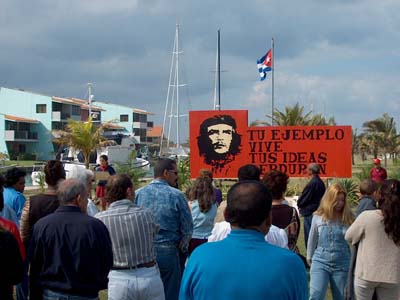
"Your example lives, your ideas last"
My second week alone was not more
lonely than the first, I got very good company of Iliana's family,
which include husband Olli and two kids, sister with three
children, who are on a visit from Germany, and the parents, who live in Havana.
Iliana and Olli came from Finland to spend a couple of months here in her
homeland. My list of exotic food increased with frogs, which were
delicious in the garlic-pepper sauce. Alligator is nothing compared to frogs! I
got a pile of tasty fruits to the boat, names are forgotten by now, but I only
regonised pinapple.
If I continue on this gastronomic line, so to my nuisance a gale hindered me to
join a lobster lunch yesterday. It was blowing 30-40 knots from the side, which
is not nice when you are sideways to a concrete dock. Kristiina's rig has a
plenty of surface and she was leaning more than the others. I put more fenders
and took off the biminis, but it did not help enough, and I decided to put a
line across the canal, to the windward side. In that weather none could come in
to the marina and anyway Kristiina was at the end of the canal. Soon almost all the boats
had lines across. Kristiina's throwing line was a new
thing for some, and when I got it back I had the right guess: it was foulded to
a mess. I spent 15 minutes sorting it out, but I think that the proper way of
coiling it was
impressed on the older British gentleman's mind.
4.3.2002
Marina Hemingway, Cuba
Hannu returned home after two busy weeks in Finland. He brought the part for
the steering as well as the new motor for the autopilot. And a lot of other
small things. Many thanks for the personnel at the Maritim in Lauttasaari
and PC Superstore on Mannerheimintie. Special thanks for our
friend Pekka Sarha, who built a perfectly fitting rack for the
autopilot according to Hannu's obscure drawing and a few photos.

The new autopilot steers the steering box, from
where the
power transmits to the rudder
Auli proudly prepared a cuban menu she had learned: yuca and malanga roots in mojo-sauce (garlic and orange), rice and black beans. The appetizer drink was mojito, which consists of rom, sugar, lime, sparkling water, ice and herba nueva, a herb that reminds mint.
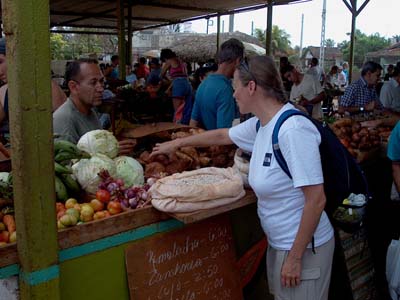
Prices at the market are inexpensive, because you
can use pesos.
A backbag full of food costs a couple of dollars.
On Wednesday (6.3.) we made a trip to the Viñales Valley and the City of Pinar del Rio, which are located 180 km west of Havana in the Province of Pinar del Rio. It is an important tobacco area of Cuba, so we visited a cigar factory.
|
|
 |
Over a month in a same harbour starts really to be too long time - and too expensive. We pay 16,65 dollars per day. As soon as Kristiina is ready to sail again and the weather is fine, we start the exploration of the northwest shore of Cuba. The southwest shore is too shallow for us, so we'll leave that and head next to the Cayman Islands.
12.3.2002
Cayos de la Leña, Cuba 10 months on the
way
On Friday, 8.3. we finally left Marina Hemingway. We sold our
bikes to Canadian s/y Flirt, because they will not be for any use
on the anchorages or on the Pacific.
Prevailing
winds blow this time of the year from north-east, so we headed west. Every boat
must show a list of places she wants to visit before leaving the marina. We got
the permission (despacho) for every village, ensenada (bay) and cayo (key), even though
we hardly have time for all. We headed to
Cayo Rapado Grande, 120 miles away. We arrived after a perfect
sailing on the Saturday morning. When we came inside the reef, two small rowing
boats came towards us. They were fishermen, selling lobster. We bought two
lobsters from the first boat with four men, price was three dollars and four
cokes - two of them were given to the other boat. But then we had a problem, how
to make them. We both had eaten lobster, but not cooked them. Alive in boiling
water, I guess, like crayfish at home - the cruel way. But how long to cook? A
phone call to Auli's aunt Dorrit cleared the situation, 5 minutes per 0.5 kg. We
cooked the creatures right away when we arrived to the anchorage, they hardly
had lived in the heat. In the evening we had a fiesta, lobster in mojo-sauce -
delicious!
We spent the next day cleaning and washing, as well as on some work on the boat.
For time to time it was wonderful to swim in the 25 degree water. We enjoyed
fully, this was the first lonely anchorage in the warmth. We realised who nice
it was to be by ourselves after the several social weeks at the marina. The next
day we sailed inside the reef into an other bay, and the day after to another
small island, Cayos
de la Leña, which is next to the west point of Cuba, Cabo San
Antonio.
The reef is at it's widest 25 miles from the coast and it provides
excellent sailing conditions inside it: wind but no waves. Navigation must be
accurate because there are a lot of shoals and reefs but no sea marks.
Cayos de la Leña has a sheltered, narrow bay, which brings the mangroves with
mosquitos and "no-see'ams" too close; after the sunset or with calm
it's an itchy place - or you have to stay inside the boat.
20.3.2002 Isla de la
Juvetud, Cuba
Mosquitos and no see'ams forced us to the other side of the island, into a big
open bay. There was one boat, and other boats we had met in the Marina Hemingway
started to pull in. Soon there were 10 boats waiting for a suitable weather for
rounding the Cabo San Antonio. The chat in the VHF and dinghy traffic were
lively.
Winds kept blowing from the East, obviously the spring has come with the
prevailing SE winds. We waited them to turn, at least to NE, but at last we got
tired to the growded bay. The night to Monday 18.3. we left, in spite of the not
so good forecast. Rounding the cape was smooth, the current was only one knot
and the sea was calm in the night. However, the narrow strait between Yucatan
and Cuba can make the Golf Stream grazy. The next day turned out something else
than smooth, wind was against, and even though not strong, maybe 15-20 knots, so
strong enough - it took 23 hours to make the 100 miles to Isla de la
Juventud. We anchored in the darkness to the west tip, Punto Frances,
and the water was so clear, that we could see the white sand and dark corals in
seven meters just in a crescent moon light. The next day we snorkled in the
"aquarium" - first time on this trip. But definetely not the last.
Now we are making strategies to beat the easterlies, maybe we sail around Isla
de la Juventud from the North or then we wait and see will the ridge with the
northerlies really come this far as the forecast says.
24.3.2002 Cayo Largo,
Cuba
The northerlies finally came and we rounded Isla de la Juventud from south
to the next biggest island of Cuba, Cayo Largo. It it's completely a tourist
area with luxorious hotels. However, we have to tell more about Isla de la
Juventud, an island with several names.
The indians called it Siguanea, and
we spent a night in a marina called that too. From there we took bus to the
capital of the island, Nueva Gerona. Columbus named the island as El
Evangelista, but far more exiting times it lived as Parrot Island,
which the pirates, such as Francis Drake and Henry Morgan, called it. They kept
the island as their hiding place in the 16th to the 18th century. Hannu's first
comment was, when we landed, that we should have brought shevels, to dig out all
the treasures. And they tell, that this island and it's pirates inspired
Robert Louis Stevenson to write his book Treasure Island. The
Cubans named the island as Isla de Pinos, Pine island, and it served as an exile
and prison location for a long time. Both Jose Marti and Fidel Castro spent some time
here. The present name, Isla de la Juventud - Youth Island - the
place got in 1978 to honor the thousand students who worked on the citrus
plantations in the 1960's and 1970's.
At the moment Isla de la Juventud has 75.000 inhabitants of whom 15.000 live in
the capital Nueva Gerona.
Cayo Largo's attraction is the fine white sand, which is so white that it does
not burn your feet. And it has been hot, 30 C inside the boat and 28 C in the
water. We have snorkled, although there is not so much to see. Obviously Punto
Frances on Isla de la Juventud, our first snorkling spot, is a very special
place for underwater life.
At last, after two months, we are ready to leave Cuba. We bought vegetables from
the market in Nueva Gerona and found a cheese (old!) in dollar shop. Cayo Largo
shop had egs and grapes. In Cuba you have to buy what you find. But I guess we
make it well the 700 miles to Panama. When we reach Gran Cayman 140 miles away
we decide whether we go ashore or not. On our way there is also two Columbian
islands, San Andres and Isla de
Providencia, which temptate to stop.