|
17.5.2005 The Atlantic Ocean 30° 36'
N 73° 31' W
We left Palm Beach, heading to Bermuda, on Friday, the 13th
- bring that bad or good luck. Two weeks in Florida was longer than we had
planned and we wanted to start the Atlantic crossing. The engine repair had
taken its part of the two weeks.
Ordering a new tube stack for the heat exchanger didn't go well. We got a wrong
part. And even waited for that an extra day, when UPS had been at the marina
office, but not found us. The parcel had boat's and skipper's name on it, and we
had told the marina staff that we are waiting for a UPS delivery. The next
problem was payment. We had been told that we can pay cash, but only a check
would do. The girl in the marina office wasn't very helpful, but fortunately the
harbourmaster accepted our request to pay the dollars to marina and they would
write the check. Next day we had the tube stack. It wasn't original Perkins
part, but a Bowman and smaller. A phone call to the company started with
an unbelievable statement, that we had
given them the wrong part number. We never made it to returning/changing issue.
They didn't have Perkins part in stock, we should have ordered it from England.
We decided not to waste any more time and energy, especially when we found a
shop, which repaired the old one! If we just had known that before
ordering the new. The old tube stack was cleaned and welded in a day,
inexpensively. We found the repair shop with a help of a local sailor, thanks to
him! And after all, the main thing is that the engine is running again.
We though that we would get some extra knots from Gulf stream, but during the
first day NE wind pushed us across the stream. At Bahama Bank we tacked north.
After that we have had 0.5-1.5 knot current against. Very frustrating.
Especially when the winds are light, S SE 5-15 knots. A high sits over Bermuda,
affecting us. In four days we have sailed and motorsailed 455 miles (avg 113
nm/day), being in the mid-way now. The unfavourable current made us study the
current charts more closely. Leaving Caribbean or east of Bahamas would give a
better angle or even a llittle extra.
We contacted Herbie, the famous weather-guru on Atlantic. His station, Southbound
II gives on 12359 kHz individual weather reports all over the Atlantic,
from Caribbean to England. Between 19.30-20 UTC is logging time, boats give
their name and position, and after that starts a 2-3 hours session, where Herbie
gives detailed weather and current info for 20-30 boats. He has done this at
least ten years, if not more. Auli remembers him from her first Atlantic
crossing in 1996.
We should arrive to Bermuda (32 N 65 W) on Saturday or Sunday, anyway after
Auli's birthday on Friday (20.5.). It has to be celebrated at sea. Fresh
croisants for breakfast and a bottle of Alaskan Amber with lunch is the wish.
Let's see how skipper handles it.
22.5.2005
St. George, Bermuda
The charted 870 nautical miles from Palm Beach to Bermuda increased with one
hundred miles because of all the tacking the shifting wind made us to do. We
were already above latitude 32, when NE wind pushed us back to south. The last
day it was blowing from SE and we had to take one more tack close to Bermuda
before we could sail along the south coast into St. George Harbour. GPS showed
970 miles, which had taken 8 days and two hours.
Leaving on Friday, 13th, turned to be lucky: we made it to the harbour just
before a gale. In the night it was raining heavily and the 30-40 knot wind rised
whitecaps even in the shelter harbour. Boats were dragging and it caused some
hassle in the full anchorage. We were on watch in the cockpit, rainclothes on,
engine running during the hardest wind, but fortunately nobody came on us and
Kristiina's anchor didn't drag. Although the sleep was interrupted, it was much
nicer to take the rough weather in the harbour than at sea. By dawn the wind
decreased and we went back to bed. No need to get up for watch!
The absolute highlight on this passage was a swordfish. Here
Hannu's own report: 
The reel squaked in its familiar way in the morning. But the line went off in a
way that this was something else than a tuna. I tightened a bit the brake and
rolled genoa in. Done that, almost all the 250 metres of line was out. I
tightened the brake full. Fish jumped 3-4 times throwing its head. A swordwish!
Many times I have had it hooked but either line or hook has given up. The fish
started to dive and came closer to boat. I reeled line in until it went directly
down. Fish dived to 50-60 metres. Then it came up to surface again and made a
couple of fine jumps. After half an hour it was 15 metres from the boat, but
wouldn't come any closer. I started the engine and pulled forward making 3 knots
for an hour trying to pull the fish closer. No luck. I increased the speed to 5
knots for half an hour. Fish started to be exhausted. It tried to swim to the
side and down. I stopped the boat and managed to get the fish alongside. It was
totally worn out. How to get it up? Fish hook was too small. Auli kept the fish
beside the boat and I put a rope around its tail. The rope to halyard and Auli
hoisted it on the deck. The fight took over two hours and if it would have been
any bigger fish, I would have lost it. It was great to get a swordfish, but
hopefully that doen's happen again, such a fine creature it is.
The fish was 2.2 metres long, the sword about half metres and tail 56 cm wide.
Swordfish can hide its fins into the body, back and belly has long, narrow case
for the fins. The skin is like plasticfiber, not possible to cut with a knife.
The meat is white, firm and almost tasteless.
The other highlight was of course Auli's birthday. Auli woke up seeing the
skipper by the oven. Soon a wonderfull smell filled the cabin: croissants! The
sunset was enjoyed with Alaskan Amber. We still have four bottles of that tasty
amber coloured ale, for special occasions.

Auli's fift birthday during the voyage, but first photo.
When coming closer to Bermuda it's
mandatory to contact Bermuda Harbour Radio on VHF. Maybe because
of security reasons. Bermuda - which consists of 150 islands - is surrounded by
dangerous reefs. On the north side is a 30-mile safety zone, where ships are not
allowed. The safest arrival is from south. The route into St. George is very
clearly marked, but still the Harbour Radio gave instructions, to some boats
even very detailed. But you can see here all kinds of cases. At the same time
with us arrived a big American boat - toeing a dinghy! Even the outboard was on.
The boat was at least 60 feet, but obviously too small because the inflatable
couldn't fit on the deck. There are boats from all over the world: Sweden,
Norway, France, England, Canada, USA, Belgium, Switzerland, Latvia.... There are
well equipped yachts and small daysailors. The most special vessel is a double
hulled, dzonkrigged wooden boat, which has two masts side by side! It was one of
the first that dragged in the night - lots of windsurface.
It's a pleasure to listen the Bermuda Harbour Radio, they are clear and polite.
Could be taken as an example by some. The clearance was easy and fast, after we
got to the busy customs dock. Had to wait two hours for our turn. The officer
filled up a clearance paper, we filled the immigration cards and paid 15 dollars
per head. Nobody came aboard looking for any vegetables or fruits. No that we
would had any, the last two onions were thrown into sea.
26.5.2005 St. George, Bermuda
Days have gone with normal maintenance: checking the rig and steering,
updating the website, laundry. Tuesday, 24.5., was a holiday, Bermuda Day, so we
joined the tourist masses brought in town by two cruiseships, and visited the
fortification of St. Catherine. There are about 25 fortifications on Bermuda,
counting the ones marked on a touristmap. No wonder, Bermuda has strategic
location. It served as a base during the first and second worldwar.
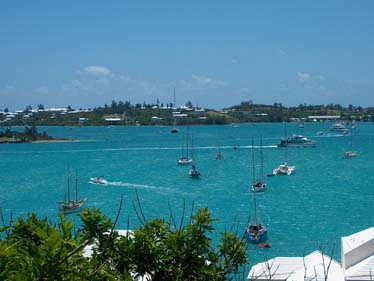
St. Davids island on the background. It offered better
protection on southerly winds. |
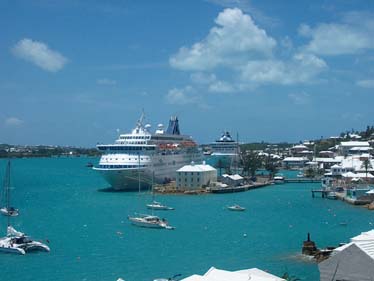
St. George harbour. There are limited dock
space for pleasure boats, so you have to anchor. |
Bermuda's English history began in 1609, when Sea
Venture wrecked on the islands on its way to America. However, the people on
Sea Venture were not the first permanent settlers of Bermuda.  They
built two ships and sailed to their original destination Virginia. Episode made
England claim the islands for the crown, and in 1612 arrived a shipload of
becoming inhabitants. The town of St. George was founded as well as the first of
the many fortifications. St. George has still several buildings from the 1700th
and 1800th century, and the town together with the forts is a Unesco world
heritage site. The first fortification was established in 1612, not too late,
because Spain sent two ships to conquer the islands. The English fired two canon
shots, which made the Spanish run away. Fortunate for the English, because they
had one shot left and the gunpowder had fallen on the ground during the hassle.
The story of Sea Venture has been an inspiration to Shakespeare's Tempest.
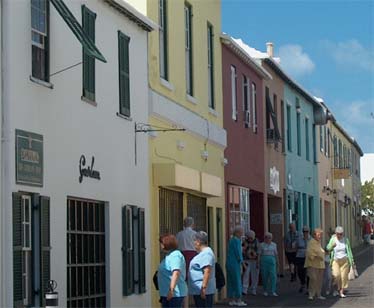
Present Bermuda has a population of 60.000 of which 60 per cent are black.
Bermuda is a special mixture of English and American.
 |
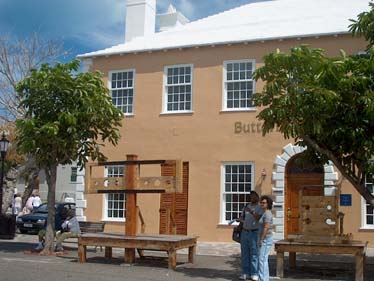
Houses are built of limestone, plastered and
painted. Roofs gather rainwater, because rain is the only source of
fresh water. The roofs are treated with lime.
|
Bermuda shorts is the dressing code for men in
Bermuda. The blue socks are bermuda socks?
On Friday or Saturday we start sailing to the Azores,
1800 nautical miles away. We intend to make the landfall in Horta, on the island
of Faial, which is very popular among the sailors. We estimate this passage
takes 16-18 days. If there is no update during this time, the reason is bad
connections, sometimes we have difficulties connecting to the Kaapeli server via
satellite phone.
Previous
- Next
|


