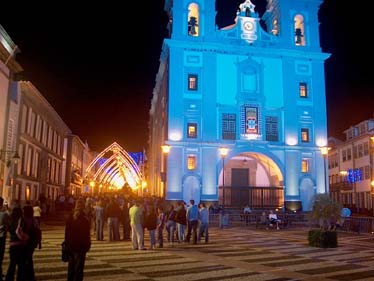
|
5.6.2005 The Atlantic
Ocean 33º N 46º
W
We left Bermuda on Saturday, 28.5., after we met a Finnish yacht, Sarema,
that arrived on Friday. Riitta and Pekka came over for a drink on Friday
evening, and we went to Sarema on Saturday morning to swap books and dvd movies.
What a joy! Pile of new books! At least that demand of the long sailing is taken
care of. And we have read. A book in a day, some days even two. There is not
much more to do than sleep, eat and read. Especially during the past week, which
has been rather windy. When the boat is rocking and rolling it's best to seek to
a safe corner with a book. Not very active or exciting, but that's the reality
of long passages. The three routines are interrupted by occasional sail
manouvers and of course following the weather.
The reason for the high winds was an exceptionally deep low (990 mba), which
tracked more south than the usual summer lows, to the 35. latitude. It was tight
and nasty, in the centre the winds gained hurricane force. We headed south well
in advance, all the way to the 31 N. There we got 25-30 knot winds, best sailing
weather. Between us and the low were 4 degrees, which is 240 nautical miles.
Wave hight was 4-5 metres (12-15 ft). Just imagine how the conditions have been
further north. Not a place to be. Without weather information - fax via SSB and
Herbie's forecasts - we would have been just in the middle of the storm, because
it moved along the route that is a recommened sailing route from Bermuda to
Azores.
Now it's calm, but another low is approaching from west, also classified as a
storm. It will move east along latitude 40, so this time we don't have to go
south, we should have 5-6 degrees, i.e. over 300 miles, distance when the centre
passes by.
The easing conditions brought a very welcome break. Although we hadn't been in a
storm, it had been uncomfortably rolly. Preparing food, washing the dishes and
taking a shower were difficult. We hadn't even thought about fishing. Yesterday,
after the wind settled down, we enjoyed a heavy meal: pork fillet, potatoes, and
green salad with a glas of red wine. Today's menu is fresh fish: in morning we
catch a 8.5 kg mahi-mahi. Homemade chocholate cake for dessert.
We are waiting for the winds take up again along the approaching low. We have
900 miles to Azores, and we have sailed one thousand, so also this passage will
be a couple of hundred miles longer than measured. We expect to arrive to Horta
on Saturday or Sunday (13.6.).
15.6.2005 Horta,
Faial, Azores, Portugal

We arrived to Horta harbour on the island of Faial early on Monday morning.
The passage from Bermuda totalled 1995 miles and took 15 days 18 hours, which is
pretty good for Kristiina. Average was 126 miles per day, max 145 nm, min 108
nm. Average speed was 5.3 knots. We had wind all the way except in two days,
when we had to motor in calm.
It's high season and the harbour is packfull. We got a place along the
breakwall, where boats are rafted in lines of four. The 10 euro daily fee
includes water and electricity.
Again we were very lucky with the timing: yesterday night it started to blow.
Two 985 mb lows are passing north of Azores causing 40-50 knot winds. Nice to be
in harbour.

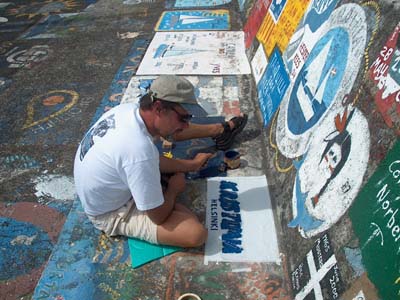
The breakwater of Horta is famous for painted
visitcards.
We are in Europe now! Euros are odd,
same with the Portuguese language. It's related to Spanish, and it's possible to
understand something of written text, but spoken Portuguese sounds like Czech or
Russian with lot of ssss.
More photos will come later, because presently the weather is rainy (and cold,
"only" 18 C!). We have time to take photos, we are staying here for
three weeks. On the 5th of July arrives our friend Jukka Kuosmanen, who will
sail with us to continental Europe.
21.6.2005
Angra do Heroismo, Terceira, Azores, Portugal
A week on Faial went quickly. Three days it was blowing and raining, after
that sunny again. We rented a car and drove around the island. It is really
beautiful, lush and green. We saw similar vegetation than in New Zealand,
red-flowered tree called pohutukawa in Maori and giant heathers. There
are also seder trees and flowers everywhere. Faial is a small island, about 100
km around. Sights include already green Caldera and a new piece of land, Ponta dos Capelinhos,
which formed in an eruption in 1957.

Horta's sights include Peter's
Sport Cafe and
a scrimshaw museum above the bar. |

Whale teeth are harder than bone and therefore suitable material for
scrimshaw. A exihibition of sailing heroes. |
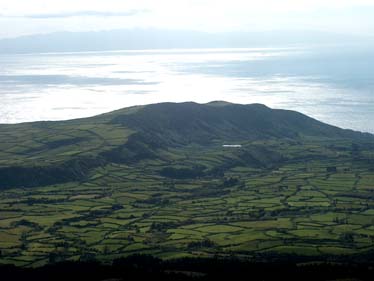
The land is like a quilt made of bush
fences to reduce the power of wind. |

Pico is the neighbour island of Faial and the highest mountain (2351 m). |

You can hike around the caldera, it takes
2.5 hours. |

Ponta dos Capelinhos was formed in an eruption in 1957. |
On Monday we headed for the island of Terceira 70
miles away. The city, Angra do Heroismo, is bigger than Horta, but
the harbour is smaller. The brand new marina looks nice, but swell comes in even
in calm weather. After one restless night we got an inner slip, which should be
better, especially because there is a front approaching. There is a festival
going on, called the Sanjoaninas Festival, with music and
bullfight, so we are going to stay to the end of the week.
28.6.2005 Velas, Sao Jorge,
Azores, Portugal
The
San Joaninas festival in Angra do Herosimo was rather
exhausting experience, because most of the happenings occured during late
evening and night. An exception was Tourada á Corda -
bulls running free on the streets in the middle of the town, a kind of
amateur bullfight. Anyone (read: men!) can tease the bulls while audience is
sitting high in trees and on roofs. Although the sharp horns were covered with
rounded metal endings, accidents do happen. That's also expected and almost
wanted, people long for dramatic. Videotapes made of street bullfights show only
people who have been caught by bull's horns or feet. The Touradas á Corda is
especially Azorean tradition and fights are arranged during the summer on
various locations. The animals are provided by local cattle farmers.
 |
 |
 |

Tourada á Corda in Angra on the Terceira island.
Five bulls were let free on a fenched area
in the middle of the town. |
We went also to see a real bullfight. The
Portugese tradition differs from the Spanish in that the bull is not killed at the end (fortunately!). In addition to the matador, also a cavaleiro,
bullfighter on a horse, and a ganadero are starring. The
latter is grazy sport: ganadero teases the bull to attack straight on, taking
the full blast of a 400 kg animal, trying to hang between the horns. Ganaderia
is typical Azorean. The horns of the bulls are covered with leather, but
still the whole thing is very dangerous.

Praca de Toros - bullfight arena |
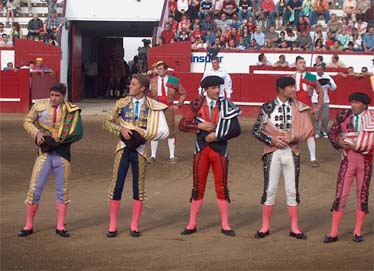
Matadores (two on the left) with their assistants |

Cavaleiro targeting a spear to bull's
neck. |
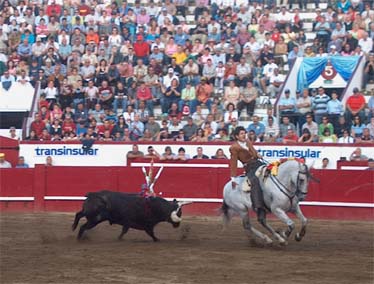
Cavaleiro has to control his horse. |

An assistant is getting bull's attention
while the big stars are preparing for the next number. |

Assistant's movements are not as
smooth
and grand than matador's. |

Ganadero makes the bull attack... |
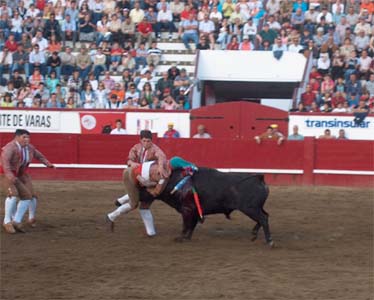
...right on himself... |

...and the assistants hurry to stop the
animal. |

Matador is meeting the bull also without
the muleta, pink cloth. Sharp sticks are stabbed to bull's neck
muskles. |
The main event of the San Joaninas festival was a
parade, where various groups marched along the streets singing songs made for
the occasion.
The festival would have continued until Sunday,
but we left for the island of Sao Jorge, located 20 miles east of
Faial. There is no sheltered harbour, but the weather is so calm that it's
possible to anchor in front of the village of Velas.
The return day
has been selected. After two months, on the 27th of August, we will arrive to our
home harbour in Lauttasaari, Helsinki!!
2.7.2005 Horta, Faial, Azores,
Portugal
Sao Jorge is really beautiful island. Roses and hortensias border the narrow
roads winding through the green and lush scenery. The north shore is very deep,
but at some places there is a flat by the sea and every one of them has a small
settlement, called fajã on Portugese.

Fajã, a small village by the sea. |
 |

The main livelihood of Sao Jorge is cheese, no doubt the milk comes
from local cows. |

Nice and quiet after the noisy Terceira. |
After our tour around the island we have to leave
very suddenly, because wind started to blow from west and the open harbour was
uncomfortable. We motored the 20 miles to Horta and anchored in dark behind the
breakwater. Next morning we moved into the marina, next to Miss Sophie.
Meeting our German friends in Horta was no coincidence, we had been in constant
radio contact with Harald and Verena. Their passage from Bermuda took 20 days
because of light and head winds. They made 600 extra miles by tacking! It was
great to meet Harald and Verena again. Our last meeting was in Mexico in
January. The rendezvous in Azores was decided long time ago, in San Diego, and
it should have included also Patago, but Jean and Sylvie sold their boat in St.
Martin and are presently back home in Noirnoutier, France.
5.7.2005
Horta, Faial, Azores, Portugal
Time has flied in the company of Verena and Harald. On Sunday we made a trip
to the island of Pico. The tourist attractions are - in addition
to the mountain of Pico - the history of whaling. There are two museums, one a
former whaling factory, which was made to a museum after whaling stopped in
1984. Azoreans hunted spermwhales (cachalots), the biggest of
toothed whales. Besides oil, also ambra, used for perfumes, and spermaceti, vax
from whale's head, were the valuable products. Presently, the teeth are the most
valuable items. A tooth with scrimshaw costs around 1300 euros. In addition to
teeth, only the jaw bone is hard enough for carving. Spermwhale has 36-50 teeth,
all in the lower jaw.
|

Vitamines, oil, flour... advertises the
former whale factory. One whale weighting about 30 tons had a lot of
valuables. Bones were grinded for animal food.
|

The town of Madalena on Pico.
The mountain itself is covered with clouds.
|
Spermwhale was easier to hunt than
the other whales because it didn't sink after dying. Azoreans hunted the whales
from small open wooden boats by hand harpoons. Boats were equipped with oars and
sails, without an engine. A flag was put on the killed whale so that a bigger
motorvessel could find it and drag it to the shore.
On Monday arrived Jukka Kuosmanen, and on Wednesday, the 6th of
July, we will head to England. There will be some motoring for the start
because a stationary high lies over the Azores. Hopefully we get some wind
further north.

19.7.2005 Falmouth,
England
The passage from Azores to England went in very light winds except the last
day. Our intention was to stop on the Scilly Isles, but it started to blow and
rain when we were approaching. The low islands vanished in grey fog, and we
decided to continue to Falmouth 70 miles away. It has an all-weather harbour.
Thanks to these last miles we made the 24-hour record, modest 130 miles, because
the whole passage had been either calm or light winds. Before the last day, we didn't
have to reef, cockpit stayed dry except after shower, and Auli was able to sleep
in the bow cabin. We made only around one hundred miles
per day. The total mileage from the Azores to Falmouth was 1393 nm which took 12 days.
An average of 116 nm per 24 hours, really slow.
We were already worried that our crew Jukka will get a very onesided image of offshore sailing, but
the last day corrected the picture. At best it was blowing 35-40 knots and we
were surfing 10 knots in tail wind. Jukka was good company, eager to do and
learn. Seasickness lied waiting for the first-timer, especially inside, so Jukka preferred staying outside
keeping watch, late
into night letting us sleep. It was also fun to talk with a new person.

Ready for the Atlantic.
Was it the light weather or what,
but we saw a lot of whales. Almost every day we saw a blow or a fin. Once we
almost hit a spermwhale. One of the best moments was when a spermwhale with a
calf came near the boat. It had a big half-moon shaped blowhole (toothed whales
have one, baleen whales two "nostrils"), and the blow directs forward
- a special feature for identifying the spermwhale. In addition to spermwhales,
we saw sei whales, which are 15-metres long baleenwhales, and pilot whales.
Every day we saw dolphins, and once the flock that swam in front of the bow had
three small babies with them.

The blow of the spermwhale directs forward.
In addition to the general birds -
storm petrels and gannets - we got a special passanger aboard. With the help of
a guide book we indentified it as a crossbill. And yes, we also saw a couple of
turtles and one shark - fortunately after Jukka had had a swim.

No shore in sight and even the bottom lies 4 km
underneath.
We feel a bit sad. This was the last
ocean passage on our four-year trip. The Atlantic Ocean has showed its nicer
side, what a perfect end. Pleasant passage leaves good memories. Althought we
still have 1200 miles to Finland, our thoughts are more and more at home. We feel
nervous. How we adapt to the everyday life, to the world of cameraphones, tight
schedules and tax reports.
Previous
- Next
|